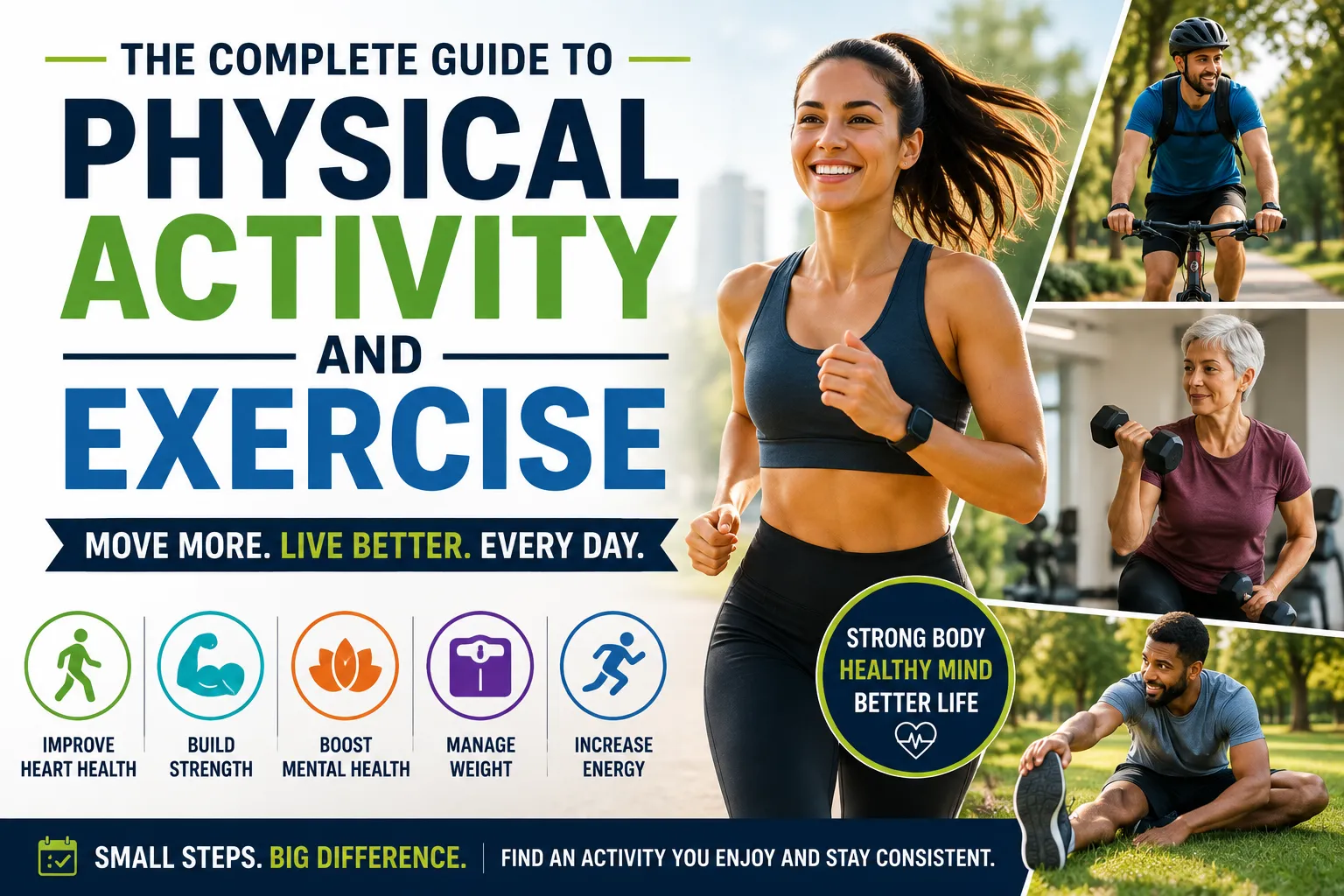

The Complete Guide to Physical Activity and Exercise
Physical activity is one of the simplest ways to support better health, yet many people still associate exercise with expensive gym memberships, complicated workout programs, or hours spent training every week.
It does not have to be that way.
**Physical activity includes much more than formal exercise.** Walking to work, cycling, climbing stairs, doing household chores, playing sports, gardening, dancing, and exercising are all forms of physical activity. Exercise is a specific type of physical activity that is planned, structured, and performed with the goal of improving or maintaining fitness.
Regular movement can benefit the heart, muscles, bones, brain, and mental well-being. It can also help reduce the risk of several chronic diseases and improve everyday functioning.
The challenge for many people is not knowing that exercise is healthy. It is figuring out **how much activity to get, what types to do, how hard to work, and how to make movement a sustainable part of everyday life**.
This guide breaks down the fundamentals.
**## **What Is Physical Activity?****
Physical activity is any bodily movement produced by skeletal muscles that requires energy expenditure.
That definition is deliberately broad.
Physical activity can happen during:
-
Exercise and workouts
-
Walking and cycling
-
Sports
-
Work
-
Household chores
-
Gardening
-
Recreation
-
Transportation
-
Playing with children
-
Everyday movement
This means you do not need to be wearing workout clothes for physical activity to count.
A brisk walk to the shops is movement. Carrying groceries is movement. Cleaning the house is movement.
The important factor is that your body is physically active.
**## **What Is Exercise?****
Exercise is a **subcategory of physical activity**.
It is usually planned, structured, repetitive, and performed to improve or maintain physical fitness.
Examples include:
-
Running
-
Weight training
-
Swimming laps
-
Cycling workouts
-
Aerobics
-
Resistance training
-
Structured walking programs
-
Fitness classes
-
Interval training
The distinction is useful because someone can become considerably more active without following a formal exercise program.
For example, a person who walks more throughout the day and regularly takes the stairs may increase their overall physical activity even if they never visit a gym.
**## **Why Physical Activity Matters****
Regular physical activity has benefits across multiple areas of health.
Physical activity can help prevent and manage conditions including cardiovascular disease, type 2 diabetes, and some cancers. It can also reduce symptoms of depression and anxiety, support brain health, and improve overall well-being.
Physical activity can also support:
-
Cardiovascular fitness
-
Muscle strength
-
Bone health
-
Balance
-
Mobility
-
Sleep
-
Physical independence
-
Healthy weight management
-
Everyday energy and function
These benefits are not limited to athletes.
They apply across age groups, although the type and amount of activity that is appropriate can differ.
**## **How Much Physical Activity Do Adults Need?****
For adults aged 18–64, general physical activity recommendations include:
-
**150–300 minutes of moderate-intensity aerobic activity per week**, or
-
**75–150 minutes of vigorous-intensity aerobic activity per week**, or
-
An equivalent combination of moderate and vigorous activity.
Adults should also perform **muscle-strengthening activities involving all major muscle groups on at least two days per week**.
People can receive additional health benefits by doing more than 300 minutes of moderate-intensity activity or more than 150 minutes of vigorous activity per week, provided additional activity is appropriate for them.
These numbers are targets, not a reason to give up if you currently do very little.
The important message is that **some physical activity is better than none**. People who are inactive can start with small amounts and gradually increase duration, frequency, and intensity.
**## **What Counts as Moderate-Intensity Activity?****
Moderate-intensity activity raises your heart rate and breathing but generally does not leave you completely unable to talk.
Examples can include:
-
Brisk walking
-
Dancing
-
Recreational cycling
-
Some household chores
-
Water aerobics
-
Hiking on moderate terrain
The exact intensity depends on the individual.
An activity that feels moderate to a physically fit person may feel vigorous to someone who is new to exercise.
Brisk walking, dancing, and household chores can all count as moderate activity.
**## **What Counts as Vigorous Activity?****
Vigorous activity requires substantially more effort.
Examples can include:
-
Running
-
Fast cycling
-
Fast swimming
-
High-intensity aerobic exercise
-
Some forms of competitive sport
-
Activities involving heavy physical effort
Running, fast cycling, fast swimming, and moving heavy loads can all represent vigorous activity.
Vigorous exercise is not automatically better than moderate exercise.
The important issue is finding an appropriate level of activity that can be performed safely and consistently.
For people interested in shorter, more intense forms of exercise, short sprints may provide meaningful exercise benefits without requiring lengthy workouts.
**## **Understanding the Talk Test****
One simple way to estimate exercise intensity is the **talk test**.
During moderate activity, you should generally be able to speak but may breathe more heavily than normal.
During vigorous activity, talking becomes much more difficult because your breathing rate is substantially higher.
Heart-rate monitoring can provide another way to estimate intensity, but you do not necessarily need a smartwatch or fitness tracker to become more active.
Your perceived effort can provide useful information.
**## **Aerobic Exercise****
Aerobic exercise primarily challenges the cardiovascular and respiratory systems.
Common examples include:
-
Walking
-
Running
-
Cycling
-
Swimming
-
Dancing
-
Rowing
-
Hiking
-
Aerobic classes
Regular aerobic activity helps improve cardiovascular fitness and can make everyday activities feel easier.
For example, someone who regularly walks briskly may find that climbing stairs leaves them less breathless over time.
**## **Strength Training****
Strength training involves working muscles against resistance.
Resistance can come from:
-
Free weights
-
Resistance bands
-
Weight machines
-
Body weight
-
Water
-
Other forms of external resistance
Common strength exercises include:
-
Squats
-
Lunges
-
Push-ups
-
Rows
-
Presses
-
Deadlifts
-
Pull-downs
-
Step-ups
Strength training is important because physical fitness is not only about cardiovascular endurance.
Strong muscles support movement, posture, everyday tasks, and physical independence.
Adults should perform muscle-strengthening activity involving all major muscle groups on at least two days per week.
People deciding between different approaches can also explore strength training vs. cardio for long-term health.
**## **Why Muscle Strength Matters as You Age****
Muscle mass and strength naturally change with age.
Maintaining strength can help people continue performing everyday activities independently.
For older adults, physical activity should also include exercises that emphasize **functional balance and strength**.
Older adults can benefit from multicomponent physical activity emphasizing balance and strength, particularly to help enhance functional capacity and prevent falls.
This can include activities such as:
-
Standing from a chair
-
Step exercises
-
Balance drills
-
Resistance training
-
Walking
-
Tai chi
-
Other activities that challenge stability
**## **Flexibility and Mobility****
Flexibility refers broadly to the ability of joints and muscles to move through available ranges of motion.
Mobility is a related but broader concept involving the ability to move effectively.
Activities such as stretching, yoga, and mobility exercises can be useful components of a balanced fitness routine.
However, flexibility is only one part of physical fitness.
A strong exercise program should not focus exclusively on stretching while ignoring cardiovascular fitness, strength, balance, or general movement.
**## **Balance Training****
Balance becomes increasingly important with age.
Balance exercises can help people practice controlling their body while standing and moving.
Examples include:
-
Standing on one leg while holding a stable support
-
Heel-to-toe walking
-
Controlled step-ups
-
Tai chi
-
Specific balance exercises recommended by a qualified professional
Older adults with poor mobility should place particular emphasis on activities that improve balance and help prevent falls.
**## **Exercise and Heart Health****
Regular physical activity is strongly associated with cardiovascular health.
Exercise challenges the heart and circulatory system, helping improve cardiorespiratory fitness.
Over time, regular activity can contribute to lower risks associated with cardiovascular disease and other health problems.
The good news is that the benefits are not reserved for people who run marathons.
Walking regularly can be a meaningful starting point.
**## **Exercise and Type 2 Diabetes****
Physical activity can also play an important role in preventing and managing type 2 diabetes.
Muscles use glucose for energy during physical activity, while regular exercise can improve aspects of metabolic health.
For people who already have diabetes or another chronic condition, exercise plans may need to be adapted to their individual circumstances.
That does not mean physical activity should be avoided.
Adults with chronic health conditions or disabilities who are able can generally follow adult activity recommendations, with appropriate consideration of their condition.
**## **Physical Activity and Bone Health****
Weight-bearing activity and resistance exercise can place beneficial stress on bones.
Activities such as:
-
Walking
-
Hiking
-
Dancing
-
Running
-
Resistance training
-
Some sports
can contribute to a physically active lifestyle that supports bone health.
The most appropriate activity depends on age, fitness level, injury history, and existing health conditions.
**## **Exercise and Mental Health****
Physical activity is not only about the body.
Regular physical activity can reduce symptoms of depression and anxiety and support cognitive health and overall well-being.
Exercise can also provide a structured break from work and other responsibilities.
A walk outside may provide time away from screens. A group fitness class can create social interaction. A run can provide an opportunity to clear your mind.
The psychological benefits can therefore come from several sources at once.
**## **Exercise and Sleep****
Physical activity is also associated with better sleep.
Regular movement can support healthy sleep patterns, while physical inactivity can contribute to a less active lifestyle and poorer overall health.
However, timing can matter for some individuals.
A vigorous workout immediately before bed may feel stimulating for certain people, while others may have no difficulty sleeping after evening exercise.
The best schedule is often the one that allows you to exercise consistently without interfering with your sleep.
**## **Exercise and Healthy Weight****
Physical activity can contribute to maintaining a healthy body weight and reducing the risk of weight gain.
It can also help preserve muscle during weight loss.
However, body weight is influenced by many factors, including food intake, metabolism, genetics, sleep, medications, health conditions, and overall activity.
The health benefits of physical activity are generally independent of changes in body weight.
That is an important point.
Someone can become healthier and fitter without seeing dramatic changes on the scale.
**## **Exercise Is More Than Burning Calories****
A common mistake is to judge every workout by the number of calories displayed on a fitness tracker.
Calories are only one part of the picture.
Exercise can improve:
-
Cardiovascular fitness
-
Strength
-
Balance
-
Mobility
-
Mood
-
Sleep
-
Metabolic health
-
Physical function
A 30-minute walk that does not produce a dramatic calorie number can still be worthwhile.
Fitness should not be reduced to a single metric.
**## **Sedentary Behavior Is Another Part of the Equation****
Being physically active for part of the day does not necessarily eliminate the effects of spending most of the remaining day sitting.
People should limit sedentary time and replace some sedentary time with physical activity of any intensity where possible.
This can be particularly relevant for people who work at desks.
For more practical strategies, see how to reduce sedentary behavior and add more movement to everyday life.
Simple strategies include:
-
Standing during some phone calls
-
Taking short walking breaks
-
Walking to nearby destinations
-
Using stairs when practical
-
Moving around during television breaks
-
Doing light household tasks
These small changes can add movement without requiring another formal workout.
**## **Walking: The Most Underrated Exercise?****
Walking is one of the easiest ways to increase physical activity.
It requires little equipment and can be adapted to different fitness levels.
You can walk:
-
Around your neighborhood
-
To work
-
During lunch
-
While talking on the phone
-
With friends or family
-
On a treadmill
-
In a shopping area
-
On hiking trails
A faster pace can increase intensity, while hills can make a walk more demanding.
For someone currently inactive, walking can be a practical entry point.
The commonly discussed 10,000-step target and what the evidence actually says can provide useful context for people wondering how much daily walking they need.
**## **Running****
Running provides vigorous aerobic exercise for people who are prepared for the demands it places on the body.
It can improve cardiovascular fitness and can be done outdoors or on a treadmill.
However, beginners do not need to start by running continuously.
A walk-run approach can allow the body to gradually adapt.
For example, someone might alternate short periods of jogging with walking before eventually increasing the running intervals.
People who exercise outdoors should also consider environmental conditions. Running in extreme heat requires additional attention to heat exposure, hydration, pacing, and safety.
**## **Cycling****
Cycling can provide moderate or vigorous aerobic activity depending on speed, terrain, resistance, and fitness level.
It can also serve as transportation.
That makes cycling particularly useful because exercise can be integrated into daily life rather than treated as a separate activity.
Indoor cycling can provide another option for people who prefer exercising at home or in a gym.
**## **Swimming****
Swimming provides aerobic exercise while placing relatively low impact on the joints.
It can be particularly useful for people who find some weight-bearing activities uncomfortable.
Different swimming strokes and speeds create different levels of challenge.
Water-based exercise can also include activities such as water aerobics.
**## **Dancing Counts as Exercise****
Exercise does not have to look like a workout.
Dancing can raise the heart rate, challenge coordination, and provide a social or recreational component.
Whether it is a dance class, traditional dance, dancing at home, or simply moving to music, the key factor is that the body is moving.
Enjoyment can make an activity easier to sustain.
**## **Exercise Through Sports****
Sports can combine physical activity with skill development and social interaction.
Examples include:
-
Football
-
Basketball
-
Tennis
-
Volleyball
-
Badminton
-
Swimming
-
Martial arts
Competitive sports can be vigorous, while recreational versions may provide moderate activity.
The best sport is often one that you enjoy enough to keep doing.
**## **Exercise at Home****
You do not need a gym to exercise effectively.
A home routine can include:
-
Squats
-
Push-ups
-
Lunges
-
Planks
-
Step-ups
-
Resistance-band exercises
-
Dancing
-
Body-weight circuits
A pair of adjustable weights or resistance bands can expand the range of exercises available.
The key is to choose movements that can be performed safely with appropriate technique.
People who prefer guided digital workouts can also explore how mobile fitness apps are transforming at-home exercise.
**## **How Beginners Should Start****
If you currently do little or no exercise, avoid trying to transform your routine overnight.
Start with small amounts of physical activity and gradually increase duration, frequency, and intensity.
A simple starting strategy might be:
**Week 1:** Take a 10–15 minute walk several times.
**Week 2:** Increase walking time slightly.
**Week 3:** Add a short strength session.
**Week 4:** Gradually increase the duration or intensity of your walks.
The exact schedule is less important than establishing a sustainable habit.
**## **The Importance of Progression****
Your body adapts to physical activity.
An exercise that feels difficult today may eventually become relatively easy.
Progression means gradually increasing the challenge.
You can progress by changing:
-
Duration
-
Frequency
-
Resistance
-
Speed
-
Distance
-
Number of repetitions
-
Exercise complexity
You do not need to increase everything at once.
Changing one variable at a time can make progress easier to manage.
Shorter workouts can still be useful, and the question of whether one workout a week can be enough to produce fitness benefits illustrates why consistency and overall activity patterns matter.
**## **Recovery Is Part of Training****
Exercise creates a stimulus.
Recovery allows your body to adapt.
For a deeper look at the role of rest, see how rest and recovery support healthy physical activity.
Recovery has also become an increasingly important part of how people think about training and fitness technology. Those interested in this area can explore recovery tracking and why it has become one of fitness’s biggest trends.
Important aspects of recovery include:
-
Adequate sleep
-
Nutrition
-
Hydration
-
Rest days or lower-intensity periods
-
Managing overall training load
More exercise is not always better if your body does not have enough time to recover.
Persistent exhaustion, worsening performance, unusual pain, or repeated injuries can be signs that a routine needs adjustment.
**## **Warm-Ups****
A warm-up prepares the body for physical activity.
It can include:
-
Easy walking
-
Light cycling
-
Dynamic movements
-
Gradually increasing exercise intensity
The goal is to transition from rest into activity rather than immediately demanding maximum effort.
A warm-up can also provide an opportunity to assess how your body feels that day.
**## **Cooling Down****
A gradual reduction in exercise intensity can provide a comfortable transition back to resting activity.
For example, after running, you might walk for several minutes before stopping completely.
Stretching can be included if it is useful to you, but it is not necessary to perform an elaborate stretching routine after every workout.
**## **How Often Should You Exercise?****
There is no single perfect schedule.
Someone might achieve the weekly aerobic target through:
-
30 minutes on five days
-
50 minutes on three days
-
Longer sessions on fewer days
-
A combination of walking and more vigorous activities
The most important consideration is consistency.
For strength training, adults should aim for at least two days per week covering the major muscle groups.
For some people, even a very short workout can be valuable. You may not need a long workout to add meaningful physical activity to your week.
**## **Can You Exercise Every Day?****
Yes, but daily exercise does not mean performing hard workouts every day.
A weekly routine might combine:
-
Walking
-
Strength training
-
Cycling
-
Mobility work
-
Recreational sports
-
Recovery activities
High-intensity training every day is a different matter and may not provide sufficient recovery for many people.
Variety can help reduce overuse problems and make exercise more sustainable.
**## **Exercise and Age****
Physical activity is important throughout life.
**### **Children and Adolescents****
Children and adolescents aged 5–17 should get an average of at least **60 minutes of moderate-to-vigorous physical activity per day**, with activities that strengthen muscles and bones included at least three days per week.
**### **Adults****
Adults aged 18–64 should generally aim for 150–300 minutes of moderate activity or 75–150 minutes of vigorous activity each week, plus muscle-strengthening activity on at least two days.
**### **Older Adults****
Older adults should follow the adult aerobic and strengthening recommendations while also emphasizing balance and functional movement, particularly when mobility is limited.
The goal at every age is not necessarily athletic performance.
It is maintaining health, function, independence, and quality of life.
**## **Physical Activity During Pregnancy and After Birth****
Pregnancy and the postpartum period require individualized considerations.
People who are pregnant or recently gave birth should discuss appropriate activity with their healthcare professional when necessary, particularly if there are complications or medical concerns.
**## **Exercise With Chronic Health Conditions****
Having a chronic condition does not automatically mean you should avoid physical activity.
Exercise may need to be adapted for conditions involving:
-
Heart disease
-
Diabetes
-
Arthritis
-
Chronic respiratory conditions
-
Neurological disorders
-
Mobility limitations
A healthcare professional or qualified exercise specialist can help determine what is appropriate.
**## **When to Get Medical Advice Before Exercising****
People who have been inactive for a long period, have known health conditions, or plan to begin vigorous exercise may benefit from discussing their plans with a healthcare professional.
This is particularly important when someone has symptoms such as unexplained chest pain, fainting, significant shortness of breath, or other concerning symptoms.
The goal is not to create unnecessary fear around exercise.
It is to make sure the activity is appropriate for the individual.
**## **Exercise Injuries****
Physical activity has enormous benefits, but injuries can occur.
Common exercise-related problems include:
-
Muscle strains
-
Sprains
-
Tendon problems
-
Overuse injuries
-
Joint pain
-
Blisters
-
Falls
Risk can be reduced by:
-
Increasing training gradually
-
Using appropriate equipment
-
Learning proper technique
-
Varying activities
-
Allowing recovery
-
Choosing activities appropriate to your fitness level
Pain should not automatically be treated as proof that a workout is effective.
**## **The Difference Between Discomfort and Pain****
Exercise can feel difficult.
Your muscles may become tired. Your breathing may increase. A challenging set of exercises may feel uncomfortable.
That is different from sharp, severe, or unusual pain.
If an exercise causes significant pain, stop and assess what is happening.
Persistent or worsening pain deserves appropriate medical evaluation.
**## **Fitness Trackers: Useful or Necessary?****
Smartwatches and fitness trackers can measure things such as:
-
Steps
-
Heart rate
-
Exercise duration
-
Distance
-
Calories
-
Sleep
-
Workout intensity
They can be useful for motivation and tracking progress.
But they are not required.
You can build excellent fitness through simple activities without monitoring every metric.
Wearable technology is increasingly used to monitor activity, recovery, and other fitness measurements, including through newer wearable fitness technology.
The wearable category is also expanding beyond conventional screen-based devices. For example, Garmin Cirqa is a screen-free fitness tracker that reflects the growing interest in fitness tracking without a traditional display.
The broader wearable market also continues to evolve as manufacturers introduce new devices and features. Readers following these developments can learn more about Garmin’s next major fitness wearable launch.
In some cases, excessive tracking can even make exercise feel like a constant performance test.
Use technology when it helps—not because you believe you need it to be healthy.
**## **Setting Realistic Exercise Goals****
A good fitness goal should be specific enough to guide action but realistic enough to maintain.
Instead of:
“I want to get fit.”
try:
“I will walk for 30 minutes after work on Monday, Wednesday, and Friday.”
Or:
“I will perform a 25-minute strength workout twice this week.”
Clear goals make it easier to turn intentions into behavior.
**## **Finding an Exercise You Actually Enjoy****
Enjoyment matters.
If you hate running, there is no requirement to become a runner.
Try:
-
Walking
-
Cycling
-
Swimming
-
Dancing
-
Sports
-
Hiking
-
Strength training
-
Group classes
-
Home workouts
There are many ways to become physically active.
The most effective exercise program is often the one you enjoy enough to repeat.
**## **Exercise With Friends and Family****
Social support can make physical activity easier to maintain.
You might:
-
Walk with a friend
-
Cycle with a group
-
Join a sports team
-
Exercise with your partner
-
Take a fitness class
-
Play active games with children
Exercise can become a social activity rather than another task on a checklist.
**## **Making Movement Part of Daily Life****
Formal workouts are useful, but daily movement can make a major difference.
Consider:
-
Walking short distances instead of driving
-
Taking stairs when practical
-
Parking farther away
-
Walking during breaks
-
Gardening
-
Cleaning actively
-
Standing periodically during desk work
-
Cycling for transportation
All physical activity counts, including movement associated with work, transportation, household tasks, recreation, and sport.
**## **What If You Have Very Little Time?****
You do not need to find a free two-hour block.
Break activity into manageable pieces.
For example:
-
A 10-minute walk in the morning
-
A 10-minute walk at lunch
-
A 10-minute walk after work
Small periods of movement can add up.
The broader message is that any physical activity is better than none.
A busy schedule may require creativity rather than abandoning exercise altogether.
**## **What If You Miss a Workout?****
Nothing catastrophic happens.
Missing one workout does not erase your progress.
The mistake is turning:
“I missed Monday.”
into:
“I’ve failed, so I might as well stop.”
Simply return to your routine at the next opportunity.
Consistency over months and years matters far more than perfection on individual days.
**## **Exercise and Motivation****
Motivation is unreliable.
It changes with:
-
Stress
-
Sleep
-
Work
-
Mood
-
Weather
-
Family responsibilities
-
Health
Instead of depending entirely on motivation, create routines that reduce the number of decisions required.
Exercise at a predictable time.
Keep walking shoes accessible.
Prepare your workout clothes in advance.
Schedule sessions like appointments.
The easier it is to start, the less motivation you need.
**## **Common Exercise Myths****
**### **“You Need a Gym to Get Fit”****
You do not.
Walking, body-weight exercises, cycling, sports, and home-based workouts can all contribute to physical fitness.
**### **“More Pain Means a Better Workout”****
Not necessarily.
Exercise can be challenging without being painful.
**### **“You Have to Exercise Every Day”****
No.
Weekly activity targets can be distributed across the week, and recovery is important.
**### **“Cardio Is All You Need”****
Cardiovascular exercise is important, but adults should also perform muscle-strengthening activity on at least two days per week.
**### **“You Need to Lose Weight for Exercise to Work”****
No.
Physical activity provides health benefits regardless of whether body weight changes.
**### **“Older People Should Take It Easy”****
Older adults benefit from regular physical activity, including aerobic, strength, and balance-focused activities appropriate to their abilities.
**## **A Simple Weekly Exercise Template****
For a generally healthy adult starting from a relatively low activity level, a simple framework could look like:
| Day | Activity |
| ——— | ––––––––––––––––––– |
| Monday | 30-minute brisk walk |
| Tuesday | Full-body strength workout |
| Wednesday | Easy walk or recreational activity |
| Thursday | 30-minute brisk walk |
| Friday | Full-body strength workout |
| Saturday | Cycling, hiking, sport, or longer walk |
| Sunday | Rest or gentle movement |
This is only an example.
Your schedule, fitness level, preferences, and health circumstances may require a different approach.
**## **A Beginner’s No-Gym Workout****
A basic body-weight session could include:
-
**Chair squats** — 8–12 repetitions
-
**Wall or incline push-ups** — 8–12 repetitions
-
**Step-ups** — 8–12 per leg
-
**Glute bridges** — 8–12 repetitions
-
**Resistance-band or backpack rows** — 8–12 repetitions
-
**Gentle core exercise** — as appropriate
Performing one or two rounds may be enough for a beginner.
The objective is to learn the movements and gradually build capacity rather than exhausting yourself on the first attempt.
**## **Building a Long-Term Exercise Habit****
A sustainable fitness routine generally has several characteristics.
It is:
-
Realistic
-
Flexible
-
Enjoyable
-
Progressive
-
Appropriate to your abilities
-
Varied enough to avoid boredom
-
Sustainable during busy periods
It should also leave room for life.
There will be holidays, deadlines, travel, illness, family responsibilities, and unexpected events.
A good routine can bend without completely breaking.
**## **The Most Important Number May Be Zero****
Fitness recommendations can sometimes make exercise sound like a mathematical problem.
150 minutes.
300 minutes.
Two strength sessions.
Specific heart-rate zones.
Those targets are useful, but there is another number worth remembering:
**Zero.**
If you currently do zero physical activity, moving to even a modest amount is progress.
Any amount of physical activity is better than none, and people who are not currently meeting activity guidelines can gradually increase their activity.
You do not have to reach the recommended target immediately.
You simply need to start moving.
**## **Building a Healthier Life Through Movement****
Physical activity is not a punishment for eating certain foods, a requirement for changing your appearance, or something reserved for athletes.
It is one of the fundamental ways the human body maintains function.
Walking, lifting, cycling, swimming, dancing, playing sports, gardening, and exercising all provide opportunities to move.
For adults, the broad target is **150–300 minutes of moderate aerobic activity or 75–150 minutes of vigorous activity each week, alongside muscle-strengthening work on at least two days**.
But the journey does not have to begin there.
If you are inactive, start smaller. If you are already active, gradually challenge yourself. If you have health limitations, adapt the plan to your abilities with appropriate professional guidance.
The most valuable exercise routine is not necessarily the hardest one.
It is the one that **fits your life, challenges your body appropriately, supports your health, and remains something you can keep doing week after week**.
Continue Reading
Similar Posts

How Your Environment Affects Everyday Health
Understanding these connections can help people make practical changes that support healthier daily living.
Read article
How Aerobic Exercise Supports Cardiovascular Health
Understanding how aerobic exercise affects cardiovascular health can make it easier to choose activities that are enjoyable, sustainable, and appropriate for your fitness level.
Read article
What Is the Gut Microbiome and Why Does It Matter
Understanding how this ecosystem works can make it easier to understand why diet, lifestyle, medications, and other factors can influence digestive health.
Read article

Join 10,000+ Readers Building Healthier Habits
Get actionable wellness tips every week plus our newest articles delivered straight to your inbox.