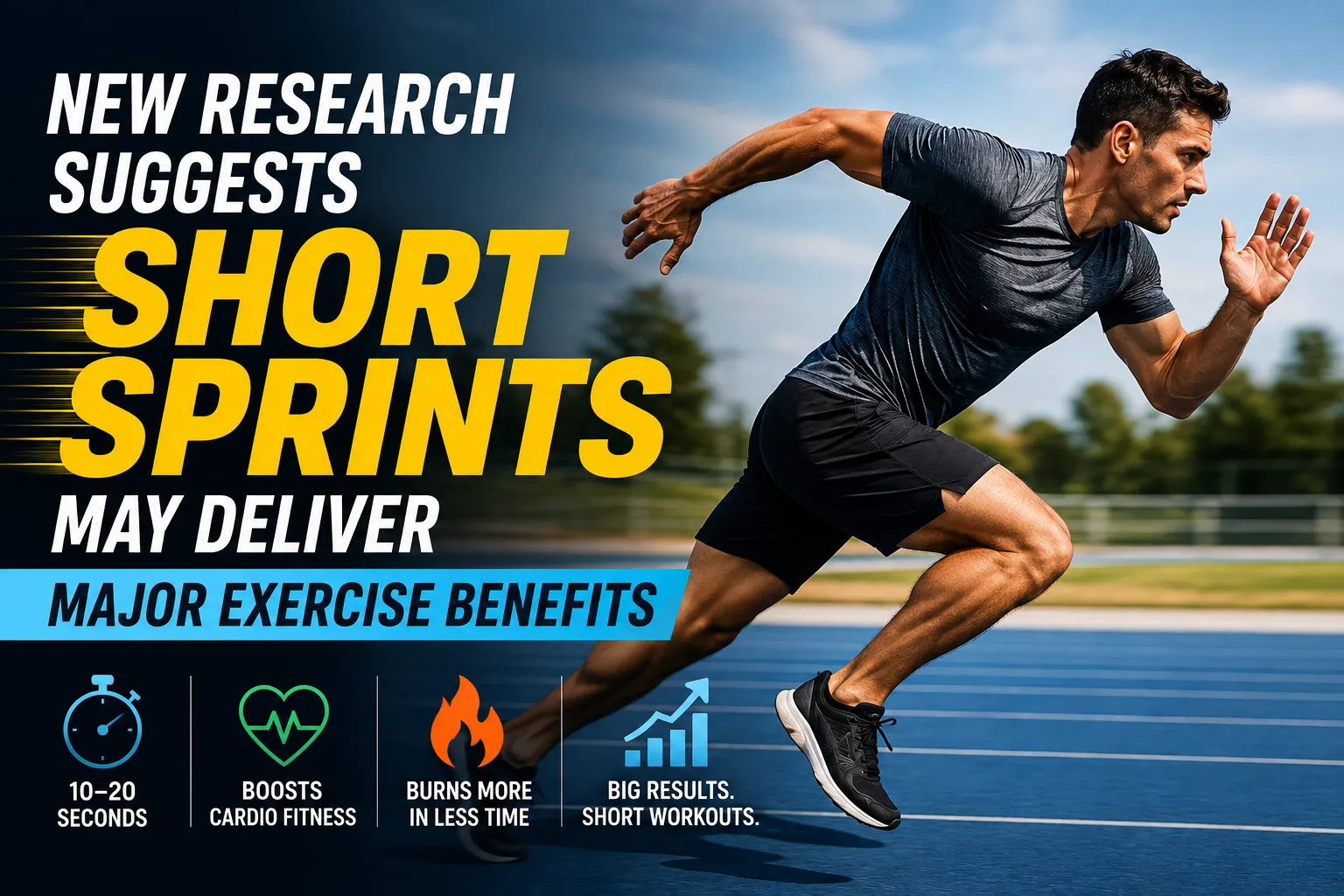

New Research Suggests Short Sprints May Deliver Major Exercise Benefits
For people who struggle to find time for exercise, a growing body of research is offering an intriguing possibility: short bursts of very intense exercise may provide meaningful fitness benefits without requiring long workouts.
Sprint interval training, often called SIT, involves brief periods of near-maximal or all-out effort separated by recovery periods. Unlike traditional endurance workouts, which may involve running, cycling or another activity continuously for 30 minutes or longer, sprint-based sessions can contain only a handful of hard efforts.
Recent research is strengthening the case for low-volume sprint training, particularly for improving cardiorespiratory fitness. A 2026 systematic review and meta-analysis found that sprint interval training produced an average 8.3% improvement in VO₂max, while adding more sprint repetitions did not meaningfully increase the improvement.
The findings do not mean that longer workouts are unnecessary. Instead, they suggest that exercise intensity and efficiency may matter more than previously assumed for some fitness goals.
For a broader look at how exercise fits into a complete approach to physical activity, training, recovery and long-term health, see The Complete Guide to Physical Activity and Exercise.
For a broader look at how exercise fits into sustainable body-composition and lifestyle goals, see this complete guide to healthy weight management.
What Is Sprint Interval Training?
Sprint interval training is a form of high-intensity interval exercise built around short, extremely demanding efforts.
A typical session might involve:
- Warming up
- Performing a short sprint
- Recovering at a low intensity
- Repeating the sprint
- Cooling down
The exact duration varies between studies and training programs.
Some research has specifically examined efforts lasting 10 seconds or less, while other sprint protocols use longer intervals. A systematic review of short sprint interval training involving efforts of up to 10 seconds found improvements in VO₂max and both aerobic and anaerobic performance compared with no exercise or usual training.
The important distinction is that a sprint interval is not simply a slightly faster jog.
The hardest versions are designed to produce a very high level of effort.
Why Short Bursts Can Have Such a Big Effect
Exercise places demands on several systems at once.
During an intense sprint, muscles need to generate energy rapidly while the cardiovascular system works to deliver oxygen and remove metabolic byproducts. Repeated efforts can stimulate adaptations that improve the body’s ability to handle intense exercise.
Over time, training can improve cardiorespiratory fitness, which is commonly assessed using VO₂max or VO₂peak.
VO₂max broadly represents the maximum amount of oxygen the body can use during intense exercise. Higher cardiorespiratory fitness is generally associated with better physical performance and is an important marker of health.
Research has consistently found that interval-based training can improve cardiorespiratory fitness, including when compared with doing no structured exercise.
The New Research Questions How Many Sprints Are Necessary
One of the most interesting developments is that researchers are beginning to examine not just whether sprint training works, but how little may be needed to produce meaningful benefits.
A 2026 meta-analysis examined 93 trials from 78 studies involving 1,188 participants. Researchers found that sprint interval training produced an estimated 8.3% improvement in VO₂max.
But increasing the number of sprint repetitions was not meaningfully associated with greater improvements.
In other words, doing more sprints did not automatically produce proportionally better results.
That could have important implications for people who find traditional exercise routines difficult to maintain.
More Exercise Is Not Always More Effective
The findings challenge a simple assumption that longer and harder workouts necessarily produce better results.
Exercise adaptations depend on numerous factors, including:
- Training intensity
- Frequency
- Recovery
- Starting fitness level
- Exercise type
- Training duration
- Individual health
- Nutrition and sleep
More training can eventually produce greater benefits in some circumstances, but there is a point at which additional work provides diminishing returns.
The latest research suggests that, for VO₂max improvement, adding more sprint repetitions to a session may not be the most productive way to increase the training effect.
Researchers found that training for longer periods across weeks was more strongly associated with improvement than simply adding more sprints to individual sessions.
That distinction is important.
The research is not saying that one tiny workout will transform someone’s fitness overnight. It is suggesting that relatively small training sessions, performed consistently over time, may be enough to generate meaningful adaptations.
Shorter Workouts Could Address One of Exercise’s Biggest Barriers
Lack of time is frequently cited as a reason people struggle to exercise regularly.
That makes time-efficient exercise particularly interesting from a public-health perspective.
If someone believes they need an hour at the gym to obtain meaningful cardiovascular benefits, they may decide that exercise simply does not fit their schedule.
A short sprint-based session presents a different proposition.
Instead of thinking:
“I don’t have time to exercise today.”
Someone might think:
“I can fit a short session into my day.”
That psychological difference could matter.
However, the hardest sprint protocols are demanding, and being short does not necessarily mean being easy.
The same time-efficiency principle has also attracted attention in research on whether one workout a week can be enough. That research addresses a different exercise strategy, but both lines of evidence raise questions about how people can make limited training time more productive.
Short Does Not Mean Easy
This is one of the most important points to understand about sprint training.
A workout lasting only a few minutes can be extremely demanding when the exercise intensity is high.
All-out sprinting places substantial stress on the cardiovascular, muscular and metabolic systems.
For someone who is untrained, overweight, older or managing a health condition, jumping directly into maximal sprints may be inappropriate.
A shorter workout should not be confused with a low-stress workout.
The intensity is the reason the session can be so time-efficient.
Sprint Training Can Improve More Than Cardio
Sprint interval training can challenge both aerobic and anaerobic energy systems.
Earlier research has found moderate improvements in physical performance following sprint interval training, with particularly strong effects observed for anaerobic outcomes. However, researchers have also cautioned that some of the evidence may be affected by small-study effects and methodological limitations.
This means sprint training may be useful for activities requiring bursts of power as well as for improving broader cardiovascular fitness.
That could make it attractive to athletes and recreational exercisers who want to improve speed, power or high-intensity performance.
But Sprint Training Is Not Automatically Better Than Traditional Cardio
The growing enthusiasm around sprint workouts needs some context.
Research does not show that sprint interval training is universally superior to moderate-intensity continuous exercise.
A 2025 umbrella review covering 16 systematic reviews found that sprint interval training improved cardiorespiratory fitness compared with control conditions. However, it found no significant difference between SIT and moderate-intensity continuous training. The researchers also noted that many of the underlying systematic reviews had low or critically low methodological quality.
Another meta-analysis comparing sprint interval training with moderate-intensity continuous training found that both approaches improved cardiovascular fitness, with no clear evidence that sprint training was superior.
That makes the most reasonable interpretation fairly simple:
Sprints are another effective exercise option, not necessarily a replacement for every other form of exercise.
Longer Intervals May Still Have Advantages
Recent research also complicates the idea that the shortest possible workout is always best.
A 2026 meta-analysis comparing HIIT with sprint interval training found that conventional high-intensity interval training produced greater improvements in VO₂max than sprint interval training in the studies analyzed. The researchers reported particularly strong results for programs using intervals longer than four minutes and lasting more than eight weeks.
This highlights an important distinction between HIIT and SIT.
HIIT generally involves hard efforts that are intense but not necessarily all-out. SIT uses shorter, much more intense efforts.
Both can be effective, but they may serve different purposes.
For someone trying to maximize cardiovascular fitness, a structured HIIT program may be preferable to repeated all-out sprints.
Short Sprints May Be Especially Interesting for Time-Efficient Exercise
The strongest argument for sprint training may not be that it produces dramatically better results.
It may be that it produces useful results with relatively little exercise time.
A 2026 systematic review examining sprint training and metabolic health found that SIT and moderate-intensity continuous training produced comparable improvements in several markers of glycemic control, including HbA1c, insulin resistance and fasting glucose in adults with metabolic dysfunction. The researchers described SIT as a potentially time-efficient alternative while emphasizing variability among studies.
That could be particularly relevant for people who struggle with traditional exercise schedules.
The ability to complete an effective workout in a relatively short period may improve the chances of maintaining an exercise habit.
Consistency Still Matters More Than a Single Hard Workout
It is tempting to focus on the intensity of sprint workouts and overlook the importance of consistency.
Fitness adaptations occur over time.
A single sprint session can provide a strong physiological stimulus, but long-term improvements depend on repeated training and adequate recovery.
The 2026 meta-analysis found that longer intervention duration was associated with greater improvements in VO₂max, reinforcing the importance of maintaining training over time.
This is an important lesson for anyone building an exercise routine.
A sustainable program performed consistently is generally more useful than an extremely difficult workout that someone cannot repeat.
Recovery Becomes Particularly Important
High-intensity exercise places substantial stress on the body.
Recovery gives the body time to adapt to that stress.
A sprint-based routine therefore should not simply involve performing maximum-effort workouts as frequently as possible.
A sensible program needs to consider:
- Rest between sprints
- Rest between training sessions
- Sleep
- Nutrition
- Overall training volume
- Individual fitness level
Beginners may need substantially more recovery than experienced athletes.
Ignoring recovery can reduce performance and increase the risk of excessive fatigue.
Understanding how rest and recovery support healthy physical activity is therefore an important part of deciding how high-intensity sessions fit into a broader exercise routine.
Running Is Not the Only Way to Sprint
The word “sprint” often makes people think of running.
But sprint interval training can be performed through different forms of exercise.
Research has examined sprint protocols involving activities such as:
- Cycling
- Running
- Paddling
- Punching
The short-sprint meta-analysis found benefits across different exercise modes.
Cycling can be particularly useful for people who want to perform very intense intervals while reducing some of the impact associated with repeated maximal running.
The best option depends on the person’s fitness, goals, preferences and physical limitations.
A Beginner Should Not Start With All-Out Effort
People new to exercise should be cautious about copying advanced sprint protocols from research studies.
A beginner may benefit from starting with less intense intervals and gradually increasing the workload.
For example, someone might begin with brisk walking and short periods of faster movement before progressing toward running intervals.
The goal is to build tolerance rather than prove how hard the body can be pushed on the first day.
People who have been inactive for a long time or who have medical concerns should consider getting appropriate professional guidance before beginning vigorous exercise.
Sprint Training and Weight Loss
Sprint workouts are sometimes promoted as a shortcut for losing body fat.
The reality is more complicated.
High-intensity exercise can burn energy and may improve fitness and metabolic health, but body-fat changes depend on overall energy balance, diet, activity levels and other factors.
A short sprint workout should not be viewed as a substitute for healthy eating and regular physical activity.
The evidence also does not suggest that sprint training is automatically superior to all other forms of exercise for weight management.
Its strongest practical advantage may be efficiency.
The Mental Side of Exercise Matters Too
A workout that produces good physiological results is only useful if people are willing to perform it.
This is another reason low-volume sprint training is attracting attention.
The 2026 research on sprint repetitions noted that fewer repetitions may improve time efficiency and reduce declines in participants’ enjoyment or affect during training.
That could be important for exercise adherence.
People are more likely to maintain routines that fit their lives and do not feel overwhelmingly difficult.
The ideal workout is therefore not necessarily the one that produces the largest possible physiological stimulus.
It may be the one that provides meaningful benefits while remaining practical enough to repeat.
How Short Sprint Workouts Might Fit Into a Routine
There is no single sprint workout that works for everyone.
Research protocols vary substantially, and many studies are conducted under supervised conditions.
For healthy, already active individuals, sprint intervals can be incorporated into a broader training program rather than becoming the entire program.
A balanced routine might include:
- Easy aerobic exercise
- Strength training
- Mobility work
- Occasional higher-intensity intervals
- Adequate recovery
This approach provides different forms of physical stimulus instead of relying exclusively on maximal-intensity exercise.
For people who want a wider cardiovascular-and-strength approach, research on combining cardio and strength training for diabetes prevention also illustrates why different exercise modalities can complement one another.
The Bigger Lesson About Exercise Efficiency
The emerging research around short sprints is part of a broader shift in how scientists think about exercise.
For years, discussions about physical activity often focused heavily on duration.
Now researchers are increasingly examining intensity, volume, frequency and efficiency together.
The evidence suggests that relatively small amounts of high-intensity exercise can produce substantial improvements in cardiorespiratory fitness, particularly compared with doing no exercise. At the same time, the evidence does not establish that sprint training is universally better than traditional moderate exercise.
That distinction is important because it moves the conversation away from searching for a single “best” workout.
Different people need different approaches.
A Few Minutes Can Be Valuable—When Used Wisely
The latest research gives time-pressed exercisers a reason to reconsider what an effective workout has to look like.
Short sprint intervals can stimulate meaningful improvements in fitness, and recent evidence suggests that increasing the number of sprints within a session may not be necessary to maximize improvements in VO₂max.
But the findings should not be interpreted as permission to turn every workout into an all-out race.
Sprint training is demanding, and its benefits need to be considered alongside recovery, individual fitness and other forms of physical activity.
The approach also fits into the broader principle that exercise for weight management can remain an important part of a sustainable health strategy.
For people looking at how relatively small amounts of exercise can fit into a demanding schedule, shorter workouts may provide another time-efficient approach to physical activity.
The most useful takeaway may be simpler: a lack of time does not necessarily mean a lack of opportunity to exercise.
For people who can safely perform vigorous activity, carefully structured short intervals could become one more practical tool for building cardiovascular fitness—proving that an effective workout does not always have to be a long one.
Continue Reading
Similar Posts

Just 3 Minutes of Intense Exercise Could Trigger Powerful Health-Related Changes, Study Finds
That does not mean three minutes of sprinting has been proven to replace a longer workout. Instead, the findings offer a closer look at why intense exercise may produce such a rapid and wide-ranging biological response.
Read article
Is Walking Enough Exercise? New Research Reopens the Fitness Debate
The study does not prove that walking faster or taking a particular number of steps prevents death. It does, however, add to a growing body of evidence suggesting that there is no single magic step count or perfect form of exercise.
Read article
Regular Exercise Linked to Lower Risk of Death in Older Adults, New Study Finds
The findings add to a growing body of evidence suggesting that staying physically active may be important not only for maintaining strength and independence in later life, but also for improving long-term health outcomes.
Read article

Join 10,000+ Readers Building Healthier Habits
Get actionable wellness tips every week plus our newest articles delivered straight to your inbox.