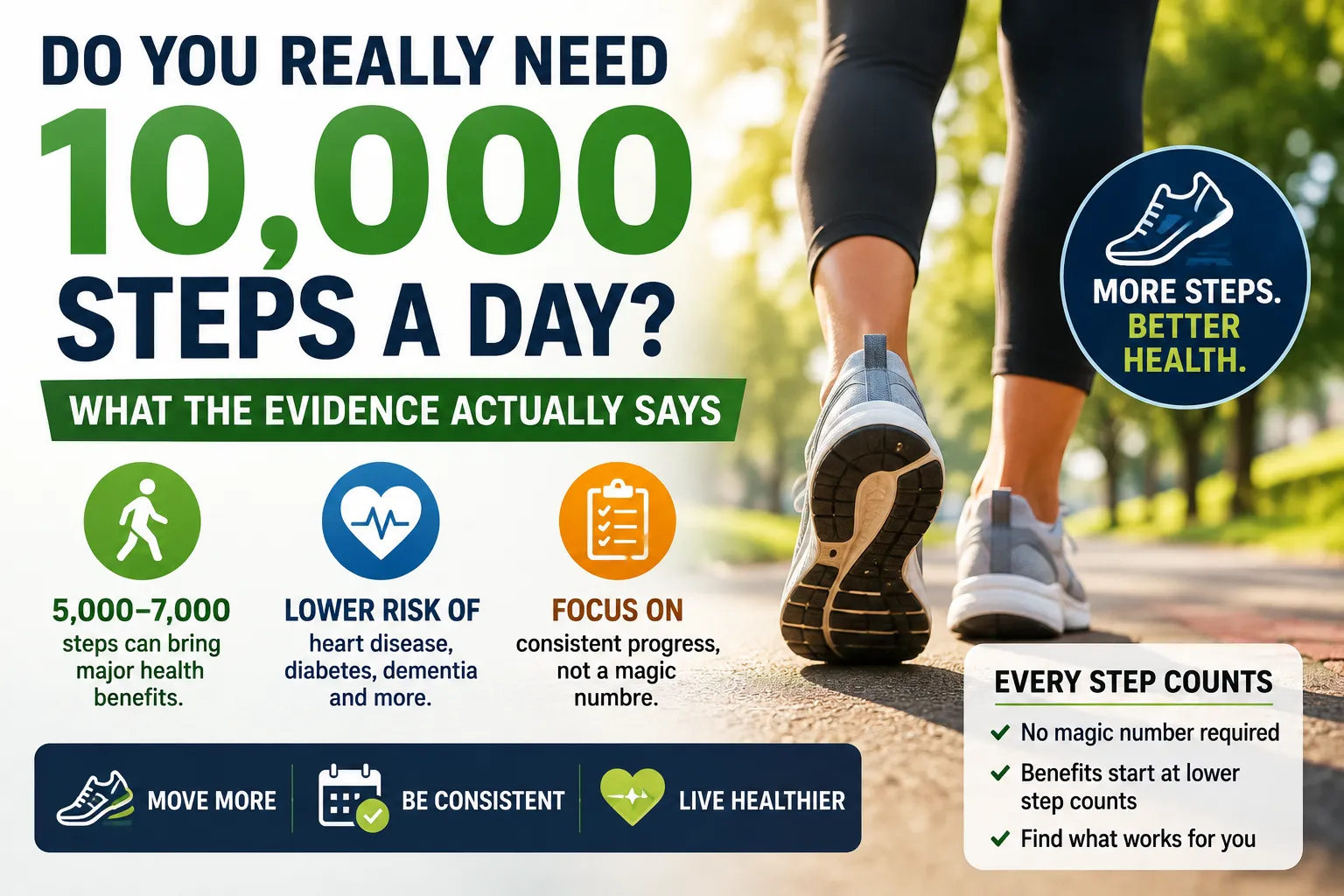

Do You Really Need 10,000 Steps a Day? What the Evidence Actually Says
For years, 10,000 steps a day has been treated almost like a universal fitness rule. Fitness trackers display it, walking challenges revolve around it, and many people feel they have failed a healthy day if their step counter stops at 7,000 or 8,000.
But where did the number come from—and does science actually show that everyone needs to reach 10,000 steps every day?
The short answer is no.
Research increasingly suggests that meaningful health benefits can occur well below 10,000 daily steps. A large 2025 systematic review and dose-response meta-analysis found that several important health outcomes improved as daily step counts increased, with benefits becoming particularly meaningful around 5,000–7,000 steps per day for several outcomes. The researchers concluded that 10,000 steps can still be a reasonable target for active people, but it isn’t a universal requirement for good health.
Here’s what the evidence actually tells us.
For a broader look at how walking fits into a complete approach to physical activity, exercise, fitness and long-term health, see The Complete Guide to Physical Activity and Exercise.
Where Did the 10,000-Step Goal Come From?
The popular 10,000-step target wasn’t originally established as a precise medical threshold.
The number became widely associated with walking and health after a Japanese pedometer marketing campaign in the 1960s. The idea was memorable, easy to communicate and useful for encouraging people to become more active.
Over time, however, the marketing target became widely perceived as a scientific recommendation.
That distinction matters.
Researchers have since investigated whether health outcomes actually change dramatically at exactly 10,000 steps. The evidence doesn’t show a biological switch that suddenly turns on when someone takes their 10,000th step.
Instead, the relationship between activity and health generally appears to be dose-responsive: going from very little activity to more activity can provide substantial benefits, while the additional benefit may become smaller as activity levels rise.
So How Many Steps Do You Actually Need?
There isn’t one number that applies equally to every person.
Age, fitness level, health status, mobility, occupation and existing activity levels all influence what constitutes an appropriate amount of movement.
Recent evidence nevertheless provides a useful range.
A 2025 review published in The Lancet Public Health analyzed 57 studies from 35 cohorts and found nonlinear associations between daily steps and several health outcomes. For all-cause mortality, cardiovascular disease incidence, dementia and falls, the researchers identified inflection points around 5,000–7,000 steps per day.
In the analysis, compared with people averaging about 2,000 steps per day, those reaching around 7,000 steps were associated with:
- 47% lower risk of all-cause mortality
- 25% lower risk of cardiovascular disease
- 47% lower cardiovascular mortality
- 14% lower risk of type 2 diabetes
- 38% lower risk of dementia
- 22% lower risk of depressive symptoms
- 28% lower risk of falls
These figures describe associations observed in prospective studies. They should not be interpreted as proof that taking exactly 7,000 steps will cause those percentage reductions in an individual person. Factors such as underlying health, fitness, lifestyle and socioeconomic circumstances can influence both activity levels and health outcomes.
What Happens Below 10,000 Steps?
One of the most encouraging findings is that the benefits don’t begin at 10,000.
Earlier research has repeatedly found associations between relatively modest increases in daily movement and better health outcomes.
A systematic review of prospective studies involving more than 30,000 adults found that an additional 1,000 daily steps was associated with lower risks of all-cause mortality and cardiovascular disease. Importantly, the researchers found evidence of benefits below 10,000 steps per day.
Another meta-analysis found a nonlinear relationship between step count and mortality, with substantial differences between lower and higher activity groups.
More recent evidence points in the same general direction: moving from very low activity to moderate activity may be especially valuable.
That means someone averaging 3,000 steps shouldn’t assume that 9,000 additional steps are required before their activity starts to matter.
An increase from 3,000 to 4,000—or from 4,000 to 5,000—can still be a meaningful improvement.
Is 10,000 Steps Still a Good Goal?
Absolutely—if it works for you.
For a healthy, active person who enjoys walking, reaching 10,000 steps can be an excellent daily objective.
The problem is treating it as a minimum requirement.
The 2025 review specifically noted that 10,000 steps remains a viable target for people who are more active, while approximately 7,000 steps may be a more realistic and achievable target for some people.
For someone currently averaging 2,500 steps, setting a goal of 10,000 immediately may feel overwhelming.
A more practical progression could look like:
| Current average | Possible next goal |
|---|---|
| 2,000 steps | 2,500–3,000 |
| 3,000 steps | 3,500–4,000 |
| 4,000 steps | 5,000 |
| 5,000 steps | 6,000 |
| 6,000 steps | 7,000 |
| 7,000 steps | 8,000+ |
| 8,000+ steps | Maintain or increase based on goals |
These aren’t medical prescriptions. They’re examples of how someone might think about progress rather than perfection.
For people who struggle to fit movement into a busy schedule, this gradual approach can also complement research on whether one workout a week can be enough. Formal exercise and everyday movement do not have to compete for the same limited time.
Does Walking Faster Matter?
Step count isn’t the only thing that matters.
Walking pace and intensity can also contribute to the health effects of physical activity.
Research examining walking speed has found associations between faster walking and lower mortality risk, although walking speed is influenced by age, fitness, health and other factors.
This is one reason a person’s overall activity pattern can be more informative than a single number on a smartwatch.
For example, 7,000 steps accumulated through purposeful walking, commuting and everyday activities may provide a very different experience from 7,000 steps taken almost entirely at a slow pace.
That doesn’t mean slow walking is ineffective. It simply means step count doesn’t capture every dimension of physical activity.
Do You Have to Walk All 10,000 Steps at Once?
No.
Daily steps can accumulate throughout the day.
Walking to work, taking the stairs, shopping, doing household chores, walking the dog and taking short breaks from sitting can all contribute to a person’s daily movement.
The emerging research also suggests that how steps are accumulated may matter.
A recent cohort analysis found that both total daily steps and steps accumulated in longer walking bouts were beneficially associated with mortality outcomes. However, this type of observational evidence doesn’t establish that a particular walking pattern will produce a specific reduction in mortality.
The practical lesson is simple: you don’t need a single 60-minute walk to make your movement count.
Several shorter walks can make it easier to build activity into a busy day.
What If You Only Get 4,000 Steps?
Don’t give up.
One of the biggest problems with the 10,000-step mindset is that it can turn exercise into an all-or-nothing challenge.
If someone walks 4,000 steps and sees that they haven’t reached 10,000, they may conclude that the effort wasn’t worthwhile.
The research suggests otherwise.
A 2024 umbrella review found that higher daily step counts were associated with benefits across several health outcomes, including all-cause mortality, cardiovascular events and metabolic diseases. It also reported that increases of roughly 500–1,000 steps per day were associated with lower risks of mortality and cardiovascular events.
In other words, everyday movement matters even when the number on the screen isn’t five digits.
What About People Over 60?
The relationship between step count and health can vary by age.
A large meta-analysis involving 47,471 adults found that mortality risk progressively decreased as daily steps increased, but the level at which the association appeared to level off differed by age. Among adults aged 60 and older, the relationship continued toward roughly 6,000–8,000 steps per day, while younger adults showed associations extending toward approximately 8,000–10,000 steps.
That doesn’t mean older adults should stop at 8,000 steps or younger adults must reach 10,000.
It illustrates why a single universal target can be misleading.
Fitness goals should take the individual’s circumstances into account.
Can Too Much Walking Be Bad?
More activity isn’t automatically better in every circumstance.
For most healthy adults, walking is generally a low-impact form of physical activity, but suddenly increasing activity can contribute to soreness or overuse problems.
The evidence around very high step counts and specific injuries is also more complicated than simply saying “more is always better.” A 2024 umbrella review noted a finding from one study suggesting a possible increase in meniscal pathology among people exceeding 10,000 steps per day, while also emphasizing the broader benefits associated with higher step counts.
This is not evidence that 10,000 steps is dangerous.
Rather, it reinforces the importance of considering individual circumstances, gradual progression and recovery.
Someone who is currently sedentary shouldn’t suddenly double or triple their walking volume simply because a fitness tracker displays a particular goal.
Recovery is also part of a complete exercise strategy, particularly when walking is combined with more demanding workouts. Understanding how rest and recovery support healthy physical activity can help people increase activity without treating recovery as an afterthought.
Steps Aren’t the Whole Fitness Picture
A step counter is useful, but it doesn’t measure everything that contributes to physical fitness.
A well-rounded exercise routine can include:
- Walking and other aerobic activity
- Strength training
- Balance exercises
- Mobility work
- Recreational activities
- Sports
- Activities that reduce prolonged sitting
Someone who walks 10,000 steps every day but never performs resistance exercise has a different fitness profile from someone who walks 7,000 steps while also strength training several times a week.
Likewise, two people with identical step counts can have very different levels of cardiovascular fitness.
That’s why 10,000 steps shouldn’t become a substitute for a broader approach to physical activity.
This broader perspective is also why reducing sedentary behavior and adding more movement matters even for people who already track their steps. Breaking up long periods of sitting can be another practical way to increase daily movement.
The Biggest Mistake Is Chasing the Number
Perhaps the most useful lesson from the research is that step goals should encourage movement rather than create unnecessary pressure.
If 10,000 steps fits naturally into your lifestyle, there’s little reason to abandon it.
But if your current routine produces 4,000 or 5,000 steps, there’s no reason to believe those steps are worthless simply because you didn’t reach 10,000.
Instead, consider asking:
How can I move a little more than I do now?
That might mean taking a 10-minute walk after lunch, walking while making a phone call, parking farther away, taking the stairs or adding an evening stroll.
Small changes can accumulate.
What the Evidence Really Says About 10,000 Steps
The popular 10,000-step target is a useful goal, not a biological requirement.
Current research suggests that health benefits can occur at substantially lower step counts, with a 2025 systematic review finding particularly meaningful associations around 5,000–7,000 steps per day for several major health outcomes.
The bigger message is not that everyone should replace 10,000 with exactly 7,000.
It’s that there is no magic number that separates a healthy amount of movement from an unhealthy one.
For someone who is relatively inactive, adding a few hundred or a few thousand steps may be a much more realistic and useful objective than obsessing over a five-digit target.
And for people who enjoy reaching 10,000 or more, there’s no reason to stop simply because the evidence shows that fewer steps can also provide substantial benefits.
The Better Goal: More Movement, Less Pressure
If your fitness tracker says 10,000, great.
If it says 7,000, that’s valuable too.
If it says 4,000 today, you can still take another walk tomorrow.
The strongest takeaway from the research is remarkably simple: regular movement matters, and you don’t have to hit an arbitrary-looking number before your body benefits from being more active.
For people starting from a low activity level, building gradually toward a higher daily step count—and combining walking with other forms of exercise—may be a more sustainable strategy than treating 10,000 as a pass-or-fail test.
Continue Reading
Similar Posts

Just 3 Minutes of Intense Exercise Could Trigger Powerful Health-Related Changes, Study Finds
That does not mean three minutes of sprinting has been proven to replace a longer workout. Instead, the findings offer a closer look at why intense exercise may produce such a rapid and wide-ranging biological response.
Read article
Is Walking Enough Exercise? New Research Reopens the Fitness Debate
The study does not prove that walking faster or taking a particular number of steps prevents death. It does, however, add to a growing body of evidence suggesting that there is no single magic step count or perfect form of exercise.
Read article
Regular Exercise Linked to Lower Risk of Death in Older Adults, New Study Finds
The findings add to a growing body of evidence suggesting that staying physically active may be important not only for maintaining strength and independence in later life, but also for improving long-term health outcomes.
Read article

Join 10,000+ Readers Building Healthier Habits
Get actionable wellness tips every week plus our newest articles delivered straight to your inbox.