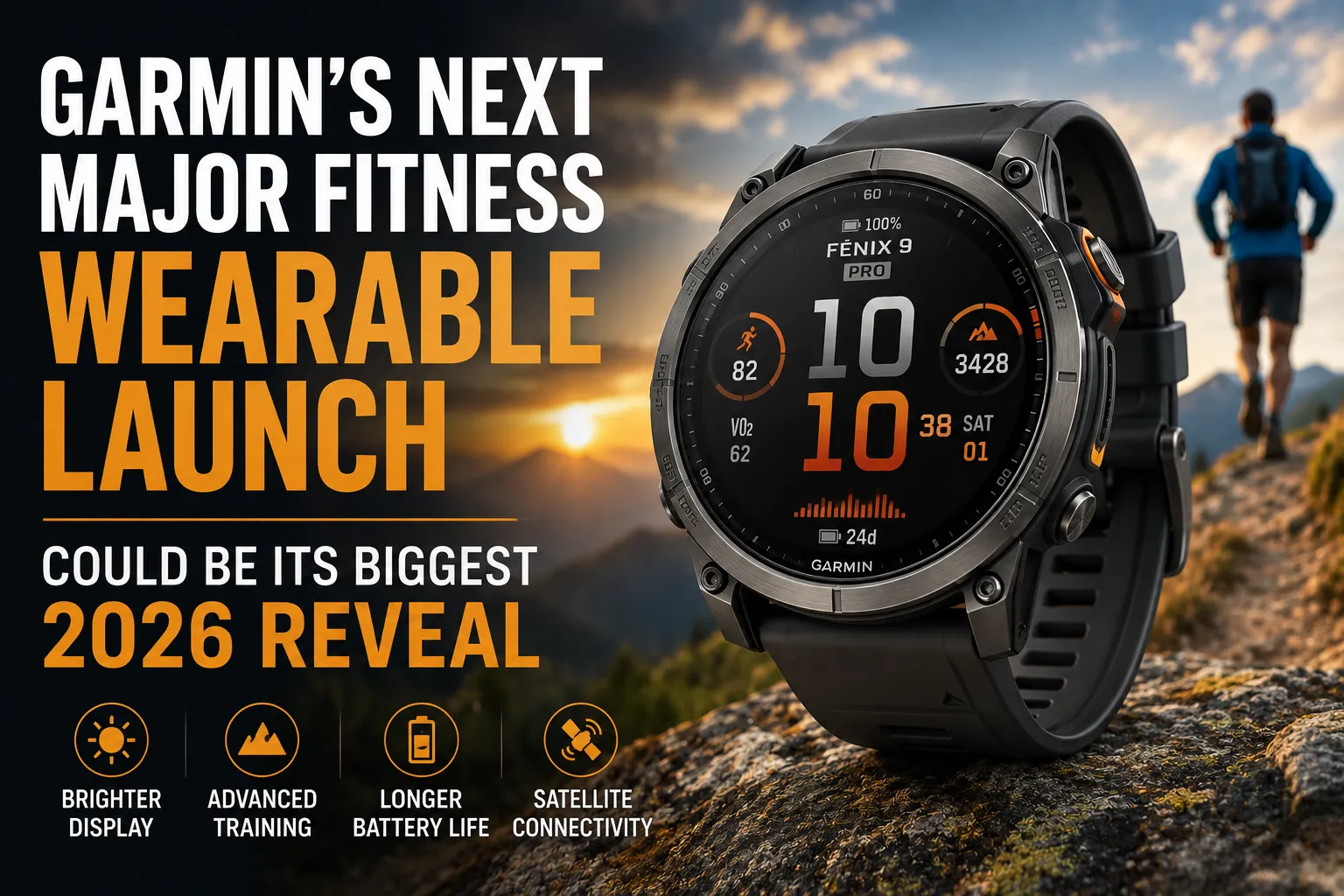

Garmin’s Next Major Fitness Wearable Launch Could Be Its Biggest 2026 Reveal
Garmin has already delivered several notable fitness products in 2026, but the company’s latest flagship smartwatch launch could prove to be its most important wearable moment of the year.
On August 25, Garmin officially expanded its flagship performance smartwatch lineup with the fēnix 9 and fēnix 9 Pro, ending months of speculation surrounding the next generation of its rugged fitness watches. Garmin’s own newsroom confirms the launch, while the new models bring major changes to display brightness, storage, mapping, training features and connectivity.
The timing is significant. Garmin has increasingly positioned its wearables as sophisticated training and health platforms rather than simple activity trackers. The new fēnix generation continues that strategy, combining long battery life with advanced performance metrics and outdoor-focused capabilities.
For athletes, runners, hikers and fitness enthusiasts, the question is whether the new generation represents a meaningful step forward or simply another premium upgrade.
Garmin’s Biggest Wearable Launch of the Year
The fēnix range has long occupied a special position within Garmin’s lineup.
These watches are designed for people who want more than basic step counting and heart-rate monitoring. They combine GPS navigation, training analysis, recovery information, outdoor features and smartwatch functionality in a rugged package.
The new fēnix 9 arrives with a starting price of $999.99, while the fēnix 9 Pro starts at $1,099.99. Garmin says the new models will be available to order beginning August 28.
That pricing makes the launch firmly premium, but Garmin is targeting customers who are willing to pay for extensive fitness and outdoor capabilities.
For a broader look at how exercise technology fits into a complete approach to physical activity, see the complete guide to physical activity and exercise.
A Much Brighter Display
One of the most visible changes is the display.
The fēnix 9 and fēnix 9 Pro feature OLED screens capable of reaching up to 3,000 nits of brightness, according to reporting on the launch. That is a substantial increase over the previous generation and could make the watches easier to read outdoors in strong sunlight.
Display brightness matters more on a fitness watch than it might on a conventional smartwatch.
Runners may need to glance at pace information while moving through bright outdoor environments. Cyclists may be checking navigation or performance metrics in direct sunlight. Hikers may rely on maps when conditions make visibility challenging.
A brighter screen can therefore have practical benefits rather than simply making the specification sheet look more impressive.
More Storage and Faster Maps
Garmin is also increasing internal storage to 64GB on the new fēnix models.
The company has paired that increase with an upgraded map engine designed to make map panning smoother and faster.
That could be particularly useful for people who use their watch as a serious navigation tool.
For outdoor athletes, maps are not merely an optional smartwatch feature. They can help with route planning, trail navigation and staying oriented in unfamiliar areas.
Improved performance when moving around maps could make the experience feel substantially more responsive.
Garmin Epic Turns Training History Into a Bigger Picture
One of the more interesting software additions is Garmin Epic.
The feature brings together workouts completed over longer periods and presents health and performance information across those sessions.
This reflects a broader trend in fitness technology.
Wearables increasingly attempt to move beyond recording individual workouts. Instead, they try to help users understand patterns across weeks and months.
For an athlete, a single training session provides useful information. A history of hundreds of sessions can provide much more context.
That makes long-term data analysis increasingly important to the value of premium fitness wearables.
Stamina Tracking Gets More Attention
The new watches also expand Garmin’s stamina-related metrics.
Stamina tracking is designed to help users understand how their available energy changes during activity. For endurance athletes, that information can be useful when deciding whether to increase effort, maintain a pace or conserve energy.
The usefulness of these metrics will ultimately depend on how accurately they reflect an individual’s real-world performance.
Fitness technology can provide increasingly sophisticated estimates, but athletes still need to combine those numbers with experience, environmental conditions and how they actually feel during exercise.
Rucking Gets a Major Upgrade
Garmin is also expanding its rucking features.
Rucking involves walking or hiking while carrying additional weight, and it has become increasingly popular as a training method.
The new software allows users to change the weight of their pack during a workout, giving the watch more context when calculating training information.
That may seem like a niche feature, but it illustrates Garmin’s approach to fitness tracking.
Rather than designing one generic system for everyone, the company increasingly provides specialized tools for different forms of training.
The Fēnix 9 Pro Adds Connectivity Options
The fēnix 9 Pro takes the lineup further with additional connectivity options.
Garmin says the Pro models can be configured with inReach satellite or LTE connectivity, while the added connectivity comes with an additional $100 cost and a subscription requirement.
For outdoor adventurers, satellite communication can be more than a convenience.
People hiking, climbing or traveling in areas without conventional cellular coverage may value the ability to communicate beyond normal smartphone networks.
That makes connectivity one of the features that could distinguish Garmin’s premium outdoor watches from mainstream smartwatches.
Solar Charging Remains Part of the Strategy
Battery life remains one of Garmin’s strongest selling points.
The largest fēnix 9 can provide up to 29 days of smartwatch-mode battery life, according to Garmin’s launch specifications reported by The Verge.
The fēnix 9 Pro goes even further with solar charging options on the 47mm and 51mm models.
Garmin says the solar versions can reach up to 57 days of battery life, under specific conditions that include spending around three hours per day outdoors in 50,000-lux conditions.
Those numbers are obviously dependent on usage and environmental conditions, but they highlight a major difference between Garmin’s approach and many mainstream smartwatches.
Garmin is prioritizing longevity.
Why Battery Life Matters for Fitness
Long battery life is particularly valuable for people who train frequently.
A runner preparing for a marathon may want continuous activity and recovery tracking. A backpacker may spend several days away from electrical outlets. An endurance athlete may need GPS tracking for hours at a time.
A watch that requires daily charging can interrupt those routines.
Garmin’s long-running emphasis on battery efficiency therefore remains an important part of its identity.
It also makes the watches useful for monitoring sleep and recovery, since users do not necessarily have to remove the device every night to recharge it.
That emphasis on recovery is becoming increasingly important across the fitness industry, as shown by the rise of recovery tracking as a major fitness trend.
Garmin Is Building a Broader Fitness Ecosystem
The fēnix 9 launch arrives during an unusually active period for Garmin’s fitness business.
Earlier in 2026, the company introduced the Forerunner 70 and Forerunner 170, while it also launched the screen-free CIRQA fitness tracker in July. Garmin has also expanded its training ecosystem through its acquisition of TrainingPeaks and TrainHeroic.
That broader strategy matters.
Garmin is no longer simply selling GPS watches.
It is increasingly building an interconnected fitness ecosystem covering training, recovery, endurance sports, health tracking and coaching.
The fēnix 9 sits at the premium end of that ecosystem.
CIRQA Shows Garmin Is Experimenting Beyond Smartwatches
The company’s CIRQA launch is particularly interesting because it moves Garmin into the screen-free fitness tracker category.
The $199 device is designed to track health and fitness information without placing a traditional display on the user’s wrist. It can provide workout-related feedback through haptic controls while relying on the Garmin Connect ecosystem for deeper information.
That gives Garmin a broader range of products for different types of users.
Some consumers want a sophisticated smartwatch with maps and advanced training features.
Others want a lightweight tracker that stays out of the way.
The company now has products aimed at both ends of that spectrum.
The Garmin CIRQA screen-free fitness tracker provides a closer look at how this new category fits into Garmin’s broader strategy.
Garmin May Also Be Entering the Smart Ring Market
The company’s wearable ambitions may extend further.
A recent certification filing reportedly revealed a product called the CIRQA Smart Ring, suggesting Garmin could be preparing its first smart ring. The filing was submitted in Indonesia earlier this month, although the listing was subsequently removed from the certification database.
If Garmin eventually releases a smart ring, it would put the company into direct competition with established players in the category.
That would also give Garmin another way to collect health and recovery information while allowing users to choose where they want to wear their tracking technology.
The Competition Is Getting Stronger
Garmin’s challenge is that the premium wearable market is becoming increasingly competitive.
Apple continues to dominate the broader smartwatch conversation, while Samsung and Google are investing heavily in health and fitness tracking.
Dedicated fitness companies such as COROS and Polar are also competing for serious athletes.
Smart rings and screen-free trackers are creating additional alternatives for people who do not want a traditional smartwatch.
Garmin therefore needs to give consumers a compelling reason to choose its ecosystem.
The fēnix 9’s combination of battery life, navigation, training metrics and outdoor capabilities is clearly intended to do exactly that.
Garmin’s Advantage May Be Its Focus on Athletes
One of Garmin’s biggest advantages is specialization.
A general-purpose smartwatch needs to balance communication, entertainment, notifications, apps and fitness.
Garmin can put considerably more emphasis on training and outdoor activities.
For a serious runner or cyclist, the depth of available metrics can be more important than having the largest app ecosystem.
For hikers and adventurers, navigation and battery endurance can matter more than traditional smartwatch features.
That focus has helped Garmin establish a strong identity among athletes and outdoor enthusiasts.
The Price Remains a Major Barrier
The biggest obstacle to the fēnix 9 may ultimately be its cost.
Starting at $999.99, the watch is considerably more expensive than many mainstream fitness trackers and smartwatches. The Pro models push the starting price even higher.
For casual users, that price may be difficult to justify.
Someone who primarily wants step counting, notifications, sleep tracking and occasional workouts can find much cheaper alternatives.
The fēnix 9 is therefore aimed at a narrower audience: people who will actually use its advanced capabilities.
Who Is the Fēnix 9 Really For?
The new watch makes the most sense for people who place a high value on advanced fitness and outdoor functionality.
Potential buyers include:
- Serious runners
- Cyclists
- Triathletes
- Hikers
- Backpackers
- Trail runners
- Outdoor adventurers
- Rucking enthusiasts
- Endurance athletes
- Fitness-focused users who want extensive training data
For those users, the additional features may justify the premium.
For everyone else, a less expensive Garmin model could offer a better balance of price and functionality.
The Bigger Shift in Fitness Wearables
The fēnix 9 launch illustrates how fitness wearables are changing.
The industry is moving beyond simple measurements such as steps and calories.
Modern devices are attempting to understand training load, recovery, endurance, sleep, stress and long-term performance.
The most valuable wearable may therefore not be the one that records the most numbers.
It may be the one that turns those numbers into information people can actually use.
Garmin’s investment in training history, stamina tracking, specialized sports features and its broader ecosystem suggests the company sees that as the future of fitness technology.
The company’s expansion is also taking place alongside the broader growth of wearable fitness technology and connected health tracking, where devices increasingly combine exercise data with sleep, recovery and everyday wellness information.
Garmin’s 2026 Strategy Is Becoming Clearer
With the fēnix 9 and fēnix 9 Pro now officially revealed, Garmin’s 2026 wearable strategy looks increasingly ambitious.
The company has expanded its traditional watch lineup, introduced a screen-free fitness tracker, invested in coaching platforms and reportedly explored new wearable categories.
That makes the fēnix 9 more than another annual hardware update.
It is a statement about where Garmin believes premium fitness technology is heading.
The new watches combine brighter displays, better navigation, more storage, long battery life, specialized training tools and optional satellite or cellular connectivity.
For athletes who want a wearable capable of functioning as a training partner, navigation device and long-term performance record, Garmin’s latest flagship could be one of the company’s most significant fitness products of 2026.
And with orders beginning August 28, consumers will soon have the opportunity to see whether Garmin’s latest attempt to push premium fitness technology forward can justify its unusually high price.
Continue Reading
Similar Posts
Just 3 Minutes of Intense Exercise Could Trigger Powerful Health-Related Changes, Study Finds
That does not mean three minutes of sprinting has been proven to replace a longer workout. Instead, the findings offer a closer look at why intense exercise may produce such a rapid and wide-ranging biological response.
Read article
Is Walking Enough Exercise? New Research Reopens the Fitness Debate
The study does not prove that walking faster or taking a particular number of steps prevents death. It does, however, add to a growing body of evidence suggesting that there is no single magic step count or perfect form of exercise.
Read article
Regular Exercise Linked to Lower Risk of Death in Older Adults, New Study Finds
The findings add to a growing body of evidence suggesting that staying physically active may be important not only for maintaining strength and independence in later life, but also for improving long-term health outcomes.
Read article

Join 10,000+ Readers Building Healthier Habits
Get actionable wellness tips every week plus our newest articles delivered straight to your inbox.