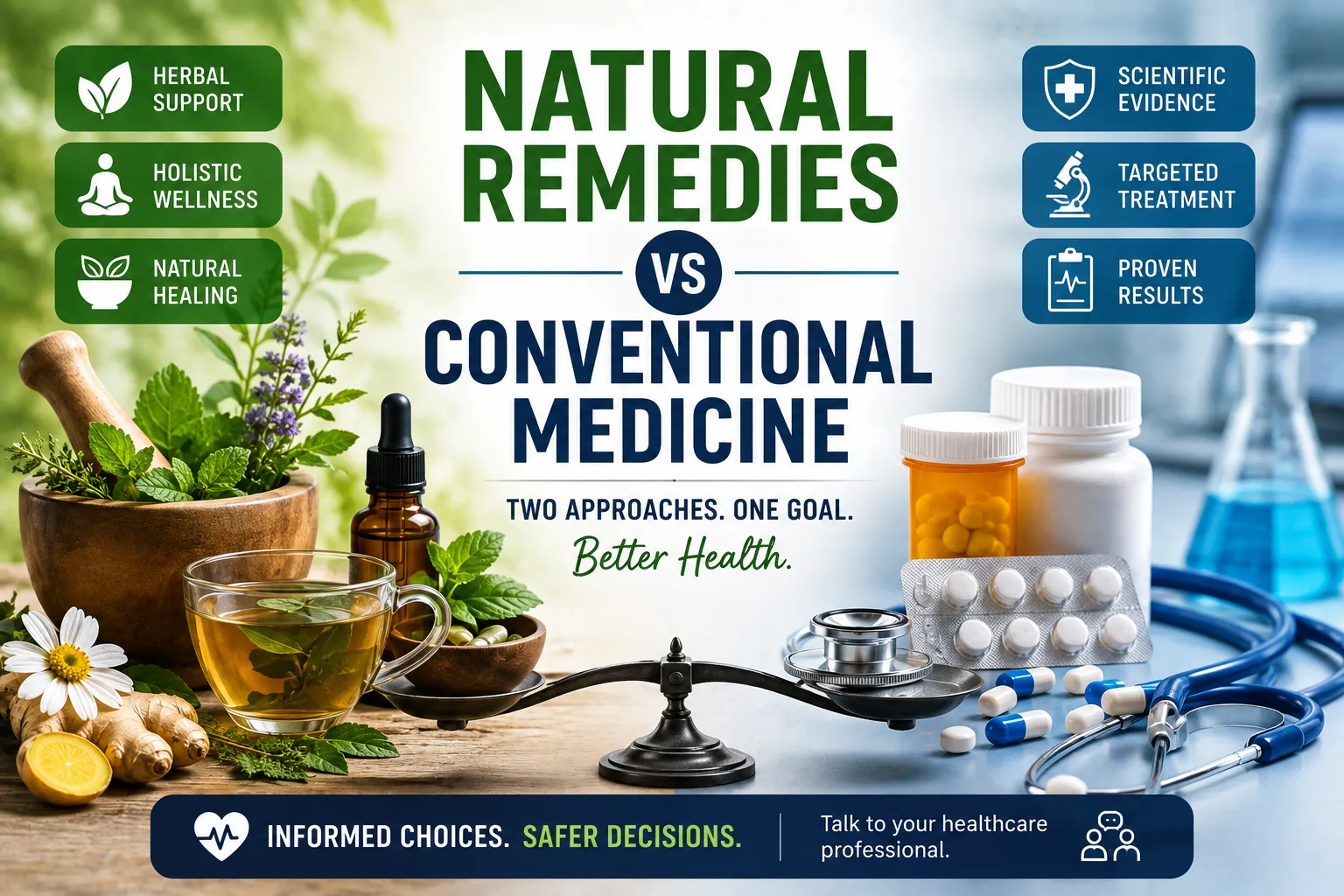

Natural Remedies vs Conventional Medicine
The debate between natural remedies and conventional medicine is often presented as a choice between two completely different approaches to health.
One side is associated with herbs, traditional practices, foods and home remedies. The other is associated with prescription medicines, surgery, diagnostic testing and modern medical technology.
In reality, healthcare is rarely that simple.
Some natural approaches have useful evidence behind them and may complement conventional treatment. Some have little evidence of benefit. Others can cause side effects or interact with medicines. At the same time, conventional medicines are not risk-free either: they can cause adverse effects, interact with other drugs and require careful dosing.
The most useful question is therefore not “Are natural remedies better than medicine?”
It is:
“Which approach is supported by evidence, appropriate for the condition, and safest for this particular person?”
That distinction can help people make better decisions without automatically dismissing traditional remedies or assuming that every pharmaceutical treatment is superior.
What Counts as a Natural Remedy?
“Natural remedy” is a broad term rather than a precise medical category.
It can refer to:
- Herbal preparations
- Plant-based products
- Traditional medicines
- Certain foods used for health purposes
- Herbal teas
- Essential oils
- Dietary supplements
- Mind-body practices
- Massage
- Meditation
- Yoga
- Other complementary approaches
Some of these approaches involve substances that can have powerful effects on the body.
In fact, many modern medicines have origins in naturally occurring substances. The distinction between “natural” and “medical” is therefore not always as clear as it may appear.
For a broader look at how natural treatments should be evaluated, see this complete guide to natural remedies evidence.
What Is Conventional Medicine?
Conventional medicine generally refers to healthcare approaches that are widely used within modern medical systems and supported by established scientific and clinical evidence.
It can include:
- Prescription medicines
- Over-the-counter medicines
- Vaccinations
- Surgery
- Diagnostic testing
- Physical therapy
- Radiation treatment
- Medical devices
- Hospital care
- Evidence-based preventive care
Conventional medicine is not one single treatment philosophy.
A doctor may recommend medication for one condition, surgery for another, physical therapy for a third and lifestyle changes for a fourth.
The appropriate treatment depends on the specific problem.
Natural Does Not Automatically Mean Safe
One of the most important misconceptions surrounding natural remedies is that something must be safe because it comes from nature.
That assumption can be dangerous.
Plants contain chemicals that can produce powerful biological effects. Some natural products can cause significant side effects, while others can interact with medications.
Products such as kava have been associated with severe liver damage, while ephedra has been associated with serious cardiovascular problems.
The same principle applies to vitamins and minerals.
A substance can be necessary for normal body function at one level and harmful at a much higher level.
Anyone considering herbal products or supplements should therefore understand the potential risks covered in this natural remedies safety guide.
Conventional Medicine Is Not Risk-Free
It would also be misleading to portray conventional medicine as completely safe.
Prescription and over-the-counter medicines can cause:
- Side effects
- Allergic reactions
- Drug interactions
- Dosage-related problems
- Dependence with certain medicines
- Complications from procedures
- Effects on organs such as the liver or kidneys
The important difference is that conventional medicines are generally evaluated within established medical and regulatory systems, with evidence used to determine their appropriate uses, doses and risks.
That does not eliminate risk.
It helps clinicians understand and manage it.
Evidence Matters More Than Labels
A treatment should not be judged primarily by whether it is called “natural,” “traditional,” “alternative” or “modern.”
The more useful questions are:
- Has it been studied?
- Does research show that it works for this condition?
- How strong is the evidence?
- What are the potential risks?
- What dose was studied?
- Does the person have conditions that change the risk?
- Could it interact with another treatment?
Consumers should look at scientific evidence for both the safety and effectiveness of complementary approaches rather than relying on marketing claims or assumptions about natural products.
Traditional Use Is Not the Same as Clinical Evidence
A remedy may have been used for hundreds of years.
That history can be valuable and worth studying.
However, long-term traditional use does not automatically establish that a treatment is effective for every condition or that it is safe at every dose.
Clinical research attempts to answer more specific questions.
For example:
- Does the treatment actually improve symptoms?
- How large is the benefit?
- How does it compare with placebo or another treatment?
- Which patients benefit?
- What side effects occur?
- What dose is appropriate?
A traditional remedy can therefore be worth researching without automatically assuming that traditional use proves effectiveness.
The relationship between historical use and modern evidence is explored further in this guide to traditional remedies versus modern research.
Herbal Remedies Can Interact With Medicines
This is one of the most important practical issues for anyone combining natural remedies with conventional medicine.
Some herbs can alter the effects of medications by changing how the body absorbs, processes or eliminates them.
St. John’s wort is a particularly important example. It can reduce the effectiveness of numerous medicines and can also contribute to serious interactions with certain antidepressants.
Other herbs and supplements may also interact with medicines.
Examples include:
- Ginkgo
- Ginseng
- Goldenseal
- Concentrated green tea extracts
- Chamomile
- Certain other herbal products
The level of evidence varies by product and interaction, so consumers should not assume that every combination is either safe or dangerous without checking the specific products involved.
Why Medication Interactions Can Be Serious
An interaction can work in different directions.
A supplement may make a medicine less effective.
Alternatively, it may make the medicine more powerful, increasing the risk of side effects.
Some supplements can increase the effects of medications, while others can decrease medication levels or effectiveness.
This becomes especially important with medicines that have a narrow therapeutic range.
For these medicines, relatively small changes in drug levels can sometimes have significant consequences.
Natural Remedies and Blood Thinners
People taking blood-thinning medicines need to be particularly careful about supplements and herbs.
Some products may influence blood clotting or change the effects of anticoagulant medicines.
Concerns have been raised about products such as ginkgo and warfarin, while people taking medicines with a narrow therapeutic index should discuss herbal supplement use with their healthcare providers.
If you take an anticoagulant, do not add an herbal product simply because it is advertised as natural.
Ask a doctor or pharmacist first.
Natural Remedies and Surgery
Natural products can also matter before surgery.
Some supplements may influence:
- Blood clotting
- Blood pressure
- Heart rate
- Sedation
- The way medicines are processed
Some supplements can have dangerous effects during surgery, making it important to discuss supplement use with a healthcare professional.
Make sure your surgical team knows about everything you take, including herbal products and supplements.
What About Home Remedies?
Not every natural approach is an herbal supplement.
Some common home remedies involve ordinary foods, fluids or simple comfort measures.
Examples can include:
- Drinking adequate fluids
- Resting
- Using warm or cool compresses when appropriate
- Eating nourishing foods
- Using honey for certain types of cough in appropriate people
- Maintaining comfortable humidity
- Practicing relaxation techniques
The safety and effectiveness of each approach depend on the specific situation.
A simple home remedy may be reasonable for mild symptoms while the body recovers.
But a home remedy should not become an excuse to ignore symptoms that require medical evaluation.
For a broader overview of traditional household approaches, see the complete guide to home remedies.
Natural Approaches Can Sometimes Complement Conventional Care
The word complementary is important.
Complementary approaches are used alongside conventional medicine rather than replacing it.
For example, a person receiving conventional treatment might also use an evidence-supported relaxation technique to help manage stress.
Similarly, certain physical or psychological approaches may be incorporated into a broader treatment plan.
Complementary approaches are distinct from alternative approaches, with alternative treatment meaning that a non-mainstream approach is used instead of conventional medical care.
Replacing proven medical treatment with an approach that has not been shown to be safe and effective can create unnecessary risks.
That distinction can make a major difference.
Alternative vs Complementary Medicine
The terminology is sometimes confusing.
Complementary
A complementary approach is used together with conventional treatment.
For example:
Medical treatment + an appropriate complementary practice
Alternative
An alternative approach is used instead of conventional treatment.
For example:
Herbal product instead of a medically recommended treatment
The second situation can be much more concerning when the conventional treatment is necessary to prevent serious complications.
When Conventional Medicine Is Especially Important
Some medical conditions require prompt assessment and treatment.
Examples can include:
- Severe infections
- Serious injuries
- Heart attacks
- Strokes
- Severe allergic reactions
- Major bleeding
- Certain cancers
- Dangerous blood-sugar abnormalities
- Severe breathing difficulties
- Acute surgical conditions
In these situations, relying exclusively on an unproven natural remedy can delay treatment.
People should not use an unproven complementary product or practice as a reason to postpone seeing a healthcare provider for a health problem.
Natural Remedies May Still Have a Place
The fact that some natural remedies are unproven or potentially risky does not mean every natural approach is useless.
Some complementary approaches have evidence supporting particular uses.
The key is to evaluate them individually.
Evidence-based resources can help people examine particular complementary approaches and specific health conditions.
A treatment should be considered according to what the evidence says about that treatment for that purpose, rather than making broad assumptions about all natural remedies.
Why Dosage Matters
A major mistake is assuming that a small amount of a natural substance must be harmless.
Concentrated supplements can contain substantially different amounts of active compounds than the foods or plants from which they originate.
A cup of a food or traditional preparation is not necessarily equivalent to a concentrated extract or capsule.
The form, concentration and dose all matter.
This is particularly important with herbal supplements because they can contain numerous biologically active compounds.
Food Is Not Always the Same as a Supplement
Eating a food that contains a nutrient is not necessarily equivalent to taking a high-dose supplement containing an isolated or concentrated form of that nutrient.
Food generally provides a complex combination of:
- Vitamins
- Minerals
- Fiber
- Protein
- Carbohydrates
- Fats
- Other naturally occurring compounds
This is one reason health authorities generally recommend a varied diet rather than relying on supplements as a replacement for nutritious foods.
Supplements should not take the place of the variety of foods important for a healthy diet.
Quality Can Vary
Another challenge with natural products is product quality.
A bottle may contain an ingredient listed on the label, but questions can remain about:
- Purity
- Concentration
- Contamination
- Manufacturing quality
- Storage
- Consistency between batches
Some supplements have been found to contain contaminants or hidden ingredients, while safety concerns have also been documented involving certain products marketed as dietary supplements.
Consumers should be cautious about products making extraordinary health claims.
Be Careful With “Cure-All” Claims
A major warning sign is a product that claims to treat a huge number of unrelated conditions.
Be skeptical of products advertised as cures for:
- Cancer
- Diabetes
- Heart disease
- Obesity
- Arthritis
- Depression
- Infections
- Multiple chronic conditions at once
Real medical conditions are usually complicated.
A single product claiming to solve numerous unrelated diseases deserves particularly careful scrutiny.
Reliable health advice is generally based on evidence accumulated over time rather than a single study or dramatic claim.
The Placebo Effect and Personal Experience
People sometimes report feeling better after using a particular remedy.
That experience is real, but it does not necessarily prove that the remedy caused the improvement.
Symptoms can change naturally.
People may also experience improvements because of:
- Rest
- Reassurance
- Changes in routine
- Expectation
- Other treatments being used simultaneously
- Natural recovery from an illness
This is one reason controlled research is important.
Anecdotal experience can generate useful questions, but it is not the same as evidence of effectiveness.
How Conventional Medicine Uses Evidence
Modern medical practice generally attempts to evaluate treatments using multiple types of evidence.
This can include:
- Laboratory research
- Observational studies
- Clinical trials
- Systematic reviews
- Meta-analyses
- Safety monitoring
- Real-world clinical experience
No single study is perfect.
Researchers therefore look at the overall body of evidence.
This process helps determine whether a treatment’s benefits are likely to outweigh its risks for a particular use.
Why Natural Remedies Deserve the Same Standard
The same principle should apply to natural products.
If a herbal treatment works, good research should ideally be able to demonstrate that benefit.
If it causes serious harm, research and safety monitoring should help identify that risk.
Natural medicine should not be held to a lower scientific standard simply because it comes from a plant.
Nor should pharmaceutical medicine receive a free pass simply because it has been developed by a medical company.
Evidence should be the standard for both.
What About Traditional Medicine?
Traditional medical systems have played important roles in many cultures for generations.
They may include extensive knowledge about plants, nutrition, physical practices and approaches to wellbeing.
Traditional knowledge can be valuable for scientific investigation.
However, individual treatments still need to be evaluated for safety and effectiveness when they are being recommended for a specific medical condition.
Tradition can provide a starting point for research.
It does not automatically provide the final answer.
How to Compare Two Treatments
If you are deciding between a natural remedy and conventional treatment, consider five major questions.
1. What Is the Condition?
A mild, self-limiting problem is very different from a potentially serious illness.
2. What Evidence Supports Each Option?
Look for evidence specifically related to your condition rather than general claims about health.
3. What Are the Risks?
Consider side effects, interactions and the consequences of delaying effective treatment.
4. What Are the Alternatives?
Sometimes the best approach is neither “natural” nor “conventional” alone.
It may be a combination of evidence-supported strategies.
5. What Does Your Healthcare Professional Recommend?
Your medical history can change the risk-benefit calculation considerably.
Questions to Ask Before Trying a Natural Remedy
Before starting a new herbal product or other natural treatment, ask:
- What exactly is in it?
- What evidence shows that it works?
- What dose has been studied?
- What side effects are known?
- Could it interact with my medications?
- Could it affect an existing medical condition?
- Is it safe during pregnancy or breastfeeding?
- Could it interfere with surgery or medical tests?
- Is the product from a trustworthy source?
- What should I do if I experience a side effect?
Discuss complementary health approaches with healthcare providers and give those providers a complete picture of the treatments and supplements you use.
Keep Your Doctor Informed
You do not have to hide natural remedies from your doctor.
In fact, the opposite is true.
Tell your healthcare providers about:
- Herbal products
- Vitamins
- Minerals
- Supplements
- Traditional medicines
- Over-the-counter medicines
- Prescription medicines
- Other complementary practices
This allows them to identify potential interactions and make more informed decisions.
Tell both complementary and conventional healthcare providers about all health approaches you use.
Pharmacists Can Be Particularly Helpful
A pharmacist can be a valuable source of information when you are combining supplements with medication.
They can help check whether a product may:
- Alter drug absorption
- Increase medication effects
- Decrease medication effectiveness
- Increase side effects
- Create a dangerous combination
Consulting healthcare professionals, including pharmacists, can be particularly useful before using dietary supplements.
Be Extra Careful During Pregnancy
Pregnancy changes the safety equation.
A substance that is relatively harmless for one adult may not be appropriate during pregnancy.
The evidence for many herbal products during pregnancy is limited.
If you are pregnant, trying to become pregnant or breastfeeding, discuss natural remedies and supplements with a qualified healthcare professional before using them.
Children Need Different Considerations
Children are not simply smaller adults.
Their bodies process substances differently, and appropriate doses can vary substantially with age and size.
Do not give children herbal products or adult supplements without checking whether they are appropriate.
Keep all supplements and medicines safely stored away from children.
Older Adults May Face Additional Risks
Older adults are more likely to take multiple medications.
That increases the possibility of drug-supplement interactions.
A natural product that seems harmless in isolation could become problematic when combined with several prescription medicines.
Anyone taking multiple medications should therefore review supplements with a healthcare professional.
What a Balanced Approach Looks Like
A balanced approach does not require choosing a side.
It means being willing to use an effective conventional medicine when evidence supports it while also considering safe, evidence-supported complementary approaches when appropriate.
For example, a treatment plan could involve:
- Medical diagnosis
- Conventional medication where necessary
- Appropriate nutrition
- Physical activity
- Sleep
- Stress management
- Evidence-supported complementary practices
- Regular follow-up
The exact combination depends on the individual and the condition.
Common Myths About Natural Remedies
“If it is natural, it cannot hurt me.”
False.
Natural substances can have powerful effects and can cause side effects or interactions.
“Doctors are against natural medicine.”
Not necessarily.
Healthcare professionals increasingly encounter patients using complementary approaches. The important issue is whether a particular approach is safe and appropriate.
“Prescription medicines are always dangerous.”
No.
All treatments have potential risks, but many conventional medicines provide substantial benefits when appropriately prescribed and monitored.
“Traditional use proves effectiveness.”
Not by itself.
Traditional use can provide useful knowledge and hypotheses for research, but clinical evidence is still important.
“Natural remedies never interact with medicines.”
False.
Some herbal products have well-documented interactions.
“If a supplement is sold in a shop, it must have been proven effective.”
Not necessarily.
Regulatory systems differ, and dietary supplements may be regulated differently from medicines. In the United States, for example, dietary supplements are regulated differently from drugs and are not generally approved for safety and effectiveness before they reach the market.
When Natural Remedies Should Not Replace Medical Care
Seek appropriate medical care rather than relying exclusively on a natural remedy when symptoms are:
- Severe
- Persistent
- Rapidly worsening
- Unexplained
- Associated with difficulty breathing
- Associated with severe chest pain
- Associated with loss of consciousness
- Associated with significant bleeding
- Associated with severe dehydration
- Suggestive of a serious infection
- Potentially related to a medical emergency
A natural remedy may sometimes provide comfort while you receive appropriate care, but it should not delay treatment for a serious condition.
The Role of Lifestyle
There is a third category that is sometimes overlooked in the natural-versus-conventional debate: basic healthy lifestyle practices.
Good nutrition, adequate physical activity, sufficient sleep, avoiding tobacco, moderating alcohol and maintaining social connections can contribute substantially to overall health.
These are not necessarily “alternative medicine.”
They are foundational health behaviors.
A person does not have to choose between eating well and taking prescribed medication when medication is necessary.
Both can have a place.
The Best Treatment Depends on the Person
Medicine is rarely one-size-fits-all.
Two people with similar symptoms may have different underlying causes.
They may also have different:
- Ages
- Medical histories
- Allergies
- Medications
- Risk factors
- Preferences
- Treatment responses
That means a treatment that worked for one person does not automatically make it appropriate for someone else.
Personalized medical advice matters.
A Practical Decision-Making Checklist
Before replacing, adding or stopping a treatment, ask:
- What condition am I treating?
- How serious could it be?
- What evidence supports this treatment?
- How quickly should I expect improvement?
- What are the known risks?
- Could it interact with another treatment?
- Could delaying conventional treatment cause harm?
- Has a qualified healthcare professional reviewed the plan?
This approach is more useful than simply asking whether something is natural or pharmaceutical.
Finding the Middle Ground
The natural-versus-conventional medicine debate can become unnecessarily polarized.
One side may assume that anything natural is automatically healthy.
The other may dismiss every traditional practice without considering the evidence.
Neither position is particularly useful.
A better approach is to evaluate treatments individually.
Some natural approaches may be useful. Some may be ineffective. Some may be dangerous.
Some conventional medicines may be highly effective. Others may have significant risks that need to be carefully managed.
The goal of healthcare should therefore be neither to reject nature nor to accept every pharmaceutical intervention without question.
It should be to choose treatments based on evidence, safety, effectiveness and individual circumstances.
Making Health Decisions Without the “Natural vs Medicine” Trap
The most important shift is to stop treating “natural” and “conventional” as opposites.
A plant-derived substance can become a modern medicine. A pharmaceutical drug can have roots in natural compounds. A traditional practice can be studied scientifically and found useful—or found ineffective.
What matters is what happens when a treatment is tested.
Before trying a natural remedy, investigate its evidence and potential risks. Before taking a conventional medicine, understand its purpose, possible side effects and interactions. If you use both, make sure your healthcare providers know about the combination.
Be an informed consumer, consider the evidence, discuss complementary approaches with healthcare providers and do not use unproven treatments as a reason to postpone necessary medical care.
The smartest approach is not choosing between “natural” and “modern.” It is choosing what is proven, appropriate and safe for the person and the problem being treated.
Continue Reading
Similar Posts
How Traditional African Herbal Medicine Works
Understanding how these remedies work requires looking at both traditional knowledge and modern scientific research. Some medicinal plants contain compounds with biological effects that researchers can study, while evidence for other traditional uses remains limited or uncertain.
Read article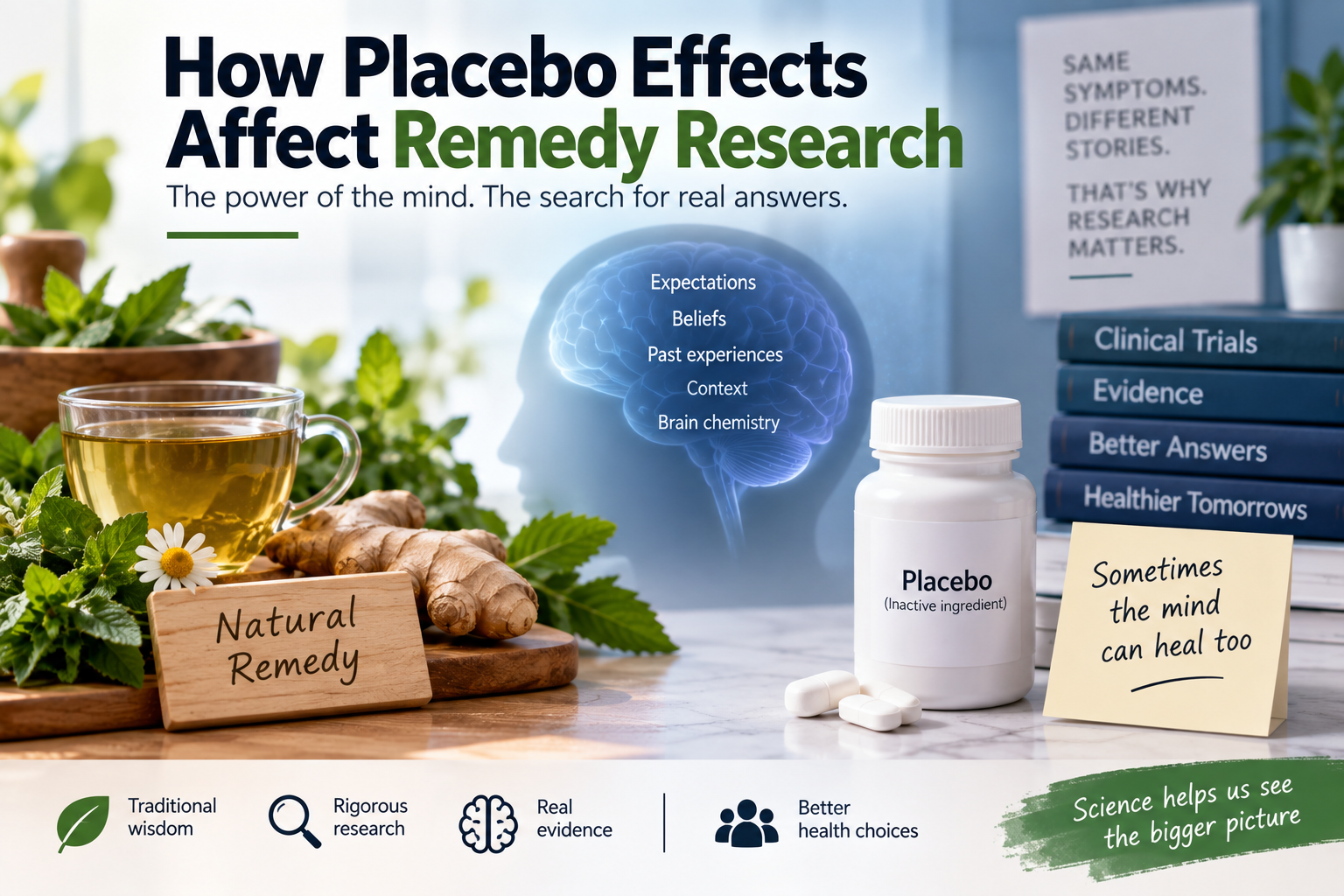
How Placebo Effects Affect Remedy Research
For natural remedies, this distinction can be particularly important. Many remedies have long histories of traditional use, and people may have strong expectations about their effectiveness. Carefully designed research is therefore needed to determine whether improvements are caused by the remedy, the context surrounding its use, natural changes in symptoms or some combination of factors
Read article
Are Natural Remedies Safe During Pregnancy
The safest approach is not to assume that a remedy is harmless simply because it is natural. Instead, its ingredients, dose, purpose, evidence, and potential risks should all be considered.
Read article

Join 10,000+ Readers Building Healthier Habits
Get actionable wellness tips every week plus our newest articles delivered straight to your inbox.