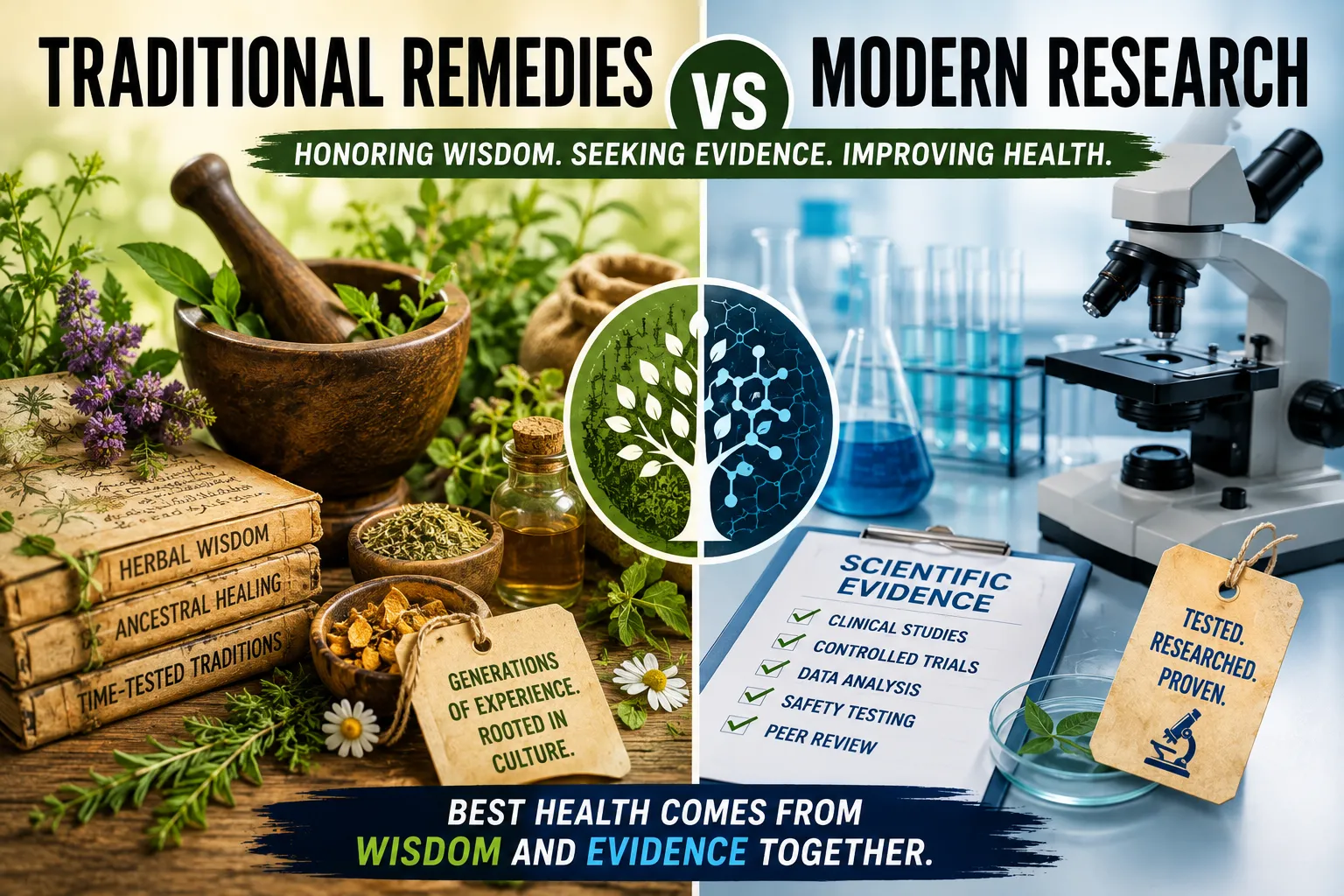

Traditional Remedies Versus Modern Research
Traditional remedies have been used for generations to support health and well-being. From herbal preparations and plant-based treatments to practices passed through families and communities, traditional medicine represents a vast body of knowledge developed across different cultures and historical periods.
Modern research approaches these remedies differently. Rather than relying primarily on historical use or personal experience, researchers attempt to determine whether a particular remedy is effective, how it works, what dose may be appropriate, and what risks it may carry.
The relationship between the two is not necessarily a choice between tradition and science. Increasingly, the important question is how traditional knowledge can be studied carefully while respecting the cultures and communities from which that knowledge originates.
The World Health Organization’s current traditional medicine strategy emphasizes strengthening evidence, improving safety and regulation, and supporting appropriate integration into health systems.
What Are Traditional Remedies?
Traditional remedies are health practices, preparations, and forms of knowledge that have developed within particular cultural or historical settings.
They can include:
- Herbal preparations
- Plant-based medicines
- Traditional dietary practices
- Massage and body-based practices
- Meditation and other mind-body approaches
- Acupuncture
- Traditional healing systems
- Other culturally established approaches to health and well-being
The term covers a remarkably broad range of practices. That means it is difficult to make one blanket statement about whether “traditional remedies” work.
Each remedy needs to be considered individually.
A traditional herb used for one purpose may have evidence supporting a particular effect, while another widely used herb may have little reliable evidence behind its claimed benefits.
The National Center for Complementary and Integrative Health notes that the amount of scientific evidence varies substantially among dietary and herbal supplements.
For a broader framework on how natural and traditional approaches can be assessed, the complete guide to natural remedies evidence examines the distinction between traditional use, scientific evidence, potential benefits, and limitations.
Why Traditional Use Matters
Longstanding use can provide valuable clues.
When communities have used a plant or practice for generations, that history may help researchers identify questions worth investigating. Traditional knowledge can point scientists toward potentially useful plants, preparations, practices, or therapeutic approaches.
But historical use is not the same as clinical proof.
A remedy may have been used for centuries without researchers knowing precisely:
- Which component produces an effect
- What dose is appropriate
- Which people are most likely to benefit
- Which people may experience adverse effects
- Whether the treatment works better than a placebo
- Whether it works for a particular medical condition
- Whether long-term use is safe
Modern research attempts to answer those questions systematically.
What Modern Research Adds
Scientific research provides methods for testing claims under controlled conditions.
Depending on the question, researchers may examine a remedy through:
- Laboratory studies
- Animal studies
- Observational studies in humans
- Clinical trials
- Systematic reviews
- Meta-analyses
Each type of research provides different information.
Laboratory research can help investigate biological mechanisms. Animal studies may provide additional information about potential effects and safety. Human studies can determine whether an observed effect actually translates to people.
The strongest evidence for a particular health claim generally comes from well-designed human research that directly evaluates the intervention and outcome in question.
Why One Study Is Rarely Enough
Health research is rarely settled by a single experiment.
One study may produce a promising result while later studies find a smaller effect or no meaningful benefit.
Researchers therefore look at the broader evidence.
Important questions include:
- Were multiple studies conducted?
- Did they produce similar results?
- Were the studies well designed?
- Were enough participants included?
- Was there an appropriate comparison group?
- Were important limitations acknowledged?
- Does the research apply to the specific product or preparation being used?
The WHO Global Traditional Medicine Centre specifically identifies gaps in the evidence base as an important challenge for safely evaluating traditional medicine.
Traditional Knowledge and Scientific Evidence Are Different Things
One of the biggest misunderstandings in discussions about traditional remedies is treating traditional knowledge and scientific evidence as competitors.
They serve different purposes.
Traditional knowledge can tell us that a particular remedy has been used for a particular purpose and can provide important cultural and historical context.
Scientific research asks whether that use can be demonstrated reliably under defined conditions.
For example, knowing that a plant has traditionally been used for digestive discomfort does not establish exactly which preparation should be used, what dose is appropriate, or whether it is effective for a specific diagnosed digestive disorder.
Those are questions that require additional investigation.
“Natural” Does Not Automatically Mean Safe
A common assumption is that traditional or natural remedies are inherently safer than modern medicines.
That is not necessarily true.
Plants contain biologically active compounds, and those compounds can have beneficial or harmful effects.
NCCIH specifically warns that natural does not necessarily mean safe and notes that some herbs can cause serious harm.
Safety can also depend on:
- Dose
- Preparation
- Duration of use
- Age
- Pregnancy status
- Existing health conditions
- Other supplements being taken
- Prescription medications
- Over-the-counter medicines
This is why evaluating a remedy requires more than asking whether it comes from nature. A detailed natural remedies safety guide provides additional context on risks, interactions, product considerations, and situations where extra caution is appropriate.
Traditional Remedies Can Interact With Medicines
Interactions are an important consideration when evaluating herbal remedies.
Some herbs can alter how medications work, potentially increasing or decreasing their effects.
St. John’s wort is one well-established example. NCCIH reports that it can interact with numerous medications and may reduce the effects of some drugs while increasing the risk of serious side effects with certain antidepressants.
Other herbal products may also interact with medications, although researchers do not have enough reliable information about many potential combinations.
This uncertainty is itself important.
A lack of evidence showing an interaction does not necessarily mean an interaction cannot occur.
The Product Studied May Not Be the Product You Buy
Another important distinction is between a traditional remedy as described in historical sources and a modern commercial product sold under the same or similar name.
The composition can differ.
Differences may involve:
- Plant species
- Growing conditions
- Extraction methods
- Processing
- Concentration
- Dosage
- Additional ingredients
- Storage conditions
NCCIH notes that dietary supplements purchased in stores or online can differ in important ways from products tested in research studies.
Consequently, evidence about one preparation cannot automatically be transferred to every product containing the same general ingredient.
The Importance of Standardization
Researchers need to know what they are actually studying.
For a complex herbal product, that can be challenging because plants may contain numerous compounds, and their concentrations can vary.
NCCIH’s natural product research policies emphasize detailed information about the identity and integrity of natural products so that studies can produce reliable and reproducible findings.
This is one reason modern research may appear more complicated than simply asking whether an herb “works.”
Researchers need to define the intervention precisely.
Traditional Remedies Can Lead to Important Scientific Discoveries
Scientific investigation does not have to dismiss traditional knowledge.
In some cases, traditional practices can provide starting points for scientific discovery.
Researchers can investigate substances used historically and determine whether particular compounds have measurable biological effects.
The process can potentially lead to:
- Identification of active compounds
- New therapeutic candidates
- Better understanding of biological mechanisms
- Improved formulations
- Identification of safety concerns
- More precise dosing information
But the transition from traditional use to scientifically established treatment requires evidence at each stage.
What About Practices Rather Than Herbal Products?
Not all traditional medicine involves consuming herbs.
Some approaches involve physical or psychological practices.
Examples include:
- Acupuncture
- Yoga
- Meditation
- Massage
- Breathing practices
- Other mind-body approaches
These interventions can require different research methods.
The WHO notes that some non-medicinal traditional practices present methodological challenges because conventional randomized controlled trials may not always capture every aspect of how such practices are delivered. It also emphasizes the need for credible research methods capable of evaluating specific uses.
That does not mean these practices cannot be studied. It means researchers may need appropriate study designs for the question being investigated.
Cultural Knowledge Deserves Respect
Scientific evaluation should not erase the cultural context surrounding traditional medicine.
Traditional health knowledge can be deeply connected to communities, languages, history, identity, and local environments.
WHO’s work on traditional medicine emphasizes respect for local heritage, resources, and rights alongside research and evidence.
This is particularly important when traditional knowledge originates from Indigenous or historically marginalized communities.
Scientific investigation and commercialization should therefore consider questions of ownership, recognition, benefit sharing, and ethical research.
Why Evidence Can Change Over Time
A remedy’s scientific reputation is not necessarily permanent.
New research can strengthen an existing claim, weaken it, or reveal that an effect occurs only in certain circumstances.
For example, NCCIH’s evidence summaries show that findings can vary substantially between herbs and between different health outcomes. Some uses may have promising evidence, while others remain inconclusive.
This is a normal part of science.
A responsible health article should therefore distinguish among:
- Evidence that supports an effect
- Evidence that is mixed
- Evidence that is insufficient
- Evidence that suggests no meaningful benefit
- Evidence that raises safety concerns
How Consumers Can Evaluate Traditional Remedies
Anyone considering a traditional remedy can begin with a few practical questions.
What Is the Remedy Supposed to Do?
A broad claim such as “supports overall health” is difficult to evaluate.
A specific claim is easier to investigate.
What Evidence Exists?
Look for credible human research rather than relying exclusively on testimonials or historical use.
Was the Actual Preparation Studied?
Check whether the research involved the same ingredient, preparation, concentration, and dosage.
What Are the Known Risks?
Look for adverse effects, contraindications, and potential interactions.
Could It Interact With Medication?
People taking prescription or over-the-counter medicines should consider discussing the remedy with a healthcare professional.
Is the Evidence Consistent?
A single positive study should be interpreted in the context of the broader evidence.
When Extra Caution Is Appropriate
People should be especially cautious before using herbal or traditional remedies when they:
- Take prescription medications
- Have a chronic medical condition
- Are pregnant or breastfeeding
- Are considering a remedy for a child
- Are preparing for surgery
- Are combining several supplements or herbal products
- Are using a remedy instead of prescribed treatment
NCCIH recommends discussing complementary health products with healthcare providers, particularly because potential interactions and safety concerns may not always be well understood.
Traditional Medicine and Modern Healthcare Can Coexist
The debate is sometimes framed as traditional medicine versus modern medicine.
A more useful approach is to ask how different forms of knowledge can contribute to safe, effective healthcare.
WHO’s current strategy calls for traditional, complementary, and integrative medicine to be appropriately integrated into health systems based on scientific evidence, safety, quality, and effective regulation.
That approach leaves room for traditional knowledge while maintaining standards for patient safety.
A traditional practice with strong evidence can be evaluated on that evidence. A practice with uncertain evidence can remain an area for further research. A practice shown to be unsafe should not be recommended simply because it has a long history.
Readers comparing natural approaches with conventional treatment can also explore natural remedies versus conventional medicine for a broader discussion of how the two approaches can be considered without treating them as automatically interchangeable.
What History Can Teach Modern Research
Traditional remedies offer an enormous historical record of how communities have approached health.
Modern research offers tools for testing specific claims.
The two can work together when each is understood for what it can and cannot establish.
Traditional use can generate questions. Scientific research can investigate those questions. Clinical evidence can help determine appropriate applications. Safety research can identify risks. Regulation and quality controls can help protect consumers.
That process may be slower than a simple claim that an ancient remedy “works,” but it provides a much stronger foundation for informed healthcare decisions.
A Better Way to Bridge Tradition and Science
The most useful question is not whether traditional remedies or modern research should “win.”
The better question is what the evidence actually shows.
A remedy can have a long history of use and still require rigorous testing. A modern study can reveal a useful effect without erasing the cultural knowledge that first drew attention to a remedy.
The strongest approach combines respect for traditional knowledge with careful research, transparent evidence, attention to safety, and honest acknowledgment of uncertainty. That allows promising practices to be investigated without turning tradition alone into proof—and without dismissing potentially valuable knowledge simply because it originated outside modern biomedical research.
Continue Reading
Similar Posts
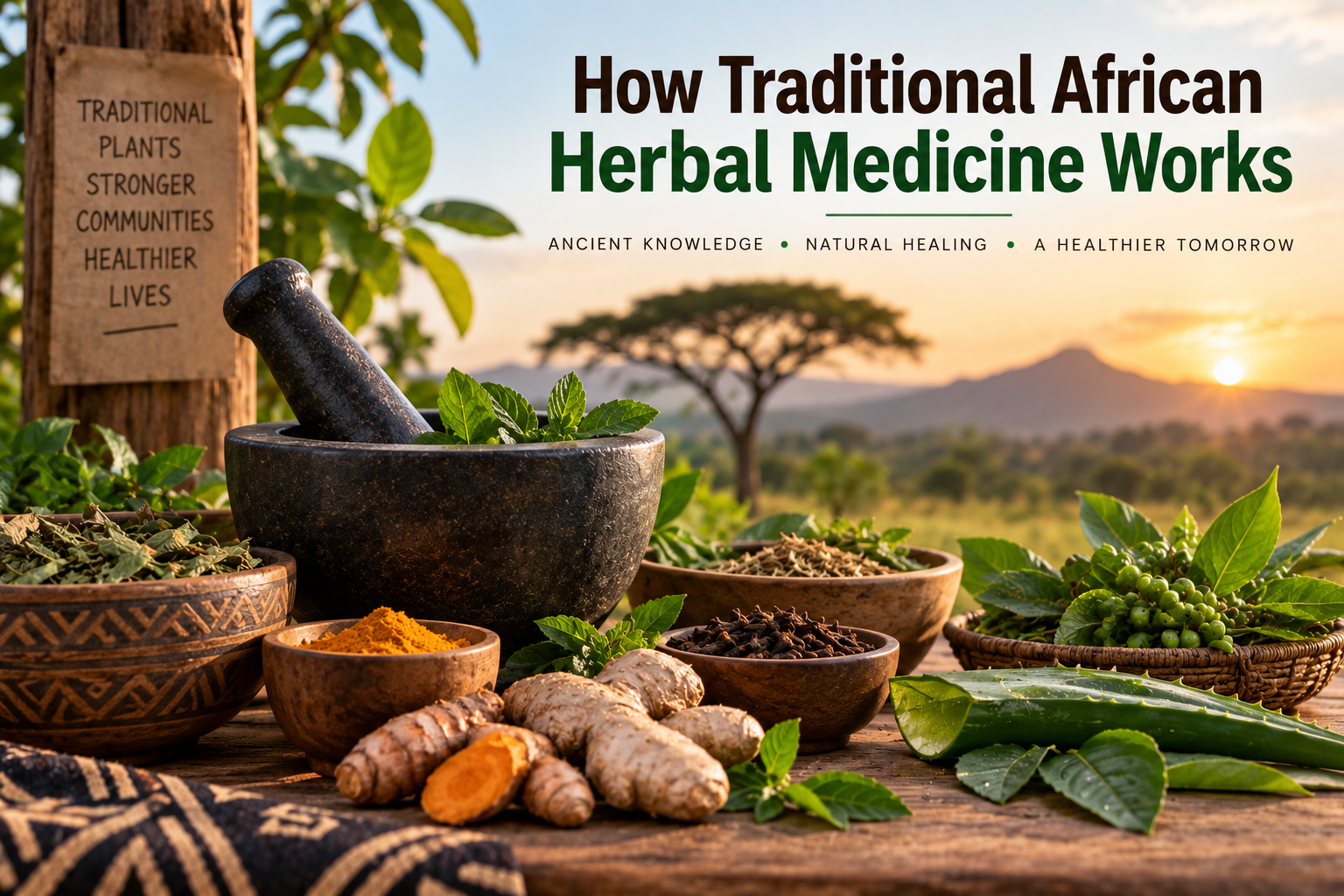
How Traditional African Herbal Medicine Works
Understanding how these remedies work requires looking at both traditional knowledge and modern scientific research. Some medicinal plants contain compounds with biological effects that researchers can study, while evidence for other traditional uses remains limited or uncertain.
Read article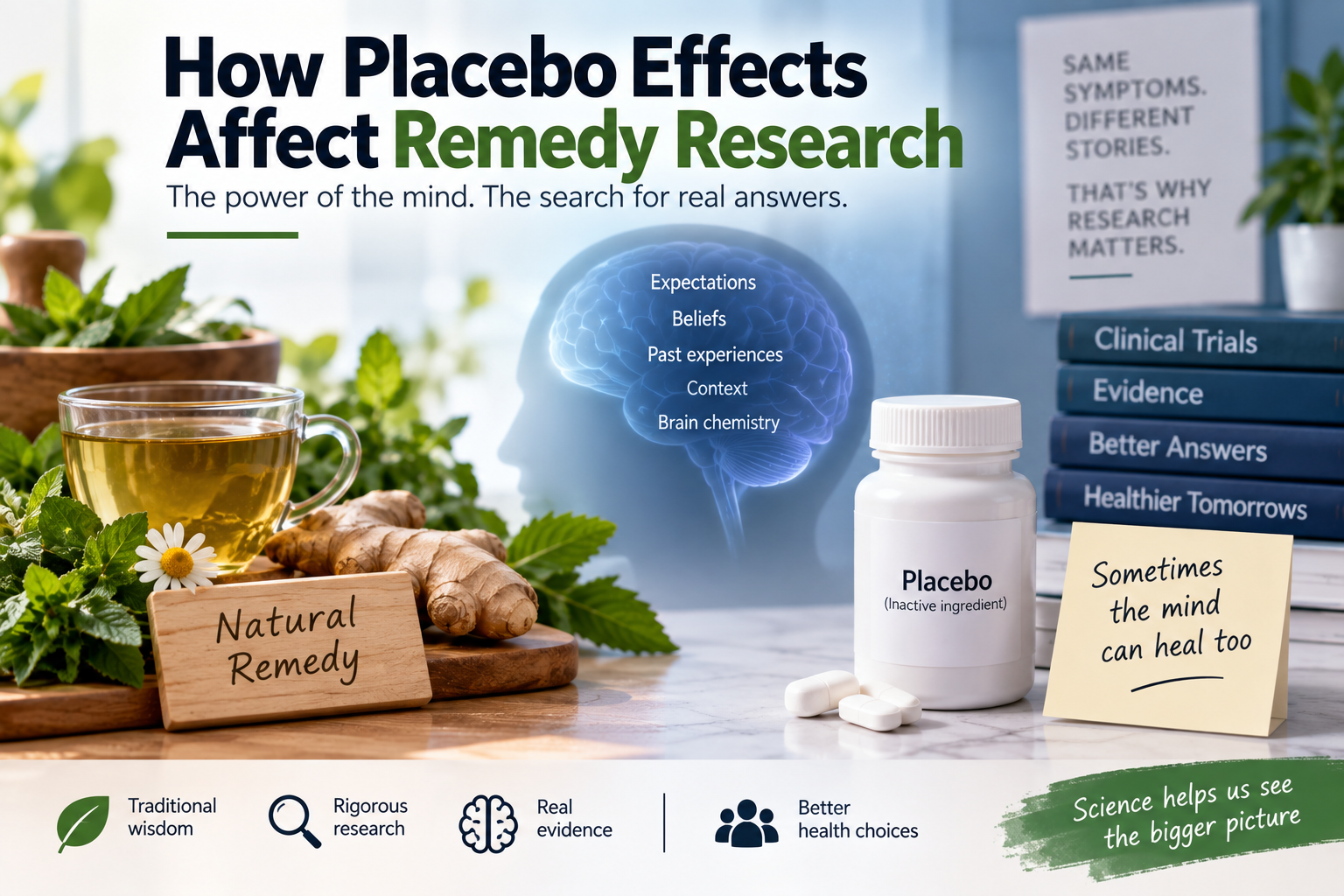
How Placebo Effects Affect Remedy Research
For natural remedies, this distinction can be particularly important. Many remedies have long histories of traditional use, and people may have strong expectations about their effectiveness. Carefully designed research is therefore needed to determine whether improvements are caused by the remedy, the context surrounding its use, natural changes in symptoms or some combination of factors
Read article
Are Natural Remedies Safe During Pregnancy
The safest approach is not to assume that a remedy is harmless simply because it is natural. Instead, its ingredients, dose, purpose, evidence, and potential risks should all be considered.
Read article

Join 10,000+ Readers Building Healthier Habits
Get actionable wellness tips every week plus our newest articles delivered straight to your inbox.