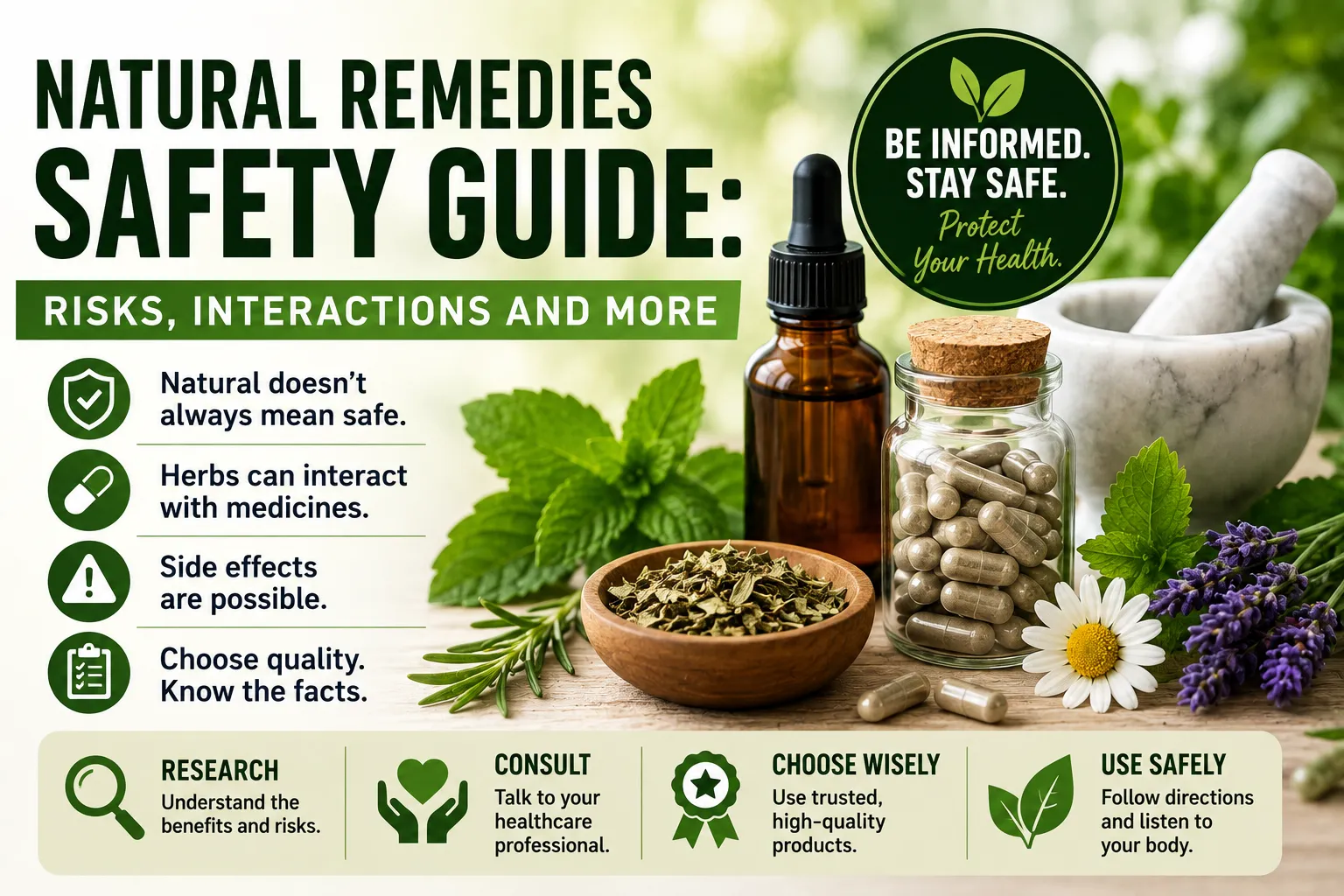

Natural Remedies Safety Guide: Risks, Interactions and More
Natural remedies have been used for centuries, from herbal teas and plant extracts to essential oils, traditional preparations, meditation, massage, and other complementary approaches. Today, many of these products are widely available in pharmacies, supermarkets, health stores, and online.
But the word “natural” does not automatically mean safe.
Some herbs can interact with prescription medicines. Others can cause side effects, affect blood clotting, alter blood sugar, or place stress on the liver. Product quality can also vary, and some supplements have been found to contain ingredients that aren’t listed on their labels.
That doesn’t mean natural remedies are inherently dangerous. It means they should be approached with the same care given to any substance that can affect the body.
For a broader evidence-based framework for assessing natural remedies, see the complete guide to natural remedies evidence.
Here’s how to evaluate natural remedies more safely.
What Counts as a Natural Remedy?
“Natural remedy” is a broad, informal term rather than a precise medical category.
It can refer to products or practices such as:
- Herbal teas
- Herbal capsules and extracts
- Vitamins and minerals
- Essential oils
- Traditional medicines
- Plant-based preparations
- Certain foods used for health purposes
- Massage
- Meditation
- Yoga
- Relaxation techniques
Some of these approaches are nutritional, some are psychological or physical, and others involve biologically active compounds.
The safety profile can therefore be dramatically different from one remedy to another. Each complementary product or practice needs to be considered individually rather than assuming that all “natural” approaches have the same risks.
Why “Natural” Doesn’t Always Mean Safe
The assumption that something derived from a plant must be harmless is one of the biggest misconceptions surrounding natural remedies.
Plants can contain powerful chemicals.
Those chemicals can potentially have useful biological effects—but they can also cause unwanted effects.
For example, some herbs such as comfrey and kava can cause serious liver problems, demonstrating why natural origin isn’t a reliable measure of safety.
Even familiar ingredients can become problematic when consumed in concentrated forms or at doses substantially higher than those normally obtained from food.
The important question isn’t simply:
“Is this natural?”
A better question is:
“What does this product contain, what does it do in the body, and what evidence exists about its safety?”
Herbal Remedies Can Interact With Medicines
One of the most important safety concerns is herb-drug interaction.
A natural product can potentially:
- Increase the effect of a medication.
- Reduce the effect of a medication.
- Increase medication side effects.
- Change how quickly the body processes a medicine.
- Produce an effect similar to the medicine, potentially making the combined effect too strong.
Some herbal supplements can interact with both prescription and over-the-counter medicines.
St. John’s Wort Is a Major Example
St. John’s wort is one of the best-known examples of a natural product with significant interaction potential.
It can alter the way the body processes numerous medicines, potentially reducing their effectiveness. It can also interact with certain antidepressants in ways that may increase the risk of serious serotonin-related effects.
Potential interactions can also involve medications such as some birth-control pills and certain HIV medicines.
This illustrates why a remedy that seems harmless on its own can become risky when combined with another substance.
Other Natural Products With Interaction Concerns
St. John’s wort isn’t the only example.
Potential interactions have been identified involving several commonly used herbs and botanical products, including:
- Asian ginseng
- Green tea extracts
- Goldenseal
- Ginkgo
- Chamomile
- Cranberry
- Echinacea
- Dandelion
The evidence varies considerably from one product to another, and some interactions are better established than others.
For people taking medicines with a narrow therapeutic index, extra caution is important. These are medicines where relatively small changes in drug levels can have significant consequences.
Examples include medicines such as warfarin, digoxin and cyclosporine, where healthcare professionals should know about supplement use.
Natural Remedies Can Have Side Effects
A remedy doesn’t have to interact with another medicine to cause a problem.
It can have direct effects on the body.
Depending on the product, possible adverse effects include:
- Nausea
- Diarrhea
- Stomach discomfort
- Headaches
- Dizziness
- Skin irritation
- Allergic reactions
- Changes in blood pressure
- Changes in blood sugar
- Bleeding problems
- Liver injury
For example, echinacea can cause gastrointestinal symptoms and allergic reactions, which can occasionally be serious.
The possibility of an allergic reaction is particularly important for people with known plant allergies.
Essential Oils Need Special Care
Essential oils are another area where “natural” can create a false sense of security.
Essential oils are highly concentrated plant extracts and are not equivalent to the plants or herbs from which they originate.
Safety depends on:
- Which oil is being used
- How concentrated it is
- Whether it is swallowed or applied to the skin
- How much is used
- Whether it is diluted
- The person’s age and health
- Other medicines being taken
Some essential oils can irritate the skin, and certain oils may be toxic when swallowed in inappropriate amounts.
Using an essential oil externally also doesn’t automatically make it safe for everyone.
Herbal Teas Are Different From Concentrated Extracts
A useful distinction is the difference between food-level exposure and concentrated medicinal products.
An herb used as a culinary ingredient or mild tea may provide a much smaller dose of active compounds than a concentrated capsule or extract.
That means evidence about an ingredient consumed as food cannot automatically be applied to a high-dose supplement.
Some products may be considered reasonably safe in amounts commonly found in foods while their safety at medicinal doses is less certain.
This is one reason dosage matters.
For more context on how herbal teas and infusions differ in preparation and use, see the complete guide to herbal teas and infusions.
Product Quality Is Another Major Concern
Even when an ingredient itself appears reasonably safe, the quality of a particular product can be uncertain.
Dietary supplements can differ from products used in scientific studies. Supplements purchased from stores or online may differ in important ways from products tested in research.
Potential problems include:
- Incorrect ingredient amounts
- Contamination
- Undeclared ingredients
- Substitution with other plants
- Poor manufacturing practices
- Misleading claims
Some supplements marketed for weight loss, sexual health and athletic performance have been found to contain hidden prescription drugs or other compounds.
Be Careful With Strong Health Claims
Marketing can make natural remedies sound more powerful than the scientific evidence supports.
Claims such as:
- “Detoxifies the body”
- “Cures inflammation”
- “Balances hormones”
- “Boosts immunity”
- “Reverses disease”
- “Replaces prescription medicine”
should be approached cautiously.
Evidence can range from strong clinical research to preliminary laboratory studies—or even traditional use without reliable clinical evidence.
A remedy having been used for hundreds of years doesn’t automatically prove that it works for a particular medical condition.
Likewise, a single positive study isn’t necessarily enough to establish effectiveness.
Reliable health advice is generally based on research accumulated over time rather than one isolated study.
Supplements Shouldn’t Automatically Replace Medical Treatment
One of the most serious mistakes is using a natural remedy as a substitute for a proven treatment for a serious illness.
Someone with:
- Diabetes
- High blood pressure
- Heart disease
- Cancer
- Asthma
- Epilepsy
- Serious infection
- Kidney disease
- Liver disease
shouldn’t stop prescribed treatment simply because a supplement is marketed as a “natural alternative.”
Some supplements may have useful roles in specific circumstances, but replacing an established treatment without medical guidance can allow a condition to worsen.
Complementary approaches should be discussed with healthcare professionals, particularly when someone has a medical condition or is receiving conventional treatment.
Natural Remedies During Pregnancy Require Extra Caution
Pregnancy changes the safety equation.
A substance that appears harmless in ordinary circumstances may not have been adequately studied during pregnancy.
Safety information for medicinal amounts of several herbs during pregnancy is limited or uncertain. Herbal supplements should therefore be discussed with a healthcare provider before use during pregnancy.
The same caution applies during breastfeeding.
A product may contain compounds that can cross into breast milk, while safety information for infants may be limited.
Don’t Assume “Traditional Use” Proves Pregnancy Safety
Traditional use isn’t enough to establish that an herbal product is safe during pregnancy.
Pregnant people should discuss herbal supplements, concentrated extracts and other complementary products with an appropriate healthcare professional before using them.
Children Need Different Safety Standards
Children aren’t simply smaller adults.
Their bodies process substances differently, and safety data may be limited for many herbal products.
Parents should be particularly cautious about giving children concentrated herbal products without professional guidance.
For products such as echinacea, allergic reactions can occur and safety information can vary by age and product.
Older Adults May Face Additional Risks
Older adults are more likely to take multiple prescription medicines, increasing the possibility of interactions.
A person taking several medications may also have conditions affecting the liver or kidneys, which can influence how substances are processed.
For this reason, adding an herbal supplement without reviewing the complete medication list can create unexpected risks.
The more medicines and supplements someone takes, the more important it becomes to tell a healthcare professional about everything being used.
Surgery and Natural Remedies
Some supplements can affect bleeding, blood pressure, blood sugar or the way medications work during medical procedures.
Anyone preparing for surgery should provide the surgical team with a complete list of:
- Prescription medicines
- Over-the-counter medicines
- Vitamins
- Herbal supplements
- Other dietary supplements
Don’t assume a supplement is irrelevant simply because it doesn’t require a prescription.
How to Evaluate a Natural Remedy Safely
Before trying a new remedy, use a structured approach.
1. Identify Exactly What It Is
Find out the precise:
- Plant or ingredient name
- Species, when relevant
- Part of the plant used
- Extract type
- Concentration
- Dose
“Herbal blend” isn’t enough information to make a meaningful safety assessment.
2. Find Reliable Evidence
Look for information from reputable medical, academic and public-health organizations.
Pay attention to whether the evidence comes from:
- Human clinical trials
- Systematic reviews
- Observational studies
- Laboratory research
- Traditional use
These aren’t interchangeable forms of evidence.
3. Check Interactions
Review the remedy against every medicine and supplement you take.
This includes over-the-counter products.
Healthcare providers should know about all medicines and supplements, including how often they are taken and at what dose.
4. Check Your Personal Risk Factors
Extra caution may be appropriate if you:
- Are pregnant or breastfeeding
- Have a chronic illness
- Take multiple medications
- Have allergies
- Are preparing for surgery
- Have liver or kidney problems
- Are giving the product to a child
- Are an older adult taking several medicines
5. Start With Evidence, Not Marketing
Ask what the remedy has actually been shown to do.
A product advertised as “clinically proven” may have evidence that applies only to a particular formulation, dose or population.
The exact product matters.
A Simple Natural Remedy Safety Checklist
| Question | Why It Matters |
|---|---|
| What exactly is in it? | Helps identify active ingredients and possible risks |
| What dose am I taking? | Higher doses can produce stronger effects or side effects |
| Does research support the claimed benefit? | Separates evidence from marketing |
| Could it interact with my medicines? | Prevents potentially harmful combinations |
| Is the product quality reliable? | Reduces the risk of contamination or undeclared ingredients |
| Am I pregnant or breastfeeding? | Safety information may be limited |
| Am I preparing for surgery? | Some supplements can affect procedures |
| Do I have a medical condition? | Certain ingredients may worsen existing conditions |
| Is this replacing prescribed treatment? | Avoids delaying effective medical care |
| Have I told my healthcare provider? | Allows risks to be evaluated in context |
What Should You Do If You Have a Bad Reaction?
Stop and seek appropriate medical advice if you develop concerning symptoms after taking a natural remedy.
Potential warning signs can include:
- Difficulty breathing
- Facial or throat swelling
- Severe rash
- Fainting
- Severe vomiting
- Unusual bleeding
- Severe abdominal pain
- Yellowing of the skin or eyes
- Confusion
- Chest pain
A severe allergic reaction or other medical emergency requires immediate medical attention.
If you experience an adverse event associated with a dietary supplement, seek medical care or advice and report the event appropriately.
Natural Does Not Mean Risk-Free
Natural remedies can have a legitimate place in healthcare and everyday wellness, but safety depends on the specific product, dose, person, health condition and other substances being used.
The biggest mistake is treating “natural” as a synonym for “harmless.”
Some natural products have evidence supporting particular uses. Others have limited evidence. Some can interact with medications, cause side effects or create risks during pregnancy, surgery or treatment for chronic diseases. Product contamination and inaccurate labeling are additional concerns.
The safest approach is not to reject every natural remedy—or to believe every claim made about one.
It is to evaluate each remedy critically, check the evidence, consider the person’s individual circumstances and discuss potential risks with a qualified healthcare professional when appropriate.
That approach allows people to explore complementary options without overlooking the most important part of natural health: making informed decisions that protect the body rather than simply trusting the word “natural.”
Continue Reading
Similar Posts
How Traditional African Herbal Medicine Works
Understanding how these remedies work requires looking at both traditional knowledge and modern scientific research. Some medicinal plants contain compounds with biological effects that researchers can study, while evidence for other traditional uses remains limited or uncertain.
Read article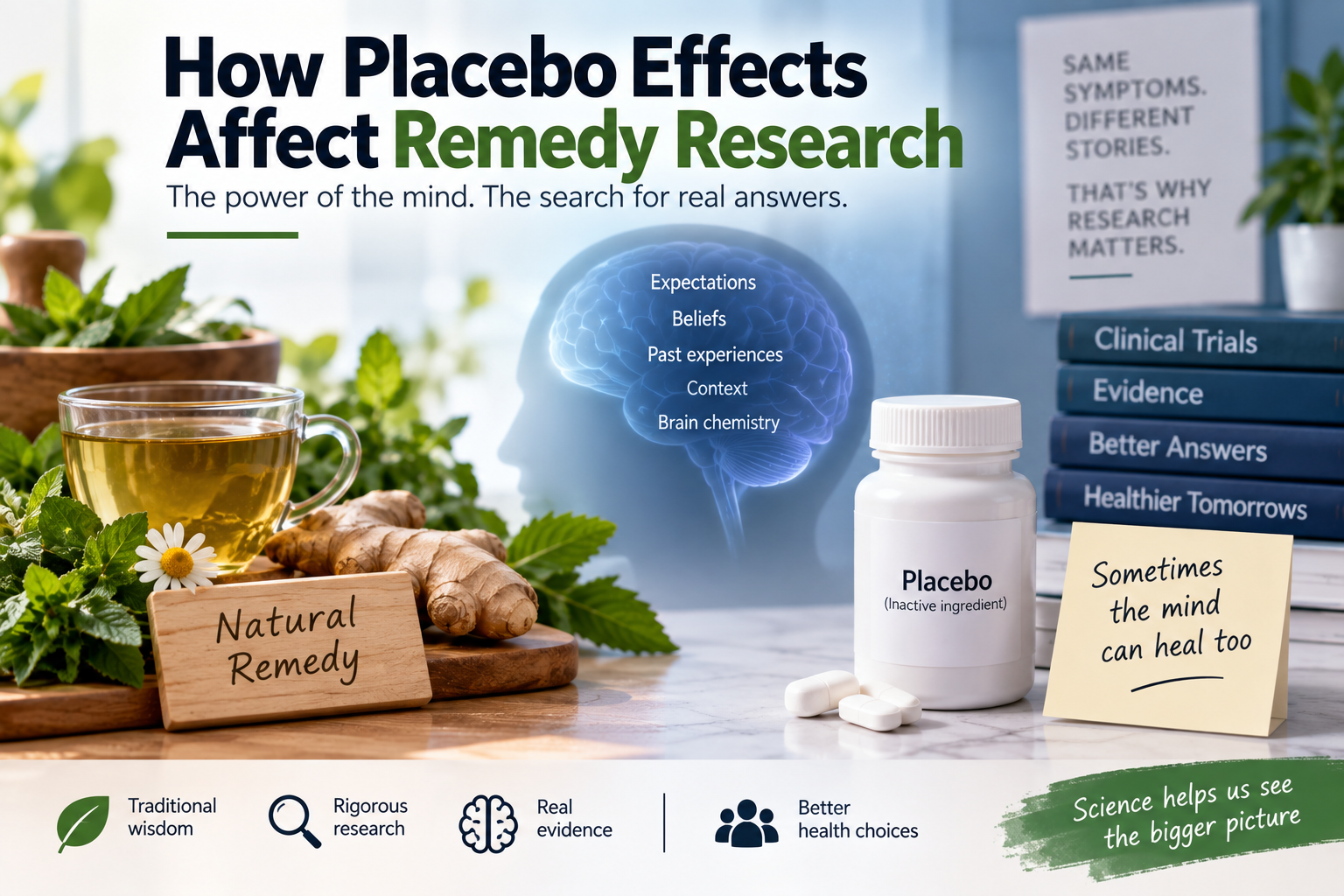
How Placebo Effects Affect Remedy Research
For natural remedies, this distinction can be particularly important. Many remedies have long histories of traditional use, and people may have strong expectations about their effectiveness. Carefully designed research is therefore needed to determine whether improvements are caused by the remedy, the context surrounding its use, natural changes in symptoms or some combination of factors
Read article
Are Natural Remedies Safe During Pregnancy
The safest approach is not to assume that a remedy is harmless simply because it is natural. Instead, its ingredients, dose, purpose, evidence, and potential risks should all be considered.
Read article

Join 10,000+ Readers Building Healthier Habits
Get actionable wellness tips every week plus our newest articles delivered straight to your inbox.