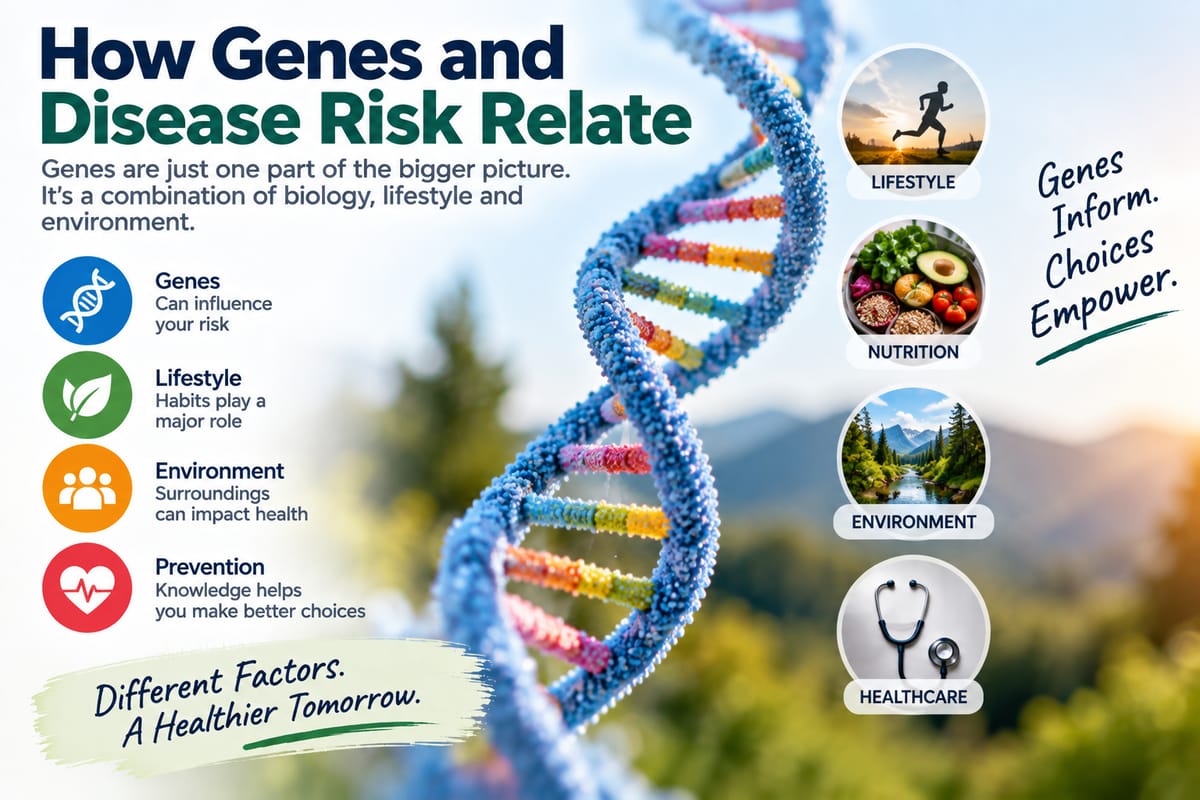

How Genes and Disease Risk Relate
Genes influence many of the characteristics that make each person biologically unique. They also play a role in susceptibility to certain diseases and health conditions. However, having a genetic risk does not necessarily mean that a person will develop a particular disease.
Disease risk usually results from a combination of genetic, environmental, behavioral, and other factors. Understanding how these influences interact can help explain why some conditions appear to run in families while others are affected more strongly by lifestyle or environmental exposures.
Learning about the relationship between genes and disease risk can also provide a clearer perspective on prevention, screening, and the importance of understanding individual risk factors.
What Are Genes?
Genes are sections of DNA that contain instructions involved in building and maintaining the body. They influence the production of proteins and help regulate many biological processes.
People inherit genes from their biological parents, which is why certain characteristics and some health risks can run in families.
However, genes do not operate in isolation. Their effects can be influenced by other genes as well as factors such as nutrition, physical activity, environmental exposures, infections, aging, and other aspects of a person’s circumstances.
This means that genetic information is generally one part of a much larger picture of health.
What Does Genetic Disease Risk Mean?
Genetic disease risk refers to the possibility that particular inherited genetic characteristics may increase a person’s likelihood of developing a health condition.
The relationship can take different forms.
Some genetic variants have a strong association with particular inherited disorders. Other variants may produce a smaller change in risk, especially when combined with other genetic or environmental factors.
There is also an important difference between genetic risk and genetic certainty.
A person can inherit a variant associated with increased risk without necessarily developing the related condition. Conversely, someone without a known family history can still develop a disease.
How Genes Can Influence Health Risks
Genes can affect disease risk in several ways.
They may influence:
- How the body processes certain substances
- How cells grow and divide
- How the immune system responds
- How the body processes medications
- How the body stores or uses energy
- The development and maintenance of tissues
- Susceptibility to particular infections
- Responses to environmental exposures
The effects vary considerably from one condition to another.
Some diseases are strongly influenced by changes in a single gene, while others involve many genes working together alongside environmental and lifestyle factors.
A broader discussion of this relationship can be found in How Genetics Can Influence Individual Health Risks.
Inherited Conditions and Genetic Risk Are Not the Same Thing
Inherited conditions are directly associated with genetic changes that can be passed from parents to children.
Examples include certain single-gene disorders in which a specific genetic change has a major effect on whether the condition develops.
Other diseases have a more complicated pattern.
For conditions influenced by many genes, a person may inherit a combination of variants that slightly increase or decrease susceptibility. These variants may interact with one another and with non-genetic factors.
This distinction is important because not every disease that appears repeatedly within a family is caused by a single inherited genetic mutation.
Why Family History Matters
Family history can provide useful information about potential health risks.
If several close relatives have experienced the same condition, particularly at younger-than-usual ages, it may indicate that genetic factors or shared environmental influences are involved.
Family members also tend to share more than genes. They may have similar:
- Diets
- Living environments
- Physical activity patterns
- Cultural practices
- Occupational exposures
- Access to healthcare
Consequently, a family history does not automatically establish that a condition is genetic.
Instead, it can provide a reason to discuss personal risk with an appropriate healthcare professional.
Genes and Lifestyle Can Work Together
For many common diseases, genetics and lifestyle are interconnected.
A person may have genetic characteristics associated with a higher susceptibility to a condition, while environmental or behavioral factors influence whether that susceptibility becomes clinically significant.
Factors that can affect disease risk include:
- Tobacco exposure
- Alcohol consumption
- Diet
- Physical activity
- Body weight
- Sleep
- Infections
- Environmental pollutants
- Sun exposure
- Occupational hazards
- Chronic stress and other social factors
The relative importance of these factors depends on the particular disease.
Why Genetic Risk Does Not Equal Disease
One of the most important concepts in genetics is that increased risk is not the same as inevitability.
A genetic variant may change the probability of developing a disease without determining what will happen to an individual.
This is particularly relevant for complex conditions influenced by multiple genes and environmental factors.
For example, two people can have similar genetic susceptibility but experience different health outcomes because their environments, behaviors, exposures, and other biological characteristics differ.
The same principle works in reverse: someone without an obvious inherited risk can still develop a disease because many health conditions have multiple contributing causes.
Common Diseases Often Have Multiple Causes
Many common health conditions cannot be explained by genetics alone.
Conditions such as cardiovascular disease, type 2 diabetes, certain cancers, and some neurological disorders can involve combinations of genetic susceptibility, age, environmental exposure, lifestyle, and other biological factors.
A broad overview of different conditions and their characteristics is available in the Complete Guide to Common Health Conditions.
Understanding these conditions in context helps prevent the assumption that a single factor is responsible for every case.
The Role of Gene Variants
Genes can exist in different forms known as variants.
Some variants have little or no noticeable effect. Others can alter how a gene functions or how much of a particular protein is produced.
A variant may be:
- Benign or unlikely to cause disease
- Associated with increased susceptibility
- Associated with reduced susceptibility
- Uncertain in its significance
- Strongly associated with a particular inherited condition
Interpreting genetic variants can be complicated because their effects depend on the specific gene, variant, condition, and available scientific evidence.
This is one reason genetic testing results should not always be interpreted in isolation.
Genetic Testing and Disease Risk
Genetic tests can identify particular genetic variants or patterns that may provide information about disease risk.
Depending on the test, genetic information may be used to:
- Investigate an inherited condition
- Clarify a family history
- Estimate susceptibility to certain diseases
- Support medical decision-making
- Identify potential carrier status
- Help guide certain screening strategies
Not every genetic test answers the same question.
Some tests look for variants associated with a specific condition, while others examine a much larger collection of genetic information.
The meaning of a result depends heavily on what was tested and how the findings are interpreted.
What a Positive Genetic Result Can Mean
A positive result does not necessarily mean that a person currently has a disease.
It may indicate that a particular genetic variant was detected. Depending on the condition and the variant, that finding could mean different things.
Some variants are strongly associated with disease, while others only modestly alter risk.
A healthcare professional or qualified genetics specialist may consider the result alongside family history, symptoms, medical history, and other relevant information.
What a Negative Result Can Mean
A negative genetic test does not always eliminate disease risk.
A test may only examine certain genes or variants. If a condition involves genetic changes that were not included in the test, those changes may not be detected.
In addition, many common diseases are influenced by non-genetic factors.
Therefore, a negative result should not automatically be interpreted as proof that a person cannot develop a particular disease.
Genetic Risk and Disease Prevention
Understanding genetic risk can sometimes support more informed prevention strategies.
Depending on the condition, people with increased risk may benefit from appropriate screening, lifestyle measures, or closer medical monitoring.
However, preventive approaches vary substantially between diseases.
Some genetic conditions may require specialized monitoring, while other conditions may be addressed through broadly useful health behaviors.
The broader principles are explained in How Disease Prevention Works and How to Reduce Health Risks.
Other Risk Factors Matter Too
Genetics is only one category of disease risk.
Other factors can include:
- Age
- Sex
- Lifestyle
- Environmental exposure
- Infection
- Occupation
- Family history
- Existing health conditions
- Medication use
- Social and economic circumstances
These factors can interact rather than operating independently.
For example, a person’s genetic susceptibility may be influenced by exposure to a particular environmental factor, while age or another health condition further changes overall risk.
A broader examination of these influences is available in Understanding Major Risk Factors for Disease.
Why Prevention Should Be Personalized
Because disease risk is influenced by multiple factors, prevention does not have a single formula that applies equally to everyone.
A person’s age, family history, existing conditions, lifestyle, and other circumstances can influence which preventive measures are appropriate.
General healthy habits can be valuable for many people, but some individuals may need additional screening or specialized guidance because of inherited risk.
This is particularly important when several close relatives have experienced the same condition or when a disease has occurred unusually early within a family.
Genetics and Precision Medicine
Advances in genetics have contributed to a more individualized approach to healthcare.
Precision medicine seeks to use information about a person’s biological characteristics to help guide prevention, diagnosis, or treatment.
Genetic information can sometimes help healthcare professionals identify differences in how people may respond to particular medications or treatments.
However, genetics is only one part of precision medicine. Other biological and clinical information may also be relevant.
Why Genetic Information Needs Context
A genetic result can be difficult to interpret without appropriate context.
For example, a variant associated with a small increase in risk may have a very different practical meaning from a variant strongly associated with an inherited disorder.
Similarly, the same genetic finding may have different implications depending on a person’s family history and other health information.
This is why genetic information is generally most useful when considered alongside other evidence rather than treated as an isolated prediction.
Can Disease Risk Change Over Time?
Yes. A person’s overall disease risk can change throughout life.
Some factors, such as inherited genetic characteristics, remain largely constant. Other factors can change considerably.
These may include:
- Age
- Weight
- Physical activity
- Diet
- Smoking status
- Environmental exposures
- Medical conditions
- Medication use
- Screening history
Consequently, having a particular genetic risk does not mean that an individual’s overall health profile remains fixed.
Understanding Risk Without Creating Fear
Learning about genetic disease risk can be useful, but genetic information can also cause unnecessary concern when misunderstood.
A risk-related genetic finding does not automatically predict an individual’s future health.
Likewise, the absence of a known genetic risk does not guarantee that a person will remain free from disease.
The most useful approach is to understand what a genetic result actually measures, how strong the evidence is, and what other factors influence the condition being considered.
Building a Broader Picture of Health
Genes provide important biological information, but they are only one piece of the health puzzle.
Disease risk can emerge from interactions among inherited characteristics, environmental conditions, lifestyle, aging, infections, existing health problems, and many other factors.
Understanding this relationship can help people approach family history, genetic testing, screening, and prevention with more realistic expectations. Rather than viewing genes as a fixed prediction of the future, it is more useful to see genetic information as one part of a broader picture of individual health risk.
Continue Reading
Similar Posts

How Vector Control Prevents Infectious Diseases
Vector control includes a wide range of measures designed to reduce contact between people and disease-carrying organisms.
Read article
How Sun Exposure Affects Skin Cancer Risk
Understanding how sun exposure affects the skin can make prevention more practical. Protection is not about avoiding daylight altogether. Instead, it involves reducing unnecessary ultraviolet exposure and recognizing situations when the skin is particularly vulnerable.
Read article
How Type 2 Diabetes Risk Develops
Understanding how type 2 diabetes risk develops can make the condition easier to prevent or manage. Risk factors do not guarantee that someone will develop diabetes, and some people develop the condition without having an obvious single cause. Instead, risk tends to emerge from the interaction of several factors over time.
Read article

Join 10,000+ Readers Building Healthier Habits
Get actionable wellness tips every week plus our newest articles delivered straight to your inbox.