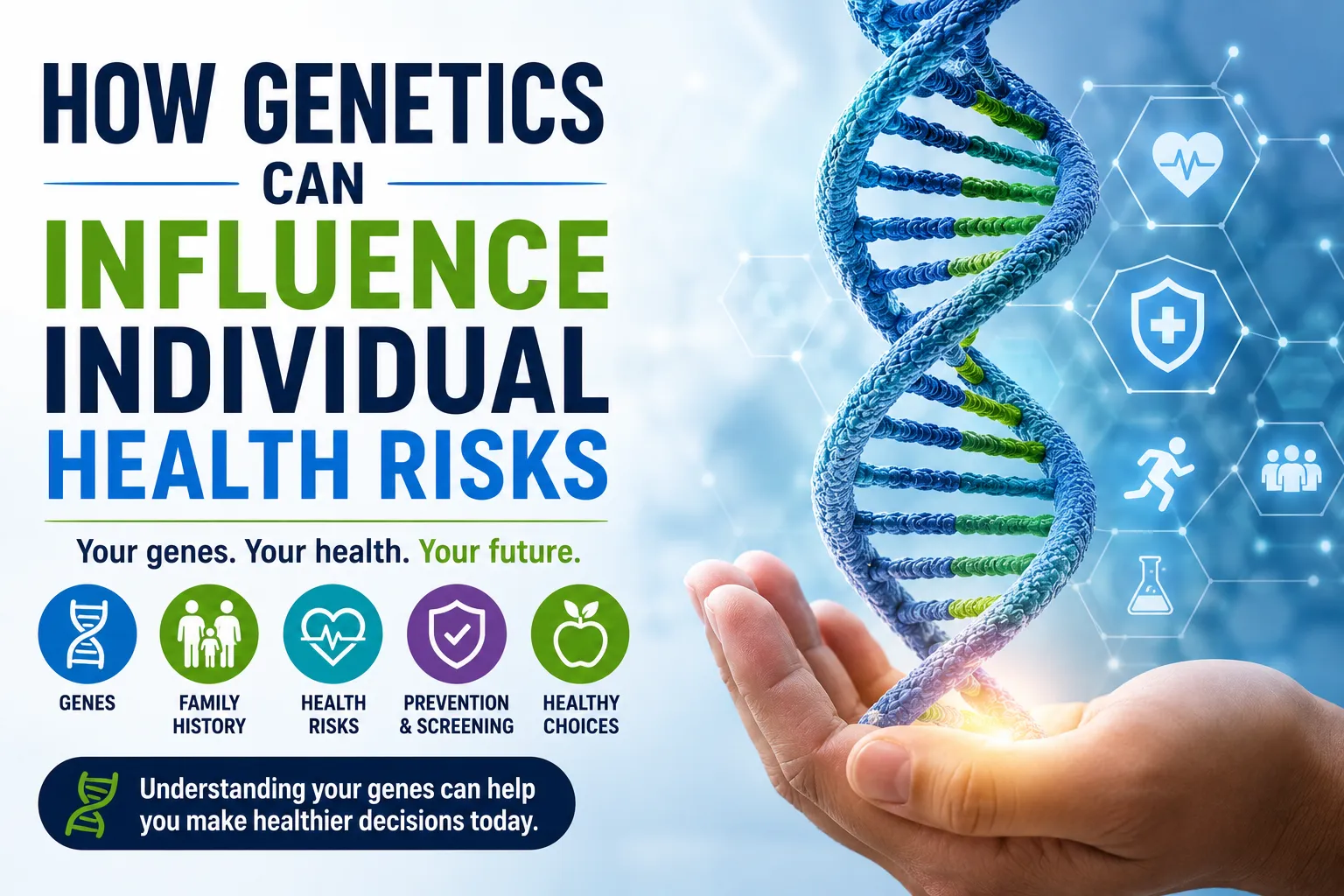

How Genetics Can Influence Individual Health Risks
Two people can follow similar lifestyles, live in similar environments and still have different risks of developing certain diseases. One reason is genetics.
The genes inherited from parents can influence characteristics ranging from blood type and physical traits to the way the body processes certain substances and responds to disease. Genetic differences can also affect an individual’s susceptibility to conditions such as heart disease, diabetes, some cancers and certain inherited disorders.
But genetics rarely tells the entire story.
For most common health conditions, risk is shaped by a combination of genes, lifestyle, environment, age, personal health history and other factors. Having a genetic predisposition does not necessarily mean a person will develop a disease, just as having no obvious family history does not guarantee protection.
Understanding this distinction can make genetic information much more useful—and prevent it from becoming a source of unnecessary fear.
What Are Genes and Why Do They Matter?
Genes are sections of DNA that provide instructions involved in how cells function and how the body develops and operates.
People inherit genetic material from both parents. Small differences in DNA between individuals contribute to natural variation in physical characteristics and can also influence health.
Some genetic variants have relatively large effects. In certain inherited disorders, a change in a particular gene can substantially increase the likelihood of developing a condition.
Other health risks are influenced by hundreds or thousands of genetic variants, each contributing a relatively small effect.
This is why the relationship between genetics and health can be complicated.
Genetics Can Increase Risk Without Determining Your Future
One of the most important concepts in genetics is risk versus certainty.
A genetic variant associated with a disease may increase someone’s probability of developing that disease without guaranteeing that it will happen.
Having genes associated with disease does not necessarily mean a person will develop the condition because factors such as physical activity, diet, smoking and other environmental influences can also affect risk.
This means genetic information should generally be interpreted as part of a larger health picture.
For example, someone may inherit genetic factors associated with increased cardiovascular risk while also having lifestyle and medical factors that either increase or decrease their overall risk.
Understanding the broader risk factors for disease can help put genetic susceptibility into perspective.
Family History Is a Useful Genetic Clue
You do not necessarily need a genetic test to learn something important about your inherited health risks.
Your family health history can provide valuable clues.
If several close relatives have experienced the same condition, particularly at unusually young ages, it may indicate that inherited factors are contributing to the family’s health pattern.
Family history can be especially informative when:
- Multiple close relatives have the same condition
- A disease appears earlier than expected
- Several related conditions occur within a family
- A relatively uncommon disease appears repeatedly
- A particular condition occurs in both men and women in unusual patterns
Healthcare professionals can use this information when assessing whether additional screening, genetic counseling or genetic testing may be appropriate.
Family history can also affect decisions about essential health screenings for men and women, particularly when a condition appears repeatedly or unusually early within a family.
Family History Is Not the Same as Genetics
A family may share genes, but relatives also tend to share environments, habits, cultural practices and socioeconomic circumstances.
Consider a family in which several people develop type 2 diabetes.
Genetic factors could contribute to the pattern. But family members may also share eating habits, activity levels and other environmental influences.
Family health history therefore reflects both genetic and non-genetic influences.
That is why a family history of disease should be viewed as an important risk signal, rather than proof that a particular gene is responsible.
Some Conditions Have Stronger Genetic Components
Genetics plays a particularly important role in certain inherited conditions.
Examples can include some forms of:
- Familial hypercholesterolemia
- Hereditary breast and ovarian cancer
- Lynch syndrome
- Cystic fibrosis
- Sickle cell disease
- Huntington’s disease
The precise inheritance pattern differs between conditions.
Some disorders result from changes in a single gene, while others involve more complicated combinations of genetic and environmental factors.
This distinction matters because the implications of discovering a disease-associated genetic variant can vary considerably from one condition to another.
Genetics and Heart Health
Cardiovascular disease is influenced by many factors, including age, blood pressure, cholesterol, smoking, physical activity, diet and genetics.
Certain inherited conditions can substantially increase cardiovascular risk.
Familial hypercholesterolemia, for example, can cause unusually high levels of LDL cholesterol and increase the risk of cardiovascular disease.
Family history can therefore be an important reason to discuss cholesterol testing and other preventive measures with a healthcare professional.
At the same time, genetic susceptibility does not make lifestyle choices irrelevant.
Healthy eating, regular physical activity, avoiding tobacco and managing conditions such as high blood pressure can still play an important role in reducing cardiovascular risk.
Genetics and Type 2 Diabetes
Type 2 diabetes illustrates how genes and environment can interact.
Having a close family member with type 2 diabetes is associated with increased risk, but the condition is not determined by family history alone.
Body composition, physical activity, diet, age and other factors also contribute.
Type 2 diabetes is a multifactorial condition in which many genes interact with environmental and behavioral factors.
This is a useful example of why the phrase “it runs in my family” should not be interpreted as “there is nothing I can do about it.”
Knowing that a condition runs in a family can instead encourage earlier attention to modifiable risk factors.
Genetics and Cancer Risk
Cancer is another area where genetics can influence individual risk.
Most cancers are not caused by a single inherited mutation. However, some inherited genetic variants can significantly increase susceptibility to particular cancers.
BRCA1 and BRCA2 are well-known examples. Certain inherited variants can increase the risk of breast, ovarian and other cancers.
Other inherited conditions, including Lynch syndrome, can increase susceptibility to colorectal and several other cancers.
When a strong family history suggests a possible inherited cancer syndrome, healthcare professionals may recommend genetic counseling and, when appropriate, genetic testing.
Importantly, having an inherited cancer-associated variant does not mean cancer is inevitable.
It can instead provide information that may influence screening, prevention and medical decision-making.
Genetics Can Influence Mental Health Risk Too
Genetic factors can also contribute to susceptibility to some mental health conditions.
However, the genetics of mental health are particularly complex.
Most genetic variants do not directly cause mental disorders. Some uncommon variants can increase risk, while many conditions involve numerous genetic and non-genetic influences.
Having a close relative with a mental health condition may therefore increase risk without determining an individual’s future.
Environmental experiences, stress, social circumstances and other biological factors can also influence mental health.
Genes Can Affect How People Respond to Medicines
Genetics does not only influence disease risk.
It can also affect how someone’s body processes certain medications.
This field is known as pharmacogenomics.
Genetic differences can sometimes influence whether a particular medicine is metabolized quickly or slowly, whether someone is more likely to experience certain side effects or whether a particular treatment is likely to work well.
Genetic testing can therefore be useful in selected clinical situations when healthcare professionals are trying to choose or adjust treatment.
It is not, however, necessary or appropriate for every medication or every person.
Genes Can Interact With the Environment
Genes do not operate in isolation.
The environment can influence whether and how strongly certain genetic tendencies affect health.
Factors such as:
- Diet
- Physical activity
- Tobacco exposure
- Alcohol use
- Air pollution
- Occupational exposures
- Sleep
- Stress
- Infections
- Socioeconomic conditions
can interact with biological characteristics to influence health outcomes.
This helps explain why people with similar genetic backgrounds can have different health experiences.
Studies of identical twins are particularly useful because identical twins share much of their DNA, yet can still develop different health conditions. Environmental and lifestyle differences help researchers understand the interaction between genetics and health.
This broader interaction between biology and surroundings is also important when considering environmental factors that affect human health and wellbeing.
What Is a Genetic Variant?
People sometimes use terms such as “mutation” and “gene variant” as though they always mean something harmful.
That is not the case.
A genetic variant is a difference in DNA sequence. Some variants have no meaningful effect. Some contribute to normal human differences. Others can increase or decrease susceptibility to a particular condition.
The effect depends on the specific variant, the gene involved and the biological context.
Modern genetics therefore requires interpretation rather than simply labeling every difference as good or bad.
What Can Genetic Testing Tell You?
Genetic testing can examine DNA for particular variants associated with diseases, traits or medication responses.
Depending on the test, it may help:
- Diagnose an inherited disorder
- Identify increased risk for certain diseases
- Clarify a family health pattern
- Guide some treatment decisions
- Determine whether someone carries a particular inherited variant
However, different genetic tests answer different questions.
A test designed to investigate a specific inherited condition is not equivalent to a broad consumer ancestry or health test.
The usefulness of a result depends heavily on the test’s purpose and how the result is interpreted.
Genetic Testing Is Not Right for Everyone
It can be tempting to assume that knowing more about your DNA is always better.
In reality, genetic testing can sometimes produce uncertain or difficult-to-interpret results.
A test may identify a variant whose significance is not fully understood. It may also reveal information that affects other family members.
For these reasons, genetic counseling can be valuable in situations where an inherited condition may be involved. Genetic counselors can review personal and family history, explain possible outcomes and help determine whether testing is appropriate.
Be Careful With Direct-to-Consumer Genetic Tests
Mail-in genetic testing has made DNA analysis widely accessible.
These services can provide interesting information, but health-related results should be interpreted cautiously.
Health-related genetic reports can vary in scientific support and may be misleading, particularly when they attempt to estimate risks for complex conditions.
A consumer test should not automatically be treated as a medical diagnosis.
If a result suggests an increased risk of a serious condition, discuss it with a qualified healthcare professional before making medical decisions.
Genetic Results Can Have Family Implications
Your genetic information does not necessarily concern only you.
Because relatives share genetic material, discovering an inherited variant may provide useful information for parents, siblings, children or other relatives.
For example, if testing identifies a disease-associated variant in one family member, other relatives may be offered genetic counseling or testing depending on the condition.
This can create opportunities for earlier screening or preventive care.
It can also raise emotional and privacy considerations, which is another reason professional guidance can be valuable.
What If You Have a Strong Family History?
A strong family history does not mean you should assume the worst.
Instead, collect as much reliable information as possible.
Try to find out:
- Which relatives had the condition
- Their relationship to you
- Their age when diagnosed
- Whether the diagnosis was confirmed
- Whether multiple relatives were affected
- Whether anyone developed the condition unusually early
- Whether genetic testing was performed
Share this information with your healthcare professional.
Family history can help clinicians determine whether you may benefit from earlier or more frequent screening, lifestyle interventions or genetic counseling.
What If You Don’t Know Your Family History?
Not knowing your family history does not mean you are free of genetic risk.
Some people have limited information because of adoption, estrangement, early deaths in the family or incomplete medical records.
You may also have an inherited variant even if nobody in your known family has been diagnosed with the associated condition.
Your personal health history and appropriate screening therefore remain important.
A missing family history should not become a reason to avoid preventive healthcare.
Genetics Can Inform Prevention
One of the most useful aspects of understanding genetic risk is that information can sometimes lead to action.
If someone has a higher-than-average risk for a particular condition, healthcare professionals may recommend:
- Earlier screening
- More frequent monitoring
- Lifestyle changes
- Preventive medication
- Genetic counseling
- Testing of relevant family members
- Other risk-reduction strategies
The appropriate response depends entirely on the condition and the individual’s circumstances.
The important point is that genetic risk can sometimes create an opportunity for earlier intervention rather than simply predicting disease.
This fits into the broader principle of how disease prevention works and how health risks can be reduced.
Healthy Habits Still Matter
A genetic predisposition does not make healthy behavior pointless.
For many complex conditions, lifestyle and environmental factors interact with inherited risk.
Regular physical activity, a nutritious diet, avoiding tobacco, maintaining appropriate medical care and addressing known risk factors can all contribute to better health.
Likewise, a person without a known family history should not assume they are protected.
Genes are one piece of the health puzzle.
Genetics and Personalized Healthcare
As genetic science develops, healthcare is becoming increasingly capable of taking individual biological differences into account.
Personalized or precision medicine can use genetic information alongside other data to help determine which prevention or treatment strategies may be most appropriate for particular patients.
But personalized healthcare is not simply about sequencing someone’s entire genome.
Personalized medicine also depends on personal health information, lifestyle, environment and other factors.
The future of individualized healthcare is therefore likely to involve combining genetic information with a much broader picture of a person’s health.
How to Use Genetic Information Wisely
Genetic information can be powerful, but it should be interpreted carefully.
A useful approach is to:
- Know your family health history.
- Discuss significant patterns with a healthcare professional.
- Ask whether genetic counseling is appropriate.
- Understand what a particular genetic test can and cannot tell you.
- Avoid treating risk estimates as predictions of certainty.
- Continue paying attention to modifiable health factors.
- Use clinically appropriate screening recommendations.
- Be cautious about acting on direct-to-consumer genetic results without professional interpretation.
This approach turns genetics into a tool for informed decision-making rather than a source of unnecessary anxiety.
Your Genes Are Part of the Story, Not the Whole Story
Genetics can influence individual health risks in profound ways, from inherited disorders caused by particular gene variants to the complex combination of genes that contributes to common diseases.
But DNA is not a crystal ball.
For most health conditions, risk emerges from an interaction between genetics, lifestyle, environment, age, personal health history and other biological factors.
That is why knowing your family health history can be so valuable. It can reveal patterns worth discussing with a healthcare professional and, in some cases, lead to earlier screening or genetic evaluation.
The most useful way to think about genetics is not as a fixed prediction of what will happen, but as information that can help people and healthcare professionals understand risk, make better-informed decisions and take appropriate steps to protect health over time.
Continue Reading
Similar Posts

How Communication Supports Sexual Health
Whether people are discussing contraception, sexual preferences, STI testing, fertility, consent, or changes in their health, clear communication can play an important role in making sexual relationships safer and healthier.
Read article
Why Health History Matters for Women
For women, keeping an accurate health history can be especially valuable because health needs can change significantly throughout different stages of life.
Read article
How Estrogen Changes During Menopause
Understanding how estrogen changes can make many of the physical and emotional changes associated with this stage of life easier to recognize and discuss with a healthcare professional.
Read article

Join 10,000+ Readers Building Healthier Habits
Get actionable wellness tips every week plus our newest articles delivered straight to your inbox.