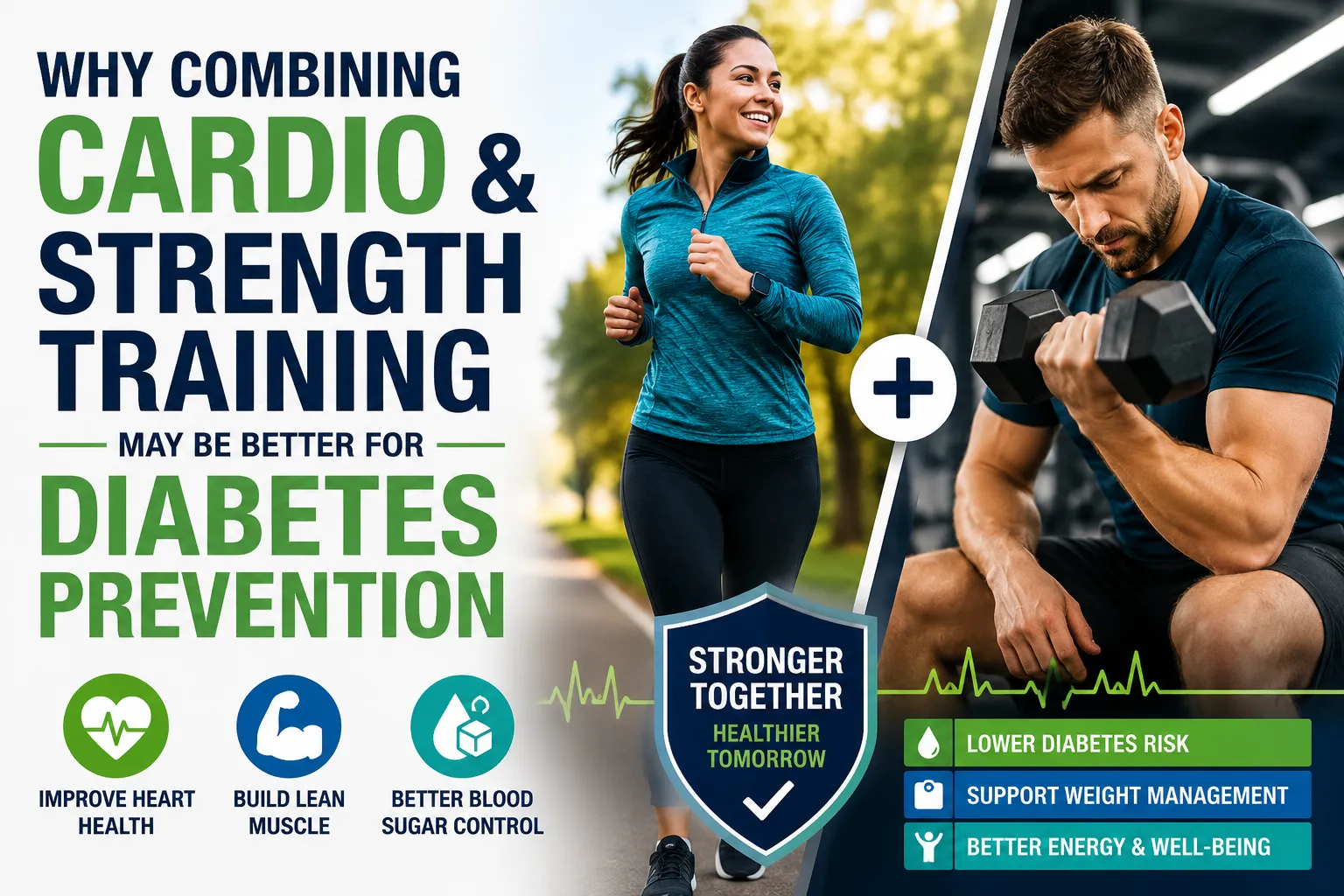

Why Combining Cardio and Strength Training May Be Better for Diabetes Prevention
Regular exercise has long been associated with better metabolic health, but the conversation around diabetes prevention is becoming more nuanced. Instead of asking whether people should choose cardio or strength training, researchers are increasingly interested in what happens when the two forms of exercise are combined.
Aerobic exercise—such as brisk walking, cycling, swimming or jogging—can improve cardiovascular fitness and help the body use glucose more effectively. Resistance training, meanwhile, helps build and maintain muscle, which plays an important role in glucose metabolism.
Using both approaches may provide complementary benefits.
Research in people with prediabetes and type 2 diabetes suggests that combined aerobic and resistance exercise can improve several measures of metabolic health. A 2025 systematic review and network meta-analysis of randomized trials in people with prediabetes found that combined aerobic-resistance exercise produced the largest reduction in fasting blood glucose among the exercise approaches analyzed, although different forms of exercise performed better for some other glucose measures.
That does not mean combined training is a guaranteed way to prevent diabetes. But it does help explain why a balanced exercise routine may be a particularly useful strategy for people trying to lower their long-term risk.
**Why Physical Activity Matters for Diabetes Risk**
Type 2 diabetes develops when the body becomes less effective at regulating blood glucose. Insulin resistance is an important part of this process, and lifestyle factors—including physical inactivity—can contribute to increasing risk.
Regular physical activity can improve the body’s ability to use glucose and can also support healthy body weight, blood pressure and cholesterol levels.
The U.S. Centers for Disease Control and Prevention recommends regular physical activity as part of diabetes prevention and notes that lifestyle changes can help people with prediabetes prevent or delay type 2 diabetes.
Exercise is therefore not simply about burning calories. It can affect several of the underlying factors associated with metabolic health.
**What Cardio Does for the Body**
Cardio, or aerobic exercise, involves activities that keep large muscle groups working continuously for an extended period.
Common examples include:
- Brisk walking
- Jogging
- Cycling
- Swimming
- Dancing
- Hiking
- Rowing
- Aerobic classes
During aerobic activity, muscles need energy and draw on glucose and other fuel sources. Regular aerobic exercise can improve cardiovascular fitness and insulin sensitivity.
For someone trying to become more active, even relatively simple activities can count.
A brisk walk after dinner, for example, may be much easier to maintain than an ambitious exercise program that requires an hour at the gym every day.
The CDC specifically suggests starting with manageable goals, such as a 10-minute walk after dinner, rather than assuming exercise has to involve long gym sessions.
**What Strength Training Adds**
Resistance training involves making muscles work against an external resistance.
That resistance can come from:
- Free weights
- Resistance bands
- Weight machines
- Bodyweight exercises
- Everyday objects
- Other forms of resistance equipment
Strength training encourages muscles to adapt and become stronger. It can also help preserve or increase muscle mass.
That matters for metabolic health because skeletal muscle is a major site for glucose uptake.
Exercises such as squats, lunges, rows, presses and other resistance movements can therefore complement aerobic activity in ways that a cardio-only routine may not fully address.
**Muscle Is More Than a Source of Strength**
Muscle is often associated primarily with physical strength and appearance, but it also plays an important metabolic role.
When muscles contract, they require energy. Physical activity can increase the movement of glucose from the bloodstream into muscle cells.
Over time, resistance training can help maintain muscle mass and physical function.
This becomes particularly relevant as people age, when maintaining muscle can become more challenging.
For someone focused on diabetes prevention, strength training can therefore be viewed as part of a broader metabolic-health strategy rather than simply a way to build bigger muscles.
**Cardio and Strength Training Work Through Different Pathways**
One reason combining the two forms of exercise may be useful is that they provide overlapping but distinct benefits.
Aerobic training can improve:
- Cardiovascular fitness
- Endurance
- Insulin sensitivity
- Energy expenditure
- Exercise capacity
Resistance training can support:
- Muscle strength
- Muscle mass
- Glucose utilization
- Physical function
- Body composition
The combination creates a more comprehensive exercise stimulus.
Rather than choosing between endurance and strength, people can train both.
**Research Is Increasingly Supporting the Combined Approach**
Evidence from studies of people who already have type 2 diabetes provides useful insight into why combined training may be beneficial.
A 2024 systematic review and meta-analysis examined combined aerobic and resistance training in people with type 2 diabetes and overweight or obesity. The researchers reported improvements across measures including glycemic control, blood pressure, cardiorespiratory fitness and quality of life.
Another recent meta-analysis of randomized trials found that combined resistance and aerobic exercise improved several metabolic measures compared with aerobic exercise alone, including fasting blood glucose and blood lipid measures, although not every outcome showed a significant advantage.
These studies primarily involve people with diabetes rather than healthy populations, so they should not be interpreted as direct proof that a specific workout prevents diabetes. They do, however, provide evidence for the biological and metabolic benefits of combining exercise types.
**Evidence From People With Prediabetes Is Particularly Relevant**
Prediabetes represents an important opportunity for prevention because blood glucose is elevated but has not reached the diagnostic threshold for type 2 diabetes.
A 2025 network meta-analysis examined different exercise approaches among people with prediabetes. The analysis found that combined aerobic and resistance exercise produced the largest reduction in fasting blood glucose among the modalities studied. Aerobic exercise alone produced the largest reductions for some other glucose measures, including two-hour post-meal glucose and HbA1c.
That distinction is important.
It suggests that there may not be one universally superior form of exercise for every measure of glucose control.
Instead, different types of exercise may offer different advantages.
**Weight Management Is Another Piece of the Puzzle**
Exercise can also contribute to diabetes prevention indirectly through its effects on body composition and weight management.
Excess body weight is an important risk factor for type 2 diabetes, although diabetes can develop in people at many different body sizes.
Regular physical activity can increase energy expenditure, support muscle retention and help people maintain healthier body composition.
The landmark Diabetes Prevention Program found that a lifestyle intervention focused on weight loss and increased physical activity reduced the risk of developing type 2 diabetes by 58% among adults at high risk. The CDC says participants were still about one-third less likely to develop diabetes after 10 years, and those who eventually developed diabetes delayed its onset by about four years.
For a broader look at how sustainable weight management fits into diabetes-risk reduction, see the complete guide to healthy weight management.
The lesson is broader than simply “exercise more.” Sustainable changes involving physical activity, eating habits and weight management can have a substantial effect on diabetes risk.
**You Do Not Have to Choose One or the Other**
Someone who enjoys running does not need to abandon it for strength training.
Likewise, someone who enjoys lifting weights does not necessarily need to become a long-distance runner.
A balanced program can include both.
For example, a weekly routine might combine:
- Brisk walking or cycling several days a week
- Two or more strength-training sessions
- Short walks after meals
- Recreational activities such as hiking or dancing
The exact schedule can be adjusted according to fitness level, age, preferences, available time and medical considerations.
The most effective exercise routine is often the one a person can maintain consistently.
For more context on how exercise can fit into a sustainable approach to weight and metabolic health, see Exercise for Weight Management Remains a Top Health Priority.
**Short Sessions Can Still Be Useful**
One barrier to exercise is the belief that every workout needs to last an hour.
That is not necessarily the case.
Physical activity can be accumulated throughout the day.
A person might take a 10-minute walk in the morning, another short walk after lunch and a longer session in the evening.
Breaking activity into manageable periods can make regular movement easier to incorporate into a busy schedule.
The CDC emphasizes that people do not need to spend hours in the gym to benefit from physical activity.
Research and practical experience also suggest that shorter, manageable workouts can have a useful place in a sustainable routine. For example, Could One Workout a Week Be Enough? explores what research says about the potential benefits of very low-frequency exercise.
**Walking Can Be an Excellent Starting Point**
For someone who has been inactive, walking is often one of the simplest ways to begin.
It requires little equipment and can be adapted to different fitness levels.
A beginner might start with a comfortable walk and gradually increase either the duration or pace.
Over time, brisk walking can become a meaningful source of aerobic activity.
Adding strength exercises later can create a more balanced routine.
The goal does not have to be an intense transformation in a matter of weeks. Consistency is more important.
**Strength Training Does Not Have to Mean Heavy Weights**
Some people avoid resistance training because they associate it with bodybuilding or heavy gym equipment.
Strength training can be much simpler.
Bodyweight movements such as squats, wall push-ups, step-ups and modified lunges can provide resistance.
Resistance bands can also be inexpensive and adaptable.
As strength improves, the resistance or difficulty can gradually increase.
For older adults or people with mobility limitations, exercises can be modified to match their abilities.
**A Sample Balanced Weekly Routine**
A general exercise schedule might look like this:
| Day | Activity |
|---|---|
| Monday | 30-minute brisk walk + strength exercises |
| Tuesday | Walking or cycling |
| Wednesday | Strength training + short walk |
| Thursday | Brisk walking |
| Friday | Strength training + light cardio |
| Saturday | Longer recreational activity |
| Sunday | Rest or gentle movement |
This is only an example, not a medical prescription.
Someone starting from a sedentary lifestyle may need considerably less activity initially and can gradually build up.
**What About High-Intensity Exercise?**
Higher-intensity exercise can improve fitness efficiently, but it is not necessary for everyone.
Recent research in people with type 2 diabetes found that a relatively low-volume combined high-intensity interval and resistance program improved glycemic control and body composition over eight weeks. However, the improvements were not maintained at 12 months when adherence to self-directed exercise was low.
For people interested in how very short, high-intensity sessions may fit into a broader exercise strategy, Once-a-Week HIIT May Help Reduce Body Fat provides a related look at the potential benefits and limitations of low-frequency HIIT.
That finding highlights an important principle: **the best exercise program is not necessarily the most intense one—it is one that can be sustained.**
Someone who can consistently walk, cycle and strength train may ultimately gain more from that routine than from a demanding program they abandon after several weeks.
**Consistency May Matter More Than Perfection**
Exercise benefits can fade when regular activity stops.
The 2024 randomized trial mentioned above demonstrated this clearly: participants improved after supervised training, but many of those improvements were not maintained once adherence declined during the self-directed period.
This is why building habits can be more important than pursuing an ideal workout.
A sustainable routine might involve:
- Activities you enjoy
- Realistic workout durations
- Gradual progression
- Rest days
- Flexible scheduling
- Social support
- Goals that focus on consistency
Exercise should become part of normal life rather than a temporary challenge.
**Nutrition Still Matters**
Exercise is only one part of diabetes prevention.
Eating patterns, body weight, sleep, stress, alcohol consumption and other lifestyle factors can also influence metabolic health.
The Diabetes Prevention Program’s results demonstrate the potential of a broader lifestyle approach rather than relying on exercise alone.
For people at elevated risk, combining regular physical activity with nutritious eating and appropriate weight management may offer a more comprehensive strategy.
**People With Prediabetes Should Take the Opportunity Seriously**
Prediabetes often produces no obvious symptoms, which means people can have it without realizing it.
The CDC notes that many people with prediabetes do not know they have it and emphasizes that early lifestyle changes can help prevent or delay progression to type 2 diabetes.
People with risk factors such as a family history of diabetes, physical inactivity, overweight or obesity, high blood pressure or a previous history of gestational diabetes may benefit from discussing diabetes screening with a healthcare professional.
Knowing your risk can make prevention efforts much more targeted.
**Exercise Should Be Personalized**
There is no single workout plan that is appropriate for everyone.
People with cardiovascular disease, significant joint problems, diabetes, other medical conditions or a long period of inactivity may need individualized advice before starting vigorous exercise.
People taking medications that can lower blood glucose should also understand how exercise can affect their glucose levels.
For anyone with a medical condition or concerns about starting a new exercise program, discussing the plan with a qualified healthcare professional can help identify appropriate intensity and precautions.
**Why the Combination Makes Sense**
Cardio and strength training should not be viewed as competing approaches.
They address different aspects of physical fitness and can complement one another.
Cardio challenges the cardiovascular system and can improve endurance and glucose regulation. Strength training challenges muscles and can help preserve or build lean tissue while supporting glucose utilization.
Combined with healthy eating, adequate recovery and sustainable habits, the two forms of exercise can form a strong foundation for metabolic health.
The latest evidence does not show that everyone must follow one particular combination or intensity to prevent diabetes. Instead, it reinforces a more practical message: **regular physical activity matters, and using more than one type of exercise can provide a broader range of benefits.**
**Building a Routine That Can Last**
Preventing type 2 diabetes is not about finding a magical workout.
It is about accumulating healthy behaviors over months and years.
A person might begin with short walks, gradually increase activity, introduce basic strength exercises and eventually develop a routine that includes both cardiovascular and resistance training.
That approach may be less dramatic than an extreme fitness program, but it is far more realistic for everyday life.
For people concerned about diabetes risk, the strongest strategy is likely to be one that combines regular movement, sensible nutrition, healthy weight management where appropriate and long-term consistency.
**Cardio can keep the heart and lungs working efficiently. Strength training can keep muscles strong and metabolically active. Together, they offer complementary tools for building a healthier body—and potentially lowering the long-term risk of type 2 diabetes.**
Continue Reading
Similar Posts

Just 3 Minutes of Intense Exercise Could Trigger Powerful Health-Related Changes, Study Finds
That does not mean three minutes of sprinting has been proven to replace a longer workout. Instead, the findings offer a closer look at why intense exercise may produce such a rapid and wide-ranging biological response.
Read article
Is Walking Enough Exercise? New Research Reopens the Fitness Debate
The study does not prove that walking faster or taking a particular number of steps prevents death. It does, however, add to a growing body of evidence suggesting that there is no single magic step count or perfect form of exercise.
Read article
Regular Exercise Linked to Lower Risk of Death in Older Adults, New Study Finds
The findings add to a growing body of evidence suggesting that staying physically active may be important not only for maintaining strength and independence in later life, but also for improving long-term health outcomes.
Read article

Join 10,000+ Readers Building Healthier Habits
Get actionable wellness tips every week plus our newest articles delivered straight to your inbox.