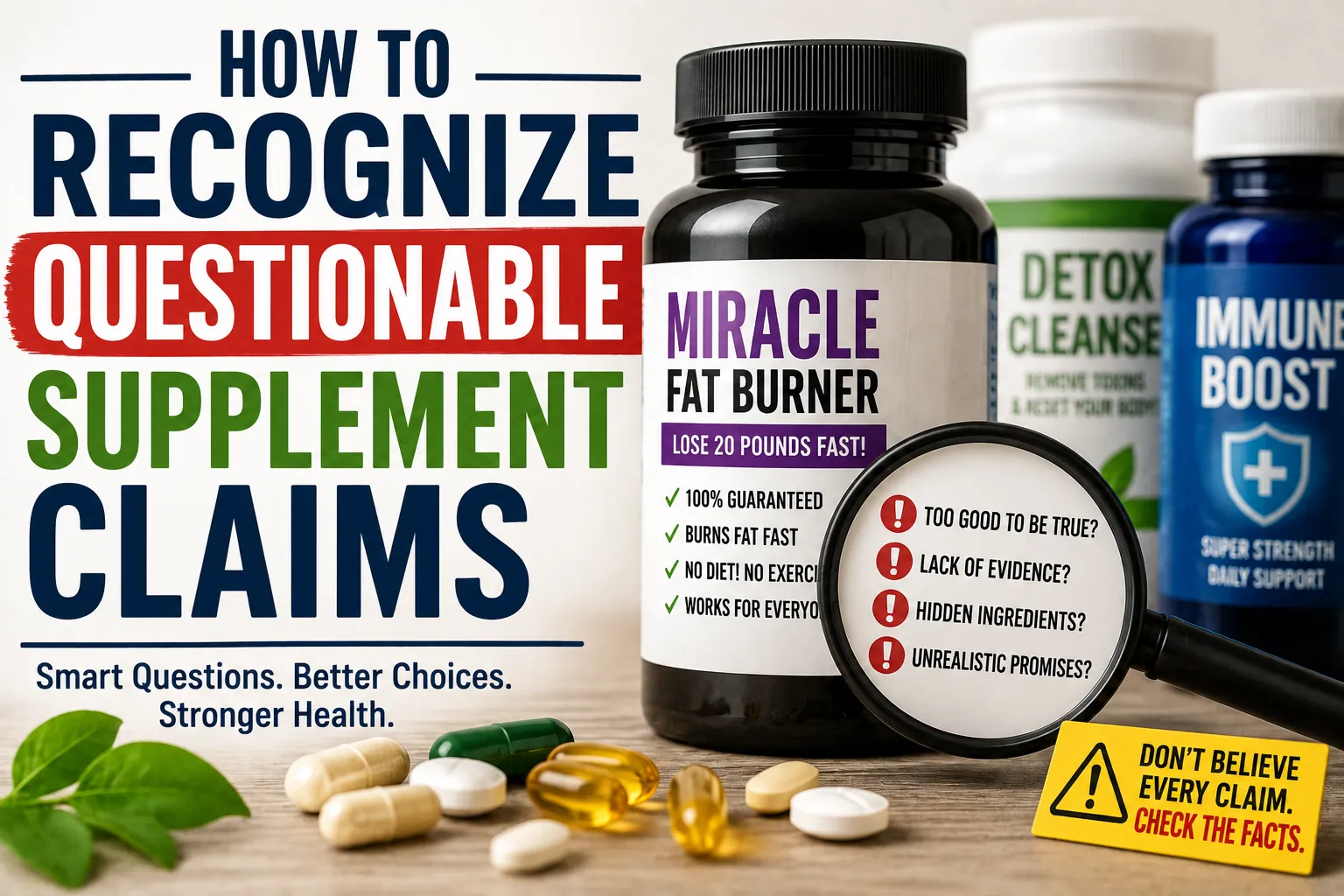

How to Recognize Questionable Supplement Claims
Walk into almost any supplement store or browse a health website, and you can quickly encounter products promising more energy, better sleep, faster weight loss, improved focus, stronger immunity, or a healthier body.
Some supplements may have legitimate uses, but the language used to market them can make it difficult to distinguish a reasonable claim from an exaggerated one.
Learning to recognize questionable supplement claims is therefore an important consumer skill. The goal is not to assume that every supplement is ineffective. It is to ask whether the evidence behind a particular claim is strong, relevant, and presented honestly. For broader context on evaluating supplements, see this complete guide to dietary supplements.
What Makes a Supplement Claim Questionable?
A supplement claim becomes worth investigating when the marketing promises substantially more than the available evidence appears capable of supporting.
Warning signs can include:
- Promises of dramatic or guaranteed results
- Claims that a product works for almost everyone
- Language suggesting a supplement can replace medical treatment
- Vague references to “science” without identifying evidence
- Testimonials presented as proof
- Claims based mainly on anecdotes
- “Secret” or “miracle” formulas
- Pressure to buy immediately
- Claims that sound too good to be true
- Important limitations hidden in fine print
The Federal Trade Commission says health-related advertising claims should be truthful, not misleading, and supported by appropriate scientific evidence.
That makes the quality of evidence one of the most important things consumers should examine.
Learn the Difference Between Structure and Function Claims and Disease Claims
Supplement marketing can use terminology that sounds medical without explicitly saying that a product treats a disease.
The U.S. Food and Drug Administration distinguishes between certain structure/function claims and disease claims.
A structure/function claim describes how a nutrient or dietary ingredient may affect the normal structure or function of the body. FDA gives examples such as calcium supporting strong bones and fiber helping maintain bowel regularity.
Disease claims are different. A supplement cannot simply be marketed as diagnosing, treating, curing, or preventing a disease under the rules governing dietary supplements.
This distinction matters because impressive-sounding language can sometimes imply a medical benefit without clearly stating it.
Be Skeptical of “Miracle” Language
Words such as miracle, instant, guaranteed, breakthrough, and effortless should prompt additional questions.
Health outcomes are often influenced by many variables, including diet, lifestyle, genetics, existing health conditions, medications, and individual differences.
A product that claims to produce dramatic results with little effort deserves particularly careful scrutiny.
For example, a statement such as:
“This supplement guarantees rapid weight loss for everyone.”
is fundamentally different from a carefully qualified statement describing a specific ingredient, population, outcome, and body of research.
The stronger and broader the promise, the more important it becomes to examine the supporting evidence.
Ask What “Clinically Proven” Actually Means
“Clinically proven” can sound authoritative, but the phrase alone does not tell you much.
Ask:
- What was actually studied?
- How many people participated?
- Who conducted the research?
- What was the study duration?
- What outcome was measured?
- Was there a control group?
- Was the research conducted in humans?
- Was the specific supplement tested?
- Was the dose the same as the product being sold?
- Were the results statistically and practically meaningful?
A study involving an ingredient does not automatically prove that a particular finished supplement produces the advertised result.
The exact product, formulation, dosage, population, and outcome all matter.
For a deeper framework for judging the strength and relevance of supplement research, see how to evaluate scientific evidence behind dietary supplement claims.
Look Beyond Testimonials
Testimonials can describe someone’s personal experience, but an individual experience does not establish that a product will produce the same result for other people.
This is particularly important when marketers use dramatic before-and-after stories.
A testimonial may leave out important information such as:
- Other lifestyle changes
- Other supplements or medications
- The person’s starting condition
- How long the result took
- Whether the result lasted
- Whether the experience is typical
The FTC has specifically emphasized that health claims in advertising need scientific substantiation rather than relying on persuasive presentation alone.
Be Careful With Celebrity and Influencer Endorsements
A familiar face can make a supplement appear more trustworthy, but popularity is not scientific evidence.
An influencer may genuinely believe that a product helped them, yet that does not establish whether:
- The supplement caused the result
- The result is typical
- The product is appropriate for everyone
- The product has been adequately studied
Consumers should separate who is recommending a product from what evidence supports the product.
Check Whether the Evidence Applies to the Actual Product
One of the most important questions is:
Was the exact product being sold studied?
A company might advertise a supplement containing a particular ingredient and reference research involving that ingredient.
But the research may have used:
- A different dose
- A different formulation
- A purified ingredient
- A combination of ingredients
- A different population
- A different method of administration
That does not necessarily make the research irrelevant, but it means the evidence needs to be interpreted carefully.
Human Studies Usually Matter More for Human Claims
Laboratory and animal research can contribute to scientific understanding, but evidence from a test tube or animal study does not automatically demonstrate that the same effect occurs in humans.
If a company makes a claim about what a supplement will do for people, look for credible human research addressing that particular outcome.
Ask whether the evidence progresses beyond laboratory observations and theoretical mechanisms.
Pay Attention to the Size of the Claimed Benefit
A statistically significant result is not necessarily a large or meaningful result.
Suppose a study finds a small difference between two groups. A marketer might present the finding as evidence that a supplement produces a major health improvement.
The original research may tell a much more modest story.
When evaluating a claim, ask:
How large was the actual effect?
This can be more informative than simply asking whether a study found a statistically significant difference.
Watch for Claims That “Detox” the Body
“Detox” is a particularly broad marketing term.
Consumers should ask what substance is supposedly being removed, how the product removes it, and what evidence demonstrates that the process occurs.
Vague claims about cleansing the body can sound scientific without providing a clearly defined biological mechanism or measurable outcome.
The more general the claim, the more carefully it should be examined.
Be Skeptical of “Natural Means Safe”
The word natural does not automatically mean safe, effective, or appropriate for everyone.
Natural substances can have biological effects. They may also interact with medications or cause unwanted effects.
The important questions are:
- What is actually in the product?
- How much is present?
- What evidence supports its use?
- What potential risks exist?
- Who should avoid it?
- Could it interact with medications or other supplements?
A natural ingredient can be useful in some circumstances without being universally safe.
For more on potential interactions and why combining supplements can require caution, see this guide to supplement interactions.
Look for Transparent Product Information
A trustworthy product should make it reasonably clear what the consumer is buying.
Look for information such as:
- Full ingredient list
- Amount of each ingredient
- Serving size
- Directions for use
- Manufacturer information
- Appropriate warnings
- Relevant quality information
Be cautious when a company makes broad claims while providing little useful information about the product itself.
Consumers can also learn more about evaluating this information by reviewing how to read supplement labels correctly.
Understand What FDA Does and Does Not Mean
Consumers sometimes assume that the presence of FDA-related language means a supplement has been approved by the agency.
That assumption can be misleading.
FDA explains that it generally does not approve structure/function claims on dietary supplements before marketing. Products making those claims must meet applicable requirements, including having substantiation that the claims are truthful and not misleading.
FDA also notes that supplement structure/function claims carry a disclaimer stating that the claim has not been evaluated by FDA and that the product is not intended to diagnose, treat, cure, or prevent disease.
Therefore, phrases such as “FDA registered,” “FDA regulated,” or FDA-related imagery should not automatically be interpreted as government approval of a supplement’s effectiveness.
Be Wary of Fake Authority
Questionable supplement marketing may use scientific-looking language, laboratory imagery, medical symbols, or references to unnamed experts to create an impression of credibility.
Ask whether the authority being presented is actually relevant.
A product can use scientific terminology without having strong evidence behind its specific claims.
Likewise, a quote from a professional does not necessarily replace independent scientific research.
Examine the Source of the Evidence
Not all evidence carries the same weight.
A useful hierarchy for consumer questions might begin with:
- High-quality systematic reviews or meta-analyses
- Well-designed randomized controlled trials
- Other controlled human studies
- Observational human studies
- Mechanistic or laboratory research
- Animal studies
- Testimonials and anecdotes
This is not an absolute ranking for every scientific question, but it provides a useful framework.
The key is to determine whether the evidence actually addresses the claim being made.
Be Suspicious of “Secret” Ingredients
A product that emphasizes a proprietary or secret formula may make it harder for consumers to determine exactly how much of each ingredient they are receiving.
A complicated ingredient list can also create the impression that a product is more advanced than it actually is.
More ingredients do not automatically mean greater effectiveness.
In many cases, understanding the dose and evidence for individual ingredients is more useful than counting how many substances appear on the label.
Watch for Pressure Tactics
High-pressure marketing can interfere with careful decision-making.
Common examples include:
- “Buy before midnight”
- “Only a few bottles left”
- “Doctors don’t want you to know”
- “This information is being censored”
- “Act now before the price doubles”
Scarcity does not prove effectiveness.
If a supplement is genuinely worth considering, consumers should be able to evaluate it without being pushed into an immediate purchase.
Consider Whether the Claim Is Too Broad
A supplement may be advertised as supporting several unrelated outcomes at once:
“Boosts energy, burns fat, improves memory, strengthens immunity, balances hormones, and reverses aging.”
The broader the list becomes, the more evidence is required to support each individual claim.
One study about one ingredient cannot automatically validate every benefit mentioned in an advertisement.
Treat each major claim as a separate question.
Ask Who Benefits From the Claim
A simple but powerful question is:
Who is making this claim, and do they benefit financially if I believe it?
This does not mean every company is dishonest.
It simply means marketing should be evaluated as marketing.
A supplement seller has an obvious commercial interest in convincing consumers to purchase its product. Independent evidence can therefore provide valuable context.
Check Whether the Evidence Is Independent
Company-funded research is not automatically invalid. Industry can legitimately fund scientific studies.
However, consumers should still consider:
- Who funded the research?
- Who conducted it?
- Was the methodology transparent?
- Were limitations acknowledged?
- Has the finding been replicated?
- Do independent studies reach similar conclusions?
Looking at the entire evidence base is more informative than relying on a single favorable study.
Understand That “More” Is Not Always Better
Higher doses do not automatically produce better results.
For some nutrients and compounds, excessive intake can create health risks.
This is one reason consumers should avoid assuming that a product with a very large amount of an ingredient is automatically superior.
People who take medications, have medical conditions, are pregnant or breastfeeding, or are considering supplements for children should be particularly cautious and discuss appropriate choices with a qualified healthcare professional.
A Simple Five-Question Supplement Test
Before buying a supplement based on an impressive claim, ask:
1. What Exactly Is Being Promised?
Write the claim in plain language.
2. What Evidence Supports It?
Look for actual human research rather than testimonials alone.
3. Does the Evidence Match the Product?
Check the ingredient, dose, formulation, population, and outcome.
4. How Strong Is the Evidence?
Consider study quality, consistency, limitations, and effect size.
5. What Important Information Is Missing?
Look for risks, uncertainty, contraindications, and limitations.
If the seller cannot provide clear answers, that is a reason to slow down rather than buy immediately.
Examples of Questionable and Better Claims
| Questionable Style | Better Question |
|---|---|
| “Works instantly” | How quickly did controlled studies observe an effect? |
| “Clinically proven” | Which clinical studies support the specific claim? |
| “Natural and completely safe” | What safety evidence exists? |
| “Doctors recommend it” | Which doctors, and based on what evidence? |
| “Detoxes your body” | What substance is removed, and how was that measured? |
| “Burns fat effortlessly” | What change in body composition was demonstrated? |
| “Boosts immunity” | Which immune outcome was measured? |
| “Miracle formula” | What specific ingredients and evidence support the claimed benefit? |
The goal is not to automatically reject every marketing statement. It is to translate vague promotional language into questions that can actually be answered.
Why Scientific Uncertainty Matters
Science rarely provides certainty from one study.
A responsible explanation should acknowledge limitations and uncertainty.
The FTC’s guidance emphasizes that health claims should be supported by competent and reliable scientific evidence and that the evidence should be relevant to the specific product and advertising claim.
That means a responsible supplement discussion should not simply ask whether any study supports an ingredient.
It should ask whether the overall evidence supports the particular claim being made.
What Consumers Should Do Before Starting a Supplement
If you are considering a supplement, especially for a specific health concern, take time to research the ingredient and product.
Consider discussing it with a doctor, pharmacist, registered dietitian, or another appropriately qualified healthcare professional.
This is especially important when you:
- Take prescription medications
- Have a chronic medical condition
- Are pregnant or breastfeeding
- Are considering supplements for a child
- Are preparing for surgery
- Plan to take several supplements together
A healthcare professional can help identify potential interactions and determine whether supplementation is appropriate.
The Bottom Line on Supplement Marketing
A persuasive supplement advertisement is not the same thing as strong scientific evidence.
The safest approach is to slow down when a product promises dramatic results, examine the exact wording of the claim, identify the evidence behind it, and determine whether that evidence actually applies to the product.
Consumers should also remember that dietary supplement claims are subject to regulatory requirements. FDA distinguishes permitted structure/function claims from disease claims, while the FTC requires health-related advertising claims to be truthful, not misleading, and appropriately substantiated.
Smart Supplement Decisions Start With Better Questions
You do not need to become a scientist to recognize questionable supplement claims.
You simply need to become comfortable asking what is being promised, what evidence supports it, whether that evidence applies to the actual product, and what the marketing may be leaving out.
When a claim is extraordinary, the evidence should be examined with extraordinary care. Taking a few minutes to investigate before purchasing can help consumers distinguish legitimate information from marketing designed primarily to make a sale.
Continue Reading
Similar Posts
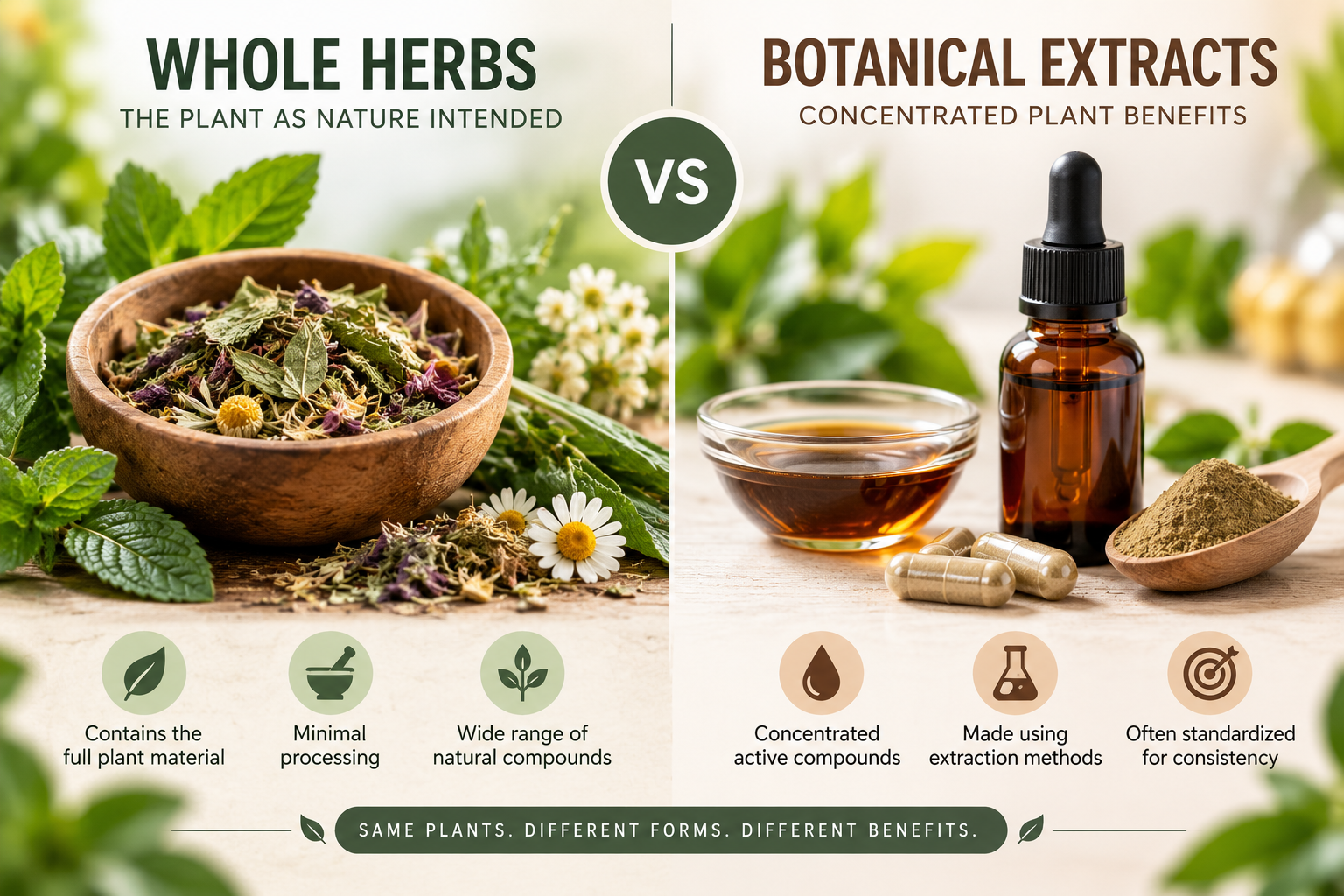
How Botanical Extracts Differ From Whole Herbs
Understanding how extracts differ from whole herbs can make it easier to interpret supplement labels, compare products, and evaluate claims about herbal ingredients.
Read article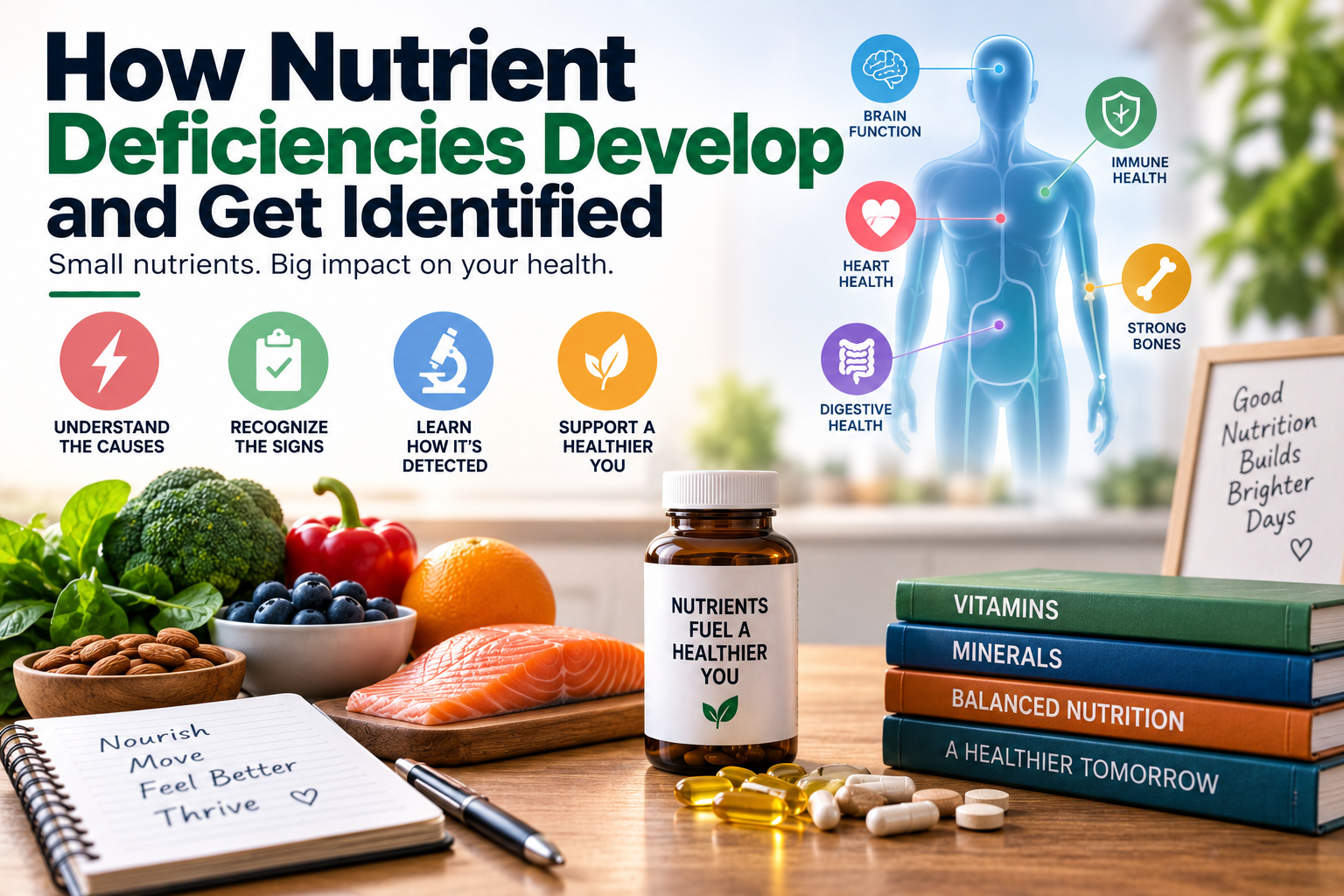
How Nutrient Deficiencies Develop and Get Identified
Understanding how nutrient deficiencies develop—and how healthcare professionals identify them—can make it easier to recognize potential problems before they become more serious.
Read article
What Is the Difference Between Water-Soluble and Fat-Soluble Vitamins
Understanding this basic distinction can make it easier to interpret nutrition information, evaluate supplements, and make informed decisions about dietary intake.
Read article

Join 10,000+ Readers Building Healthier Habits
Get actionable wellness tips every week plus our newest articles delivered straight to your inbox.