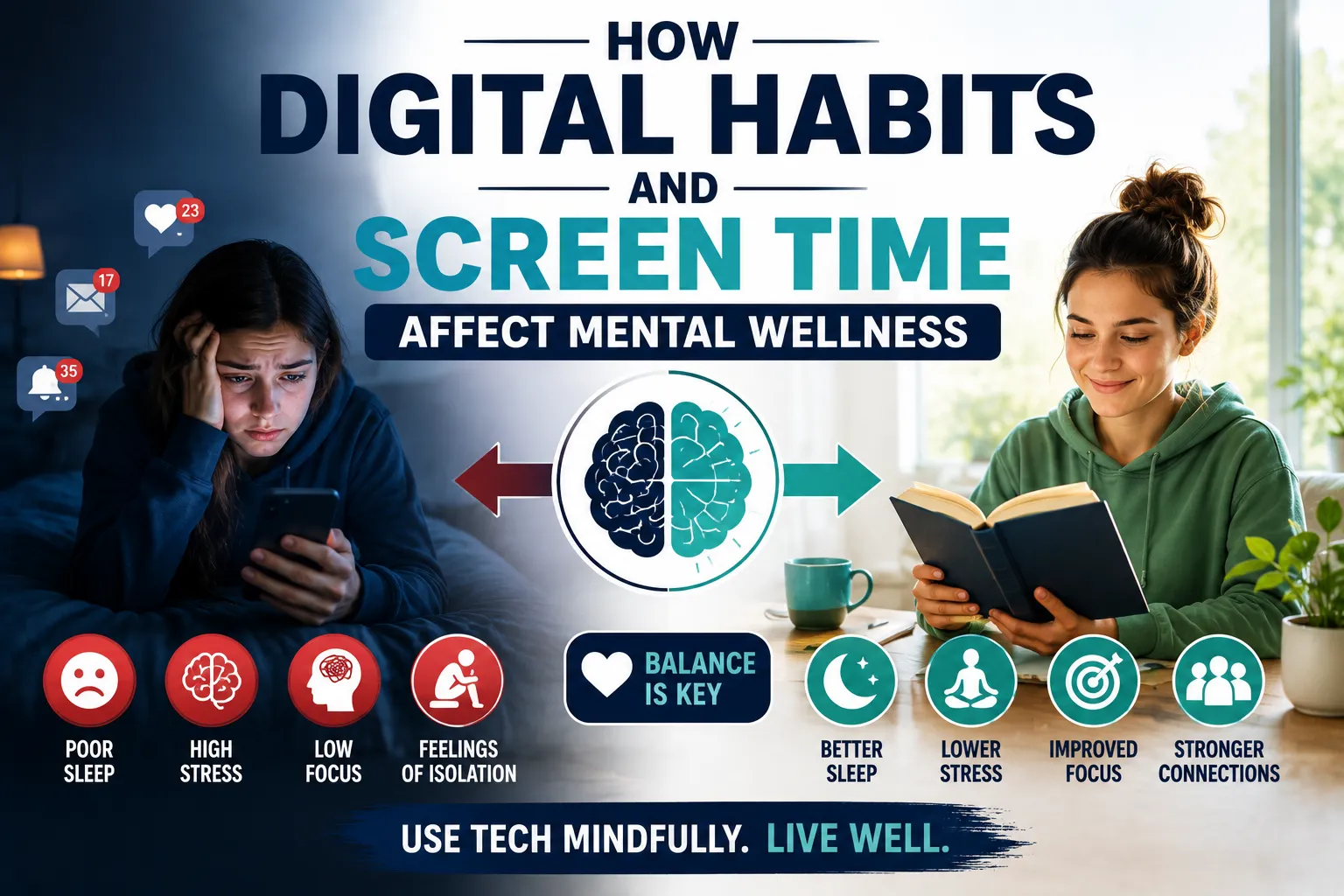

How Digital Habits and Screen Time Affect Mental Wellness
Screens have become part of nearly every area of modern life. People use smartphones to communicate, computers to work, televisions to relax and social platforms to maintain relationships. Digital technology can make life more convenient and connected, but the way people use it can also influence sleep, stress, attention, mood and social well-being.
The relationship between screen time and mental wellness is more complicated than simply counting hours.
Watching an educational video, talking with a friend, working on a laptop and endlessly scrolling through distressing content are all forms of screen use, but they can have very different effects.
The goal, therefore, is not necessarily to eliminate screens. It is to develop digital habits that leave enough room for sleep, physical activity, relationships, focused work and genuine offline recovery. These choices are part of the broader principles discussed in The Complete Guide to Emotional Well-Being.
What Are Digital Habits?
Digital habits are the repeated ways people interact with technology.
They include:
- How often someone checks their phone
- How long they spend on social media
- Whether they use devices before sleeping
- How frequently they switch between apps
- Whether notifications interrupt daily activities
- What type of content they consume
- How often they use technology for work or study
- Whether they use screens while eating
- How much time they spend communicating digitally
- Whether they regularly take breaks from connected devices
These patterns can become automatic.
Someone may reach for a phone whenever they feel bored, uncomfortable or stressed without consciously deciding to do so.
Over time, repeated behaviors can become routines that are difficult to change.
Screen Time Is Not All the Same
One of the biggest problems with the phrase “screen time” is that it combines many different activities.
A person could spend two hours:
- Video-calling a family member
- Taking an online course
- Creating digital artwork
- Playing a video game
- Reading the news
- Working
- Scrolling through social media
These experiences are not psychologically identical.
This means that improving digital wellness is not simply about reaching an arbitrary number of screen-free hours.
It is also about what the screen is replacing and what the person is doing while using it.
How Screens Can Affect Sleep
Sleep is one of the clearest areas where digital habits can matter.
Using devices late at night can encourage people to stay awake longer, particularly when content is engaging or notifications continue arriving.
Screens can also become psychologically stimulating. A person who intends to check one message may end up spending another hour watching videos or scrolling through social media.
Poor sleep can then affect mood, concentration, emotional regulation and energy the following day.
This creates a cycle:
Late-night screen use → less or poorer sleep → lower energy and mood → greater reliance on passive digital entertainment → more late-night screen use.
Breaking that cycle can be more valuable than simply trying to reduce total daily screen hours.
Why Notifications Can Increase Mental Load
Smartphones are designed to keep people connected.
Messages, emails, social-media alerts and application notifications can create a constant stream of interruptions.
Even when someone does not respond immediately, the arrival of a notification can shift attention toward the device.
Frequent interruptions can make it harder to maintain periods of uninterrupted concentration.
For someone already dealing with work pressure, academic demands or personal stress, constant digital interruptions can contribute to a sense of being perpetually “on.”
Turning off nonessential notifications can therefore be a surprisingly effective digital-wellness measure.
Social Media Can Affect Mood in Different Ways
Social media can be beneficial.
It can help people maintain relationships, find communities, exchange information and receive social support.
For someone who feels isolated, an online community can provide meaningful connection. Building and maintaining supportive relationships is also an important part of healthy relationships, communication and trust.
But social media can also expose users to comparison, criticism, cyberbullying, disturbing content and an endless stream of carefully selected images of other people’s lives.
The result can vary considerably between individuals.
The important question is not simply:
“How much social media do I use?”
It is also:
“How do I feel during and after using it?”
The Problem With Constant Comparison
Social platforms often present highly selective versions of people’s lives.
Users may see:
- Career achievements
- Vacations
- Relationships
- Fitness progress
- New homes
- Social events
- Financial success
- Carefully edited photographs
They rarely see the complete context behind those moments.
Repeated exposure can create unrealistic comparisons.
Someone may begin to evaluate their own life against a stream of other people’s highlights.
That does not mean social media inevitably damages self-esteem. Experiences differ, and online communities can be supportive.
But recognizing the difference between someone else’s curated digital presentation and their complete real life can help put social-media content into perspective.
How Digital Habits Affect Attention
Many digital platforms compete for attention.
Short videos, notifications, rapidly changing feeds and interactive applications can encourage frequent switching between activities.
Constant switching may make sustained attention more difficult, particularly when people become accustomed to immediate stimulation.
This can affect activities such as:
- Reading
- Studying
- Writing
- Working
- Conversations
- Creative activities
The problem is not that technology automatically destroys attention.
Digital tools can also support concentration—for example, a writing application, e-reader or educational platform can be useful for focused work.
The difference often lies in whether technology is supporting a deliberate activity or repeatedly interrupting it.
Multitasking Can Increase Mental Fatigue
People sometimes try to combine digital activities with other tasks.
Someone might:
- Watch television while working
- Scroll through social media while studying
- Check email during conversations
- Respond to messages while eating
- Keep multiple applications open while trying to concentrate
This may create the impression of efficiency, but frequent task switching can increase mental effort.
Instead of giving full attention to one task, the brain repeatedly redirects attention.
Creating periods in which only one activity receives attention can make digital life feel less exhausting.
Digital Technology Can Support Mental Wellness
It is important not to portray technology as inherently harmful.
Digital tools can provide substantial benefits.
People can use technology to:
- Stay connected with loved ones
- Access educational resources
- Find mental-health information
- Participate in supportive communities
- Exercise with guided programs
- Practice meditation
- Track habits
- Access professional services
- Explore creative interests
- Maintain relationships across long distances
For some people, online communities may provide support that is difficult to find locally.
Digital technology can therefore contribute positively to mental wellness when it is used intentionally.
When Digital Use Starts Replacing Essential Activities
One of the strongest warning signs is not simply high screen use but crowding out.
Consider someone who spends several hours on their phone each evening.
If that time does not interfere with sleep, relationships, responsibilities or physical activity, its effect may differ from someone whose phone use consistently replaces those activities.
The question becomes:
What is the screen time taking the place of?
Digital Habits and Physical Activity
Long periods of sedentary screen use can reduce opportunities for movement.
This can happen when people spend extended periods:
- Watching television
- Gaming
- Browsing social media
- Working at a computer
- Using phones while sitting
Physical activity is closely connected to overall well-being.
Taking regular movement breaks can therefore improve the balance between digital and physical activities. This is one reason positive habits can support mental wellness beyond simply reducing screen exposure.
How Technology Can Influence Stress
Technology can reduce stress in some situations and increase it in others.
A video call with a close friend might provide emotional support.
A meditation application might help someone relax.
A useful productivity tool might reduce organizational stress.
At the same time, constant work messages, alarming news, online arguments and notifications can increase psychological pressure.
This is why digital wellness is partly about controlling when technology has access to your attention.
For people who already experience persistent pressure, learning broader stress-management strategies can provide another way to reduce the effects of constant digital stimulation.
Work-Related Screen Time Is Different
Many people cannot simply reduce their screen time because their jobs depend on computers.
A software developer, designer, accountant or remote worker may spend much of the day looking at a screen.
The solution is therefore not necessarily to eliminate screen use.
Instead, workers can improve their digital environment by:
- Taking regular breaks
- Separating work and personal notifications
- Using screen-free periods during meals
- Avoiding unnecessary multitasking
- Getting up and moving periodically
- Establishing a clear end to the workday
- Limiting work messages outside working hours when possible
The objective is to prevent digital work from occupying every part of the day.
Children and Teenagers May Need Additional Consideration
Young people can be particularly affected by digital environments because technology is deeply integrated into education, social relationships and entertainment.
Rather than assuming that one screen-time limit works for every child, families can focus on protecting sleep, movement, reading, family interaction and other healthy activities while considering the child’s age and circumstances.
For families, useful boundaries may include:
- Screen-free bedrooms
- Device-free meals
- Technology-free periods before sleep
- Clear expectations about social-media use
- Age-appropriate privacy settings
- Regular conversations about online experiences
- Time for outdoor and offline activities
Parents can also model healthy behavior.
Children notice how adults use their own phones.
Why Screen-Free Bedrooms Can Help
Keeping phones and other devices out of the bedroom can create a physical boundary between digital activity and sleep.
Instead of having a phone within arm’s reach throughout the night, people can charge devices elsewhere.
Adults can apply a similar principle if nighttime phone use interferes with sleep.
A simple charging station outside the bedroom can make the habit easier to maintain.
How to Recognize Unhealthy Digital Habits
Some warning signs include:
- Checking a device automatically throughout the day
- Feeling anxious when separated from a phone
- Staying online much later than intended
- Losing sleep because of screen use
- Frequently interrupting conversations to check notifications
- Using digital entertainment to avoid every uncomfortable emotion
- Neglecting responsibilities because of online activities
- Abandoning hobbies or exercise for screen use
- Feeling consistently worse after using certain platforms
One sign alone does not necessarily indicate a mental-health disorder.
However, a persistent pattern of digital behavior interfering with everyday life may be worth addressing.
A Better Way to Think About Screen Time
Instead of asking only “How many hours should I spend on my phone?”, consider five questions:
1. What Am I Doing?
Is the activity productive, social, creative, educational or purely passive?
2. How Do I Feel Afterwards?
Do you feel informed and connected, or drained and dissatisfied?
3. What Is It Replacing?
Is screen use replacing sleep, exercise, relationships or responsibilities?
4. Can I Stop Easily?
Can you put the device down when you intend to?
5. Does It Fit My Priorities?
Does the amount of time spent online reflect what you actually want to do with your day?
These questions often provide more useful information than a single screen-time number.
Practical Ways to Improve Digital Wellness
Changing digital habits does not require abandoning technology.
Small environmental changes can make healthier behavior easier.
Turn Off Unnecessary Notifications
Keep alerts for important communication while disabling notifications that do not require immediate attention.
Create Screen-Free Meals
Eating without phones can create opportunities for conversation and mindful eating.
Protect the Last Hour Before Sleep
Use the period before bedtime for reading, conversation, stretching, preparation for the next day or another relaxing activity.
Keep Phones Away From the Bed
Charging a device across the room—or outside the bedroom—reduces the temptation to check it during the night.
Schedule Offline Activities
Make time for activities that do not involve a screen, such as walking, exercise, hobbies, cooking or spending time with friends.
Use Technology Intentionally
Before opening an application, ask what you actually intend to do.
This can reduce automatic scrolling.
Review Your Most-Used Apps
If one application consistently consumes more time than expected or leaves you feeling worse, consider reducing access to it.
Digital Detoxes Are Not the Only Solution
The phrase “digital detox” suggests that people need to completely disconnect from technology to feel better.
That may work for some individuals, but it is not always practical or necessary.
A more sustainable approach may be digital boundaries.
For example:
- No social media before breakfast
- No work email after a certain time
- No phones during meals
- No devices in the bedroom
- One screen at a time
- Social media only during designated periods
These rules are easier to integrate into everyday life because they target specific behaviors rather than requiring complete disconnection.
For some people, setting boundaries around communication and availability can also be part of a broader approach to healthy boundaries.
Build Technology Around Your Life
Healthy digital habits are ultimately about putting technology in its proper place.
A phone should support communication without replacing relationships.
A laptop should enable productive work without making every hour a work hour.
Social media should provide connection without becoming the primary measure of self-worth.
Entertainment should provide relaxation without consistently sacrificing sleep.
Digital wellness is therefore less about rejecting technology and more about using it deliberately.
When Digital Habits Become a Mental-Health Concern
If screen or internet use is consistently interfering with sleep, work, school, relationships or daily functioning, it may be worth discussing the situation with a qualified healthcare or mental-health professional.
This is especially important when digital behavior is accompanied by persistent anxiety, depression, severe sleep problems, social withdrawal or other significant changes in functioning.
Digital habits can interact with mental-health concerns in complicated ways, and it is not always possible to determine cause and effect simply from the amount of time someone spends online.
Professional assessment can help identify what is actually happening.
A Healthier Relationship With Screens
Digital technology is neither inherently good nor bad for mental wellness.
Its effects depend on what people do with it, how often they do it, when they do it, what it replaces and how it makes them feel.
The strongest approach is not necessarily to count every minute spent looking at a screen.
It is to protect the activities that support mental and physical well-being: adequate sleep, movement, meaningful relationships, focused work, recreation and time away from constant digital stimulation.
A balanced approach is particularly important for children and adolescents, where healthy sleep, physical activity, social connection and development should not be crowded out by digital media.
The goal of digital wellness is not to live without technology. It is to make sure technology remains a tool that serves your life rather than a habit that quietly takes over the time, attention and relationships that make life fulfilling.
Continue Reading
Similar Posts

How to Provide Emotional Support to Others
Good emotional support is also about respecting boundaries. People need different kinds of help at different times. Some may want to talk, while others may need practical assistance, quiet companionship, or simply reassurance that someone cares.
Read article
How Stress Affects Concentration and Memory
Understanding the connection between stress, concentration and memory can help explain why the mind sometimes feels less efficient during stressful periods—and why managing stress can be an important part of maintaining overall mental well-being.
Read article
When Should Someone Seek Professional Mental Health Support
Understanding **what mental wellness means** is a useful starting point. Mental wellness involves more than simply being happy or avoiding mental illness. It includes the ability to manage emotions, handle challenges, maintain relationships, make decisions, and function in everyday life.
Read article

Join 10,000+ Readers Building Healthier Habits
Get actionable wellness tips every week plus our newest articles delivered straight to your inbox.