
Ultra-Processed Foods Linked to Higher Fat Inside Thigh Muscles in New Study
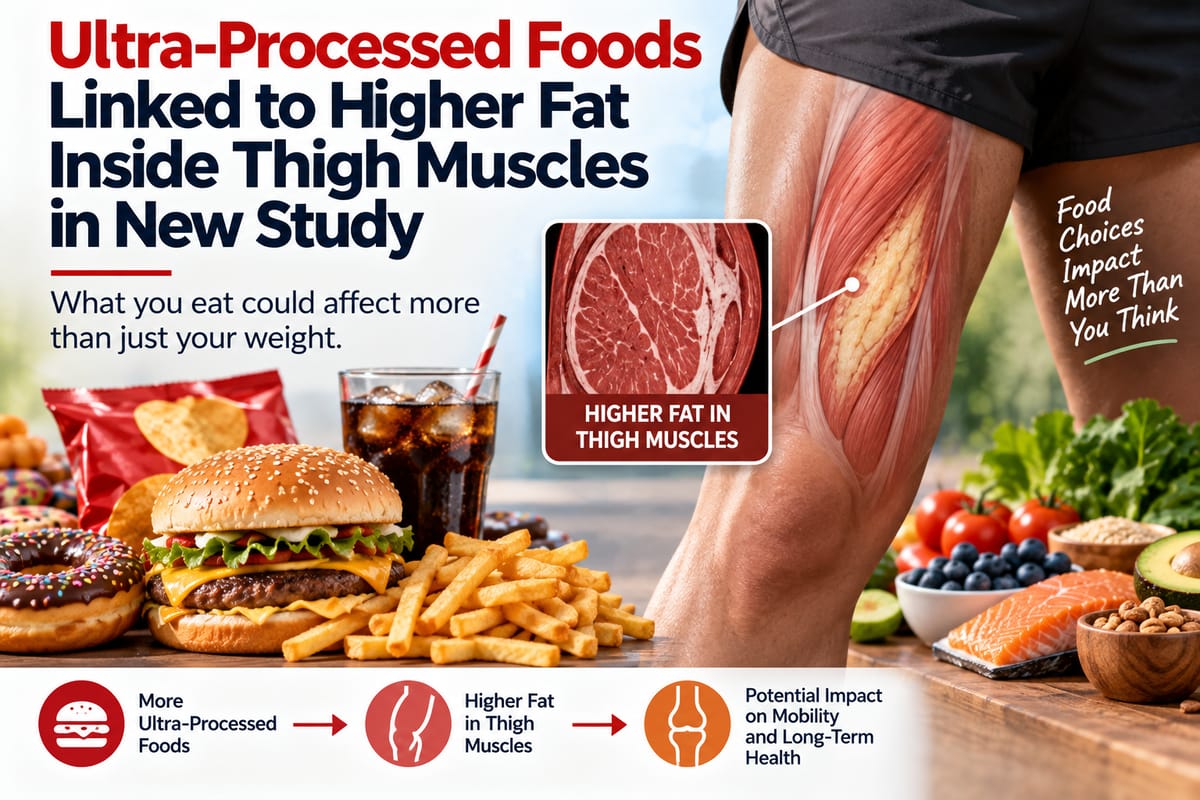
Ultra-processed foods have long been studied for their potential links to weight gain, metabolic health and cardiovascular disease. Now, new research is drawing attention to another possible connection: the amount of fat stored inside the muscles of the thighs.
A study published in Radiology examined MRI scans and dietary information from 615 adults and found that greater consumption of ultra-processed foods was associated with higher levels of fat infiltration in the thigh muscles. The association remained after researchers accounted for factors including body mass index, calorie intake, physical activity and other characteristics.
The findings add another dimension to the ongoing discussion about diet quality. They do not prove that ultra-processed foods directly cause fat to accumulate inside muscles, but they suggest that the relationship between dietary patterns and muscle health may be more complicated than body weight alone indicates.
What the New Study Examined
Researchers analyzed baseline data from the Osteoarthritis Initiative, a large research project designed to improve understanding of knee osteoarthritis.
The analysis included 615 people with an average age of about 60. There were 340 women and 275 men, and participants had an average body mass index of approximately 27.
The researchers estimated participants’ ultra-processed food consumption using dietary questionnaires covering the previous year. On average, ultra-processed foods accounted for about 41% of the participants’ diets.
Researchers then used thigh MRI scans to assess muscle fat infiltration in several muscle groups, including the flexors, extensors and adductors.
This approach allowed the researchers to examine something that may not be visible simply by measuring body weight or looking at body shape.
What Is Fat Infiltration Inside Muscle?
Muscle fat infiltration refers to fat stored within or between muscle fibers.
A certain amount of fat can naturally exist within muscle tissue. However, higher levels of intramuscular fat can be associated with poorer muscle quality and physical function.
MRI provides a way to identify this fat without requiring invasive procedures. In the study, researchers used a grading system based on the appearance of fatty tissue within the muscles on MRI scans.
This is different from the fat stored directly beneath the skin or around internal organs.
That distinction is important because two people with similar body weights can have differences in where their fat is distributed and in the composition of their muscle tissue.
Higher Ultra-Processed Food Consumption Was Associated With More Muscle Fat
The central finding was an association between greater ultra-processed food consumption and higher muscle fat infiltration.
After adjusting for body mass index, researchers found a statistically significant relationship between higher ultra-processed food consumption and fat infiltration across all thigh muscles. Associations were also observed specifically in the flexor and adductor muscle groups.
The relationships became stronger in models that adjusted for abdominal circumference rather than BMI.
Importantly, the researchers also accounted for total calorie intake and physical activity. This suggests that the observed association was not explained simply by people consuming more calories or exercising less.
However, an association after statistical adjustment does not establish a direct cause-and-effect relationship.
Why the Findings Matter
Muscle health is often discussed in terms of strength, size and physical activity. Diet is another important part of that picture.
The study suggests that the quality of the foods people regularly consume may be connected with muscle composition, even when traditional measures such as body weight are taken into account.
That makes dietary quality an important consideration alongside exercise and weight management.
The broader principles of building a balanced diet are covered in the Complete Guide to Healthy Eating and Balanced Nutrition, which provides a wider framework for understanding how different foods contribute to overall nutrition.
What Counts as an Ultra-Processed Food?
Ultra-processed foods are generally products that have undergone extensive industrial processing and often contain ingredients, additives or formulations that are uncommon in traditional home cooking.
Examples can include:
- Packaged snack foods
- Sugar-sweetened beverages
- Some ready-to-eat meals
- Processed breakfast products
- Packaged desserts
- Certain processed meat products
- Some commercially produced baked goods
- Highly formulated convenience foods
Not every packaged or processed food is automatically unhealthy.
Freezing vegetables, pasteurizing milk, canning beans and processing foods for safety or preservation are different from producing highly formulated foods with numerous industrial ingredients.
The term “ultra-processed” is therefore broader than simply saying a food has been cooked, packaged or preserved.
The Study Focused on People at Risk for Knee Osteoarthritis
The participants came from the Osteoarthritis Initiative and were considered at risk for knee osteoarthritis, but they did not have radiographic osteoarthritis or frequent knee or hip pain at the baseline assessment used in this analysis.
This population is important because researchers are interested in identifying potentially modifiable factors that could influence musculoskeletal health before significant joint disease develops.
The study did not show that ultra-processed foods cause osteoarthritis.
Instead, the researchers examined the relationship between dietary intake and muscle composition, while previous research has identified muscle fat as a potentially relevant factor in musculoskeletal health.
Could Muscle Fat Affect Knee Health?
The researchers highlighted the possibility that higher levels of fat within thigh muscles could be relevant to knee osteoarthritis.
Muscles surrounding the knee play important roles in movement, stability and load management. Changes in muscle quality could therefore have implications for how the body handles physical demands.
The study itself, however, was cross-sectional. That means researchers examined information from a particular point in the participants’ data rather than following them over time to determine whether higher ultra-processed food consumption eventually caused specific muscle changes or knee disease.
The distinction matters because it prevents the findings from being interpreted as proof of a direct pathway from diet to osteoarthritis.
Body Weight Does Not Tell the Whole Story
One of the more interesting aspects of the research is its focus on body composition rather than weight alone.
Two people can have the same BMI but different amounts of muscle, body fat and fat distribution.
Similarly, someone may not appear to have substantial excess body fat while still having differences in muscle composition that cannot be identified through ordinary measurements.
This is one reason nutrition research increasingly looks beyond simple calorie totals.
The Complete Guide to Healthy Weight Management provides broader context on why sustainable weight management involves nutrition, physical activity, eating patterns and other lifestyle factors rather than focusing exclusively on a number on the scale.
Why Nutrient Density Remains Important
Reducing ultra-processed foods does not necessarily mean eliminating every packaged food from a diet.
A more practical approach is to consider what foods contribute nutritionally.
Foods with greater nutrient density can provide vitamins, minerals, fiber, protein and other useful nutrients relative to their calorie content. Whole or minimally processed foods such as vegetables, fruits, legumes, whole grains, nuts, seeds, eggs and many lean protein sources can form important parts of a balanced eating pattern.
Understanding What Nutrient Density Means and How to Choose Nutrient-Dense Foods can help put the discussion into perspective.
The objective does not have to be achieving a perfectly “clean” diet. Instead, it can involve gradually making nutrient-rich foods a larger part of everyday meals.
The Researchers Accounted for Several Important Factors
The study’s statistical analysis considered multiple factors that could potentially influence the relationship between diet and muscle fat.
Researchers adjusted for characteristics including:
- Sociodemographic factors
- Total daily calorie intake
- Smoking
- Physical activity
- Depression
- Body mass index in some models
- Abdominal circumference in other models
The researchers also examined whether the relationship differed according to sex and did not find statistically significant sex interactions.
These adjustments strengthen the analysis, but they cannot eliminate every possible source of confounding.
Dietary studies are particularly difficult because eating patterns are connected with many other lifestyle and socioeconomic factors.
Why the Results Should Be Interpreted Carefully
The findings are interesting, but they should not be interpreted as proof that eating an ultra-processed food directly causes fat to accumulate inside a person’s thigh muscles.
The research was a cross-sectional secondary analysis, meaning exposure and outcome were examined using existing baseline data rather than through a controlled dietary intervention.
There are also limitations to dietary questionnaires. People may not always remember exactly what they ate, and estimating the degree of food processing can involve classification decisions.
In addition, the participants were drawn from a population at risk for knee osteoarthritis, so the results should not automatically be assumed to apply equally to every population.
More research, particularly longitudinal and intervention studies, would be needed to determine whether changing ultra-processed food consumption actually changes muscle fat over time.
The Bigger Nutrition Debate
The findings arrive amid a broader discussion about how researchers and consumers should evaluate the healthfulness of a diet.
Ultra-processing is one way of classifying foods, but it is not the only characteristic that matters.
Nutrient content, fiber, protein, added sugars, sodium, fats, portion size, dietary variety and overall eating patterns can all contribute to nutritional quality.
That is why New Research Challenges How We Judge Healthy Diets is relevant to the wider conversation. Different ways of classifying diets can highlight different aspects of food quality, and no single measurement necessarily captures every dimension of a healthy eating pattern.
What People Can Take From the Research
For consumers, the study does not mean that one meal containing an ultra-processed food will suddenly change muscle composition.
Dietary patterns develop over months and years.
A practical response may therefore be to look at the overall balance of the diet rather than individual foods.
People can consider gradually increasing foods such as:
- Vegetables and fruits
- Beans and other legumes
- Whole grains
- Nuts and seeds
- Fish and other protein-rich foods
- Plain or minimally sweetened dairy products where appropriate
- Foods prepared from recognizable ingredients
At the same time, highly processed snacks, sugary drinks and other ultra-processed products can be consumed less frequently if they currently make up a large portion of the diet.
This approach focuses on adding nutritious foods rather than relying entirely on restriction.
Exercise Remains Part of the Picture
Nutrition is only one component of muscle health.
Resistance training, aerobic activity, mobility, adequate recovery and sufficient protein can all contribute to maintaining physical function.
The new study does not suggest that dietary changes can replace exercise.
Instead, its findings reinforce the idea that muscle quality may be influenced by several interconnected lifestyle factors.
Maintaining healthy muscles can be especially important as people age because muscle strength and function play major roles in mobility and independence.
What Researchers May Study Next
Future research could investigate whether reducing ultra-processed food consumption leads to measurable changes in intramuscular fat.
Longer-term studies could also determine whether people with higher ultra-processed food consumption are more likely to develop changes in muscle function or knee osteoarthritis over time.
Researchers may also investigate whether particular categories of ultra-processed foods are more strongly associated with muscle fat than others.
That distinction could eventually make nutrition guidance more precise.
For now, the study provides another reason for researchers to examine diet quality alongside traditional measures such as calories, body weight and physical activity.
A Broader View of Food and Muscle Health
The relationship between diet and health rarely comes down to a single ingredient or food category.
The new MRI research adds evidence that eating patterns may be connected with aspects of body composition that are not visible from weight or waist measurements alone. Among adults at risk for knee osteoarthritis, greater consumption of ultra-processed foods was associated with greater fat infiltration in thigh muscles, but the study does not establish that the foods directly caused those changes.
That distinction is important as nutrition research continues to explore how food quality, physical activity, body composition and long-term health interact.
For consumers, the most useful takeaway is not necessarily to fear every processed food, but to pay greater attention to the overall quality and variety of the foods that make up the diet.
Continue Reading
Similar Posts

Bettergoods Pasta Recalled Over Listeria Risk: What Consumers Need to Know
The recall originally covered two specific lots, but consumers should now treat the broader recall as applying to the product regardless of lot number.
Read article
GLP-1 Drugs and Nutritional Deficiencies: What New Research Says About Children
The findings do not prove that GLP-1 drugs directly caused the deficiencies. The study used administrative insurance claims rather than laboratory measurements or detailed clinical records, and the researchers themselves describe nutritional deficiencies as an under-recognized concern rather than establishing a direct causal relationship.
Read article
New Micronutrient Research Could Reshape How Experts Fight Vitamin and Mineral Deficiencies
The findings could influence how governments, nutrition organizations and food producers approach one of the world's most persistent nutrition problems.
Read article

Join 10,000+ Readers Building Healthier Habits
Get actionable wellness tips every week plus our newest articles delivered straight to your inbox.