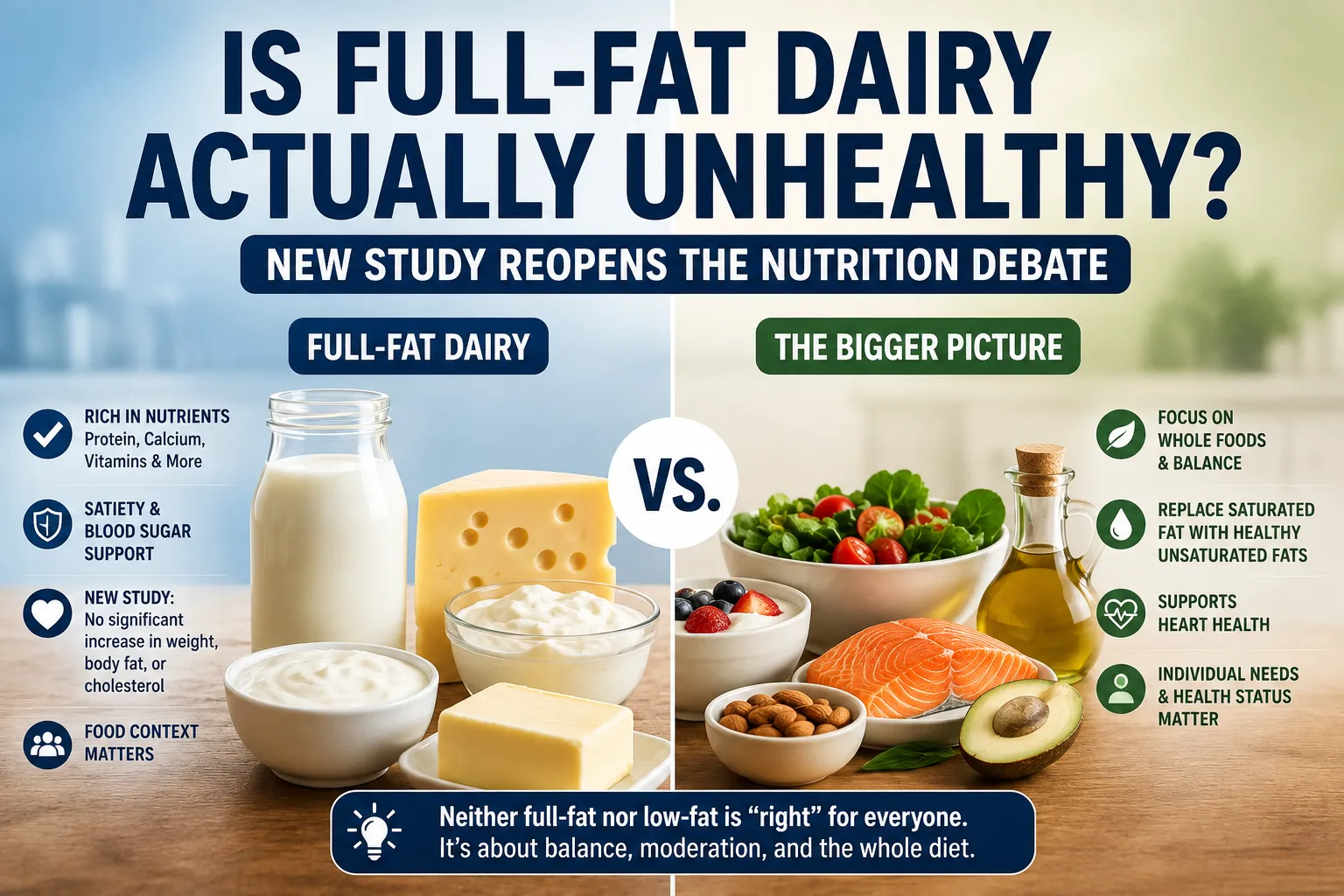

Is Full-Fat Dairy Actually Unhealthy? New Study Reopens the Nutrition Debate
For decades, shoppers walking through the dairy aisle have been given a relatively simple message: choose low-fat or fat-free milk and dairy products when possible.
The reasoning has been straightforward. Full-fat dairy contains more saturated fat, and saturated fat can raise LDL cholesterol, a major risk factor for cardiovascular disease. Reducing saturated-fat intake has therefore been a long-standing part of heart-health advice.
But the nutrition debate is becoming more complicated.
A new 12-week clinical trial involving 74 adults with overweight or obesity found that consuming three servings of full-fat dairy per day did not lead to meaningful increases in body weight, body fat, or blood cholesterol compared with lower-fat dairy or reduced dairy consumption. The study, published in The Journal of Nutrition, has added fresh fuel to questions about whether all full-fat dairy products should automatically be treated as unhealthy.
The findings are interesting, but they do not mean that butter, cream, cheese, and whole milk have suddenly become universally “healthy.”
Instead, the study highlights a more complicated question: Does the health impact of dairy depend on the whole food, the amount consumed, and what it replaces in the diet?
These questions are part of the broader discussion around healthy eating and balanced nutrition, where individual nutrients need to be considered within the context of an overall dietary pattern.
What the New Study Actually Found
Researchers from the University of Toronto and collaborating institutions followed 74 adults with overweight or obesity for 12 weeks.
Participants were divided into groups with different dietary approaches involving full-fat or lower-fat dairy and calorie restriction. The researchers examined changes in body weight, body composition, blood lipids, and other metabolic measures.
The results did not show the dramatic weight or cholesterol deterioration that might be expected from a diet containing three servings of full-fat dairy each day.
According to reporting on the study, participants consuming full-fat dairy did not experience significant increases in weight, body fat, BMI, or cholesterol. One group consuming full-fat dairy without calorie restriction also experienced a modest reduction in hip circumference.
There was an important caveat: triglycerides increased temporarily around the fourth week in some participants but had returned toward baseline by the end of the 12-week study.
The study therefore challenges the idea that adding full-fat dairy automatically produces short-term weight gain or worsening blood markers.
But it does not answer every question about long-term cardiovascular health.
Why Full-Fat Dairy Has Been Controversial
The controversy largely comes down to saturated fat.
Whole milk, cheese, butter, cream, and other full-fat dairy foods contain varying amounts of saturated fatty acids.
Saturated fat can raise LDL cholesterol, and elevated LDL is associated with a higher risk of cardiovascular disease.
A major 2026 review in The Journal of Nutrition examined evidence from feeding trials, observational studies, and long-term dietary interventions. The authors concluded that replacing saturated fat with polyunsaturated fats generally lowers LDL cholesterol and coronary heart disease risk. They also argued that the health impact of dairy can vary depending on the food and what it replaces in the diet.
That distinction is critical.
A question such as “Is saturated fat bad?” is much less informative than asking:
What food is replacing it?
Replacing saturated fat with nuts, seeds, fish, or unsaturated plant oils is different from replacing it with refined carbohydrates.
Dairy Is More Than Its Fat Content
One reason nutrition researchers are reluctant to treat dairy simply as a delivery system for saturated fat is that dairy foods contain many other nutrients.
Milk and many dairy products provide:
- Protein
- Calcium
- Phosphorus
- Potassium
- Vitamin B12
- Other vitamins and minerals
- Various fatty acids
- Water and other nutrients
Fermented dairy products such as yogurt and some cheeses also have characteristics that distinguish them from isolated sources of saturated fat.
This is why comparing “dairy fat” with “saturated fat” can sometimes oversimplify the issue.
A food is a package of nutrients and compounds consumed together.
The Type of Dairy Product Matters
“Full-fat dairy” covers a surprisingly broad range of foods.
Whole milk, plain full-fat yogurt, cheese, butter, cream, ice cream, and flavored dairy desserts are not nutritionally interchangeable.
A cup of plain whole milk is a different food from a large serving of ice cream containing substantial amounts of added sugar.
Likewise, plain full-fat yogurt can have a very different nutritional profile from a sweetened yogurt dessert.
This means that the label full-fat does not tell the entire nutritional story.
The overall composition of the food matters.
Cheese May Behave Differently From Butter
Cheese and butter are both high in dairy fat, but they are structurally different foods.
Cheese contains protein and minerals and is consumed in a variety of forms and portions.
Butter is primarily a concentrated source of fat.
That distinction matters when researchers compare dairy products with other sources of saturated fat.
Recent cardiovascular-nutrition reviews have found that the health effects of full-fat dairy remain less clear than those of some other saturated-fat-rich foods. A 2026 JACC: Advances review categorized the evidence surrounding full-fat dairy as insufficient to establish clear cardiovascular benefit or harm, while noting that replacing saturated fats with unsaturated fats remains a favorable strategy for cardiovascular health.
What About Weight Gain?
The new study is particularly interesting because it challenges another common assumption: that full-fat dairy necessarily makes people gain weight because it contains more calories.
Fat contains more calories per gram than protein or carbohydrates, so full-fat dairy generally contains more energy than its low-fat counterpart.
In theory, consuming more calories than the body uses can contribute to weight gain.
But real-world eating is more complicated.
Foods affect hunger, fullness, eating behavior, and what people consume later in the day.
In the 12-week Toronto trial, participants consuming full-fat dairy did not experience significant increases in body weight or body composition.
That finding does not mean calories no longer matter.
It suggests that the relationship between one food’s fat content and long-term body weight cannot necessarily be predicted by looking at fat content alone.
The Study Was Relatively Small
This is one of the most important limitations.
Only 74 people participated, and the intervention lasted 12 weeks.
That is useful for detecting relatively short-term changes in measurements such as body weight and blood lipids, but it is not enough to determine whether consuming full-fat dairy for many years reduces or increases the risk of heart attacks, strokes, or other major diseases.
Long-term health outcomes require substantially larger populations and much longer follow-up.
The study should therefore be viewed as one piece of evidence rather than a definitive answer to the dairy debate.
The Study Also Had Industry Funding
Another consideration is funding.
The trial received partial industry support, a factor that does not automatically invalidate the findings but is relevant when interpreting nutrition research.
Independent replication is important, particularly when research addresses a highly debated dietary question.
A single study should rarely overturn decades of evidence on its own.
Instead, researchers look at the totality of evidence across different study designs.
Why LDL Cholesterol Still Matters
The new findings do not change the basic importance of LDL cholesterol.
LDL particles contribute to the development of atherosclerosis, in which fatty deposits accumulate in artery walls.
For people with elevated LDL cholesterol or other cardiovascular risk factors, reducing LDL can be an important part of managing long-term heart-health risk.
This is one reason experts remain cautious about interpreting the latest dairy study as permission to eat unlimited amounts of full-fat dairy.
A food can have a neutral or relatively modest effect in one context while still being less advantageous than another food.
What the Latest Reviews Say
The broader scientific picture remains more nuanced than either side of the social-media debate often suggests.
A 2026 JACC: Advances review concluded that the evidence specifically surrounding full-fat dairy was insufficient to recommend it over low-fat dairy—or vice versa—as a strategy for minimizing cardiometabolic risk. The review noted that dairy generally appeared more favorable than red meat as a replacement food but less favorable than plant-based protein sources such as nuts, legumes, and soy.
Another 2026 review in The Journal of Nutrition reached a more conservative position, recommending moderate intake of low-fat and fermented dairy while emphasizing unsaturated fats from sources such as plant oils, nuts, and seeds.
So the scientific debate has not disappeared.
If anything, it has become more specific.
This reflects a broader development in nutrition research: new research is challenging how we judge healthy diets, with increasing attention to dietary patterns and the foods that replace one another rather than isolated nutrients alone.
The “Food Replacement” Question Changes Everything
Imagine two people who both reduce their saturated-fat intake.
The first replaces butter with olive oil, nuts, or seeds.
The second replaces butter with refined carbohydrates and highly processed snacks.
Those dietary changes are not nutritionally equivalent.
The 2026 review found that replacing saturated fat with polyunsaturated fat was associated with lower coronary heart disease risk, while replacing saturated fat with refined carbohydrates produced more neutral effects.
This is why nutrition advice increasingly focuses on dietary patterns and substitutions, rather than labeling individual nutrients as simply good or bad.
Fermented Dairy Deserves Attention
Yogurt and certain cheeses are fermented foods, and fermentation can alter the nutritional and biological characteristics of dairy.
Research on fermented dairy has generated interest because these foods can have different associations with health outcomes compared with some other dairy products.
However, that does not mean every fermented dairy product is automatically healthy.
Added sugar, portion size, total calories, and the rest of the diet still matter.
Plain or minimally sweetened yogurt, for example, is a very different nutritional choice from a highly sweetened dairy dessert.
Full-Fat Does Not Mean “Eat Without Limits”
This is perhaps the biggest takeaway from the new research.
Finding that three servings of full-fat dairy did not cause significant short-term deterioration in several health markers does not mean that people should consume unlimited amounts.
Portion size remains relevant.
Dietary context remains relevant.
Individual health status remains relevant.
And the foods being displaced remain relevant.
Eating cheese occasionally as part of a diet rich in vegetables, legumes, whole grains, fruit, nuts, fish, and other nutrient-dense foods is a different dietary pattern from building meals around large amounts of cheese, butter, cream, and processed foods.
What About People With High Cholesterol?
People with high LDL cholesterol should be especially cautious about interpreting the new findings as a reason to abandon dietary guidance.
The 2026 cardiovascular review emphasized that saturated fat can raise atherogenic LDL cholesterol when it replaces unsaturated fats.
For someone already managing high cholesterol, cardiovascular disease, diabetes, or other health conditions, dietary choices should be considered within the context of their individual risk profile.
A healthcare professional or registered dietitian can help determine whether full-fat or lower-fat dairy makes sense for a particular person.
Does Low-Fat Dairy Still Have a Place?
Absolutely.
The new study does not show that low-fat dairy is unhealthy.
In fact, reducing dairy fat can lower the amount of saturated fat and calories consumed from a particular serving.
For someone who enjoys dairy but wants to reduce saturated fat, low-fat or fat-free milk and yogurt remain practical options.
The important point is that the choice does not have to be framed as a battle between “healthy” and “unhealthy” foods.
Different people can make different choices within an overall healthy eating pattern.
Why Social Media Makes the Debate More Confusing
Nutrition discussions online often turn complicated scientific findings into simple declarations.
One week, a headline may suggest that saturated fat is dangerous.
The next week, another headline may announce that scientists have “proved” butter is healthy.
Neither interpretation necessarily reflects the underlying research.
Nutrition science rarely works through one study proving that a food is universally good or bad.
Instead, researchers gradually build evidence from randomized trials, observational studies, metabolic research, and long-term health outcomes.
The full-fat dairy debate is a good example of why headlines should be read carefully.
A More Useful Way to Think About Dairy
Rather than asking whether full-fat dairy is “healthy” or “unhealthy,” consumers can ask several more useful questions:
What type of dairy am I eating?
Plain yogurt and ice cream have very different nutritional profiles.
How much am I eating?
Portion size matters even when a food can fit into a healthy diet.
What does it replace?
Replacing a nutrient-rich food with dairy is different from replacing butter with nuts or olive oil.
What does the rest of my diet look like?
A single food rarely determines the quality of an entire dietary pattern.
Do I have a health reason to limit saturated fat?
Individual circumstances can change the most appropriate choice.
These questions provide considerably more useful information than a simple “full-fat versus low-fat” argument.
What the New Research Does—and Does Not—Prove
The latest study provides useful evidence that three daily servings of full-fat dairy did not produce significant short-term increases in body weight, body fat, or cholesterol in the small group studied.
It does not prove that full-fat dairy protects against heart disease.
It does not prove that saturated fat is harmless.
It does not prove that full-fat dairy is healthier than low-fat dairy.
And it does not establish what happens after many years of consuming large quantities of full-fat dairy.
Those distinctions are essential.
A More Nuanced Dairy Aisle
The emerging picture is less dramatic than the headlines.
Full-fat dairy does not appear to deserve automatic classification as a forbidden food. At the same time, the latest research does not justify abandoning caution around saturated fat or replacing healthier unsaturated-fat sources with large amounts of animal fat.
The strongest evidence still supports emphasizing a broad dietary pattern built around vegetables, fruits, whole grains, legumes, nuts, seeds, seafood, and unsaturated plant oils, while keeping foods high in saturated fat in moderation.
Dairy can fit into that pattern.
For some people, that may mean low-fat milk or yogurt. For others, moderate amounts of full-fat yogurt, cheese, or milk may be perfectly reasonable.
The important shift is away from asking whether a food is simply “good” or “bad” and toward understanding what the food contains, how much is consumed, what it replaces, and how it fits into the rest of the diet.
The Dairy Debate Is Moving Beyond Simple Labels
The new study is unlikely to settle the full-fat dairy debate—and perhaps that is exactly what makes it useful.
It adds evidence that the relationship between dairy fat, body weight, cholesterol, and health is more complicated than the old assumption that “more fat automatically means worse health.”
At the same time, the broader evidence continues to support replacing saturated fats with healthier unsaturated fats when the goal is to reduce cardiovascular risk.
For consumers, the practical lesson is not that full-fat dairy has suddenly become a health food.
It is that nutrition is rarely that simple.
A reasonable diet can include dairy while still emphasizing nutrient-dense plant foods, healthy fats, adequate protein, and appropriate portions. Whether full-fat or lower-fat dairy is the better choice can depend on the individual, the specific dairy product, overall dietary pattern, and health goals.
The latest research adds another chapter to the debate—but it does not erase the importance of the bigger picture.
Continue Reading
Similar Posts

Broccoli Sprouts Linked to Multistate Salmonella Outbreak: What Consumers Need to Know
For consumers, the most important step is to determine whether recalled broccoli sprouts are in the refrigerator, freezer, or kitchen and to avoid eating, serving, or selling them.
Read article
Fibermaxxing Is Taking Over Social Media: How Much Fiber Is Actually Too Much
More is not automatically better. Increasing fiber too rapidly or consuming very large amounts can cause bloating, gas, abdominal discomfort, constipation, or changes in bowel habits.
Read article
Salmonella Outbreak Linked to Broccoli Sprouts: What Consumers Need to Know
For consumers, the most important issue right now is knowing what products are affected, what symptoms to watch for, and how to reduce the risk of foodborne illness.
Read article

Join 10,000+ Readers Building Healthier Habits
Get actionable wellness tips every week plus our newest articles delivered straight to your inbox.