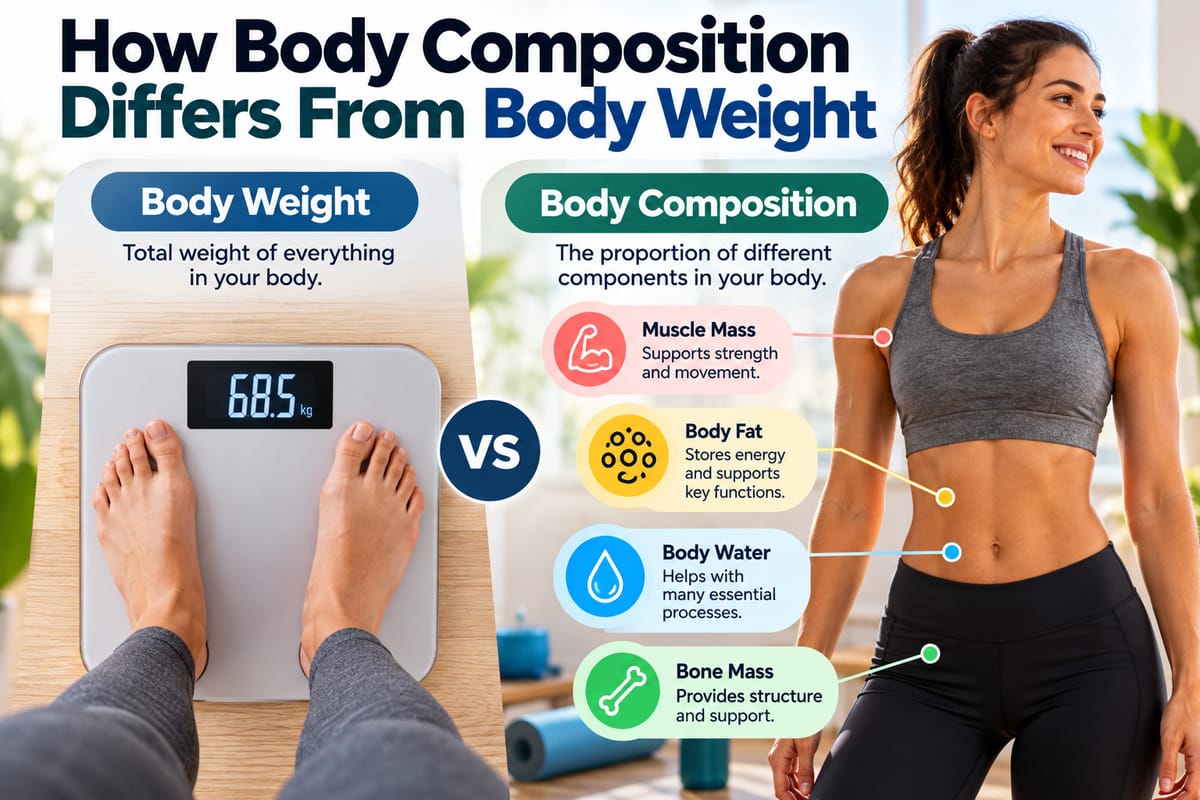

How Body Composition Differs From Body Weight
Body weight is one of the simplest measurements used to describe the human body, but it does not tell the whole story about health or physical fitness.
Two people can weigh exactly the same amount while having very different proportions of muscle, fat, bone, water, and other tissues. Likewise, a person can maintain a similar body weight while their body composition changes significantly over time.
Understanding the difference between body composition and body weight provides a more complete way to think about physical health, fitness, nutrition, and changes in the body.
What Is Body Weight?
Body weight is the total weight of everything that makes up the body at a particular moment.
It includes:
- Muscle tissue
- Body fat
- Bones
- Water
- Organs
- Blood
- Connective tissue
- Other body tissues
A scale measures the combined result of all these components.
Body weight can also fluctuate naturally from day to day. Changes in hydration, food and fluid intake, digestion, sodium consumption, hormonal changes, and other factors can temporarily affect the number shown on a scale.
This means that a single weight measurement provides only limited information about what is happening inside the body.
What Is Body Composition?
Body composition refers to the relative amounts of different components that make up the body.
It is commonly discussed in terms of:
- Fat mass
- Fat-free mass
Fat-free mass includes muscle, bone, organs, body water, connective tissue, and other non-fat components.
More detailed assessments can divide the body into additional components.
The key difference is that body weight tells you how much the body weighs, while body composition provides information about what that weight consists of.
Why Two People With the Same Weight Can Look Different
Imagine two adults who both weigh 80 kilograms.
One person may have relatively more muscle and less body fat, while the other may have less muscle and more body fat.
Their scales show the same number, but their bodies are composed differently.
This is partly because muscle and fat have different physical characteristics and distributions.
The difference can become particularly noticeable among people who participate in strength training, athletics, or other forms of regular physical activity.
A person’s appearance is influenced by many factors, including muscle development, fat distribution, bone structure, height, posture, and genetics.
Why Muscle Matters When Looking at Body Composition
Muscle is part of fat-free mass and plays important roles in movement, strength, physical function, and energy expenditure.
Regular resistance exercise can increase or preserve muscle tissue, particularly when combined with adequate nutrition and recovery.
This is one reason that a person may become stronger or change body shape without experiencing a large change in body weight.
For a broader understanding of movement and fitness, The Complete Guide to Physical Activity and Exercise provides useful context about different forms of physical activity and their role in health.
Body Fat Is Another Important Component
Body fat is not simply something the body should have as little of as possible.
Fat serves several physiological functions, including:
- Storing energy
- Supporting cell membranes
- Helping produce certain hormones
- Insulating the body
- Protecting internal organs
- Helping the body absorb fat-soluble vitamins
However, the amount and distribution of body fat can have implications for health.
This is why body composition discussions need to avoid treating either body fat or body weight as a simple measure of whether someone is healthy or unhealthy.
Body Water Can Affect Body Weight
Water makes up a substantial portion of the human body.
As a result, changes in hydration can cause noticeable short-term changes in body weight without representing changes in muscle or body fat.
For example, weight may temporarily increase after consuming more fluids or decrease after losing water through sweating.
Dietary sodium, carbohydrate intake, physical activity, illness, environmental conditions, and other factors can also influence fluid balance.
This is one reason that short-term changes on a scale should not automatically be interpreted as changes in body fat.
Bone and Other Lean Tissues Contribute to Weight
Bones, organs, connective tissue, and other structures also contribute to body weight.
Bone mass can differ between individuals based on factors including genetics, age, sex, physical activity, and other influences.
The body’s lean tissues therefore represent much more than muscle alone.
When people discuss “lean mass,” they should remember that the term generally encompasses several non-fat components of the body.
Body Composition Can Change Without Major Weight Changes
One of the most important differences between the two concepts is that body composition can change while body weight remains relatively stable.
For example, someone who begins resistance training and improves their diet may gain some muscle while losing some body fat.
If the amounts change in opposite directions, the scale may show little overall change.
This is sometimes described as a change in body composition or body recomposition.
The person may notice differences in strength, measurements, clothing fit, or physical appearance even when their body weight changes very little.
Weight Loss Does Not Always Mean Fat Loss
A reduction in body weight does not necessarily represent an equivalent reduction in body fat.
Weight loss can involve changes in:
- Body water
- Stored carbohydrates
- Digestive contents
- Fat tissue
- Muscle tissue
- Other tissues
The proportions depend on factors such as the individual’s diet, activity level, rate of weight loss, starting body composition, and other circumstances.
This is why focusing exclusively on the scale can sometimes provide an incomplete picture.
Weight Gain Does Not Always Mean Fat Gain
The same principle works in the opposite direction.
An increase in body weight can result from several different changes.
Someone who begins a structured strength-training program may gain muscle over time. Increased food or fluid intake can also produce temporary increases in scale weight.
The context surrounding a change therefore matters.
Instead of asking only, “Did my weight change?” it can be useful to ask, “What might be contributing to that change?”
The Role of Nutrition in Body Composition
Nutrition provides the energy and nutrients required for normal physiological functions and physical activity.
Protein is particularly important for maintaining and building muscle tissue.
Why Does the Body Need Protein Every Day? explains the broader role of protein in the body and why regular dietary intake matters.
Other nutrients are important as well. Carbohydrates provide an important source of energy, while dietary fats have numerous physiological functions. Vitamins, minerals, fiber, and water also contribute to overall nutrition.
A healthy eating pattern should therefore be considered as a whole rather than focusing on one nutrient or food.
Nutrient Density and Body Composition
Food quality can influence the overall nutritional value of a person’s diet.
Nutrient-dense foods provide substantial amounts of useful nutrients relative to their energy content.
The principles described in What Nutrient Density Means and How to Choose Nutrient-Dense Foods can help explain why the overall quality of food choices matters.
Examples of nutrient-rich foods can include:
- Vegetables
- Fruits
- Legumes
- Whole grains
- Nuts and seeds
- Fish
- Eggs
- Dairy or suitable alternatives
- Lean meats
- Other minimally processed foods
The appropriate balance depends on individual nutritional needs, preferences, culture, and circumstances.
How Exercise Can Influence Body Composition
Physical activity can affect body composition in different ways.
Aerobic activities such as walking, cycling, swimming, and running can increase energy expenditure and support cardiovascular fitness.
Resistance training provides a stimulus for maintaining or developing muscle.
Other forms of physical activity can support balance, mobility, coordination, and physical function.
A combination of different activities may therefore be useful for overall health.
However, the response to exercise varies between individuals. Training frequency, intensity, nutrition, recovery, age, genetics, and previous fitness experience can all influence changes in body composition.
Body Composition and Healthy Weight Management
Body composition is one factor that can provide additional context when thinking about weight management.
A Complete Guide to Healthy Weight Management can help place body weight within the broader context of nutrition, physical activity, sustainable habits, and overall health.
Healthy weight management does not necessarily mean trying to achieve the lowest possible number on a scale.
Instead, a person’s goals may involve:
- Maintaining physical function
- Supporting healthy eating patterns
- Developing sustainable activity habits
- Preserving muscle
- Supporting cardiovascular health
- Improving fitness
- Maintaining an appropriate weight for their circumstances
Individual health goals can vary considerably.
Common Ways Body Composition Is Estimated
There are several methods for estimating body composition.
Skinfold Measurements
Skinfold assessments use calipers to measure the thickness of subcutaneous fat at specific locations.
The measurements can then be used in equations designed to estimate body fat.
Results depend heavily on measurement technique and the method used to calculate the estimate.
Bioelectrical Impedance Analysis
Bioelectrical impedance devices send a small electrical current through the body and use electrical resistance measurements to estimate body composition.
These devices are widely available, including in some household scales.
However, hydration status and other factors can affect measurements.
Dual-Energy X-Ray Absorptiometry
Dual-energy X-ray absorptiometry, often called DXA or DEXA, can provide detailed measurements of bone mineral content, fat mass, and lean mass.
It is used in clinical and research settings but is not typically necessary for everyday health monitoring.
Other Assessment Methods
Researchers and healthcare professionals may also use other techniques, including imaging-based methods and laboratory approaches, depending on the purpose of the assessment.
No measurement method is perfect.
Why Body Composition Measurements Can Vary
Body composition estimates should be interpreted with care because different methods can produce different results.
Measurements can be influenced by:
- Hydration
- Recent meals
- Exercise
- Body temperature
- Device characteristics
- Measurement technique
- Time of day
- Individual physiology
For this reason, comparing measurements taken under similar conditions can sometimes be more useful than comparing isolated measurements taken under very different circumstances.
Waist Measurements Provide Additional Context
Body weight and body composition are not the only measurements that can provide information about body size and health.
Waist circumference can provide information about abdominal fat distribution.
Fat distribution matters because fat stored around the abdominal region can have different health associations from fat stored in other parts of the body.
However, waist measurements also have limitations and should not be interpreted in isolation.
A broader assessment may consider multiple factors rather than relying on one measurement.
Why Body Mass Index Is Not the Same as Body Composition
Body mass index, or BMI, is calculated using height and weight.
It is commonly used as a population-level screening measure, but it does not directly measure body fat or distinguish between muscle and fat.
For example, a muscular person may have a relatively high BMI despite having a comparatively low amount of body fat.
Conversely, someone can have a BMI within a particular range while still having a body composition that does not reflect their overall health or fitness.
BMI can therefore provide useful context in some settings but should not be treated as a direct body composition measurement.
Looking Beyond the Scale
For people interested in health and fitness, the scale can be one source of information among several.
Other indicators can include:
- Strength
- Cardiovascular fitness
- Mobility
- Waist circumference
- Physical performance
- Energy levels
- Dietary quality
- Sleep
- Recovery
- General physical function
These measures can provide additional context that a single body-weight number cannot capture.
For example, someone may maintain the same weight while becoming stronger, more physically active, and better conditioned.
Body Composition Changes Over Time
Body composition naturally changes throughout life.
Age-related changes can influence muscle mass, fat distribution, bone health, and overall physical function.
Physical activity, nutrition, illness, hormonal changes, lifestyle, and other factors can also affect composition.
This means that comparing body composition with an arbitrary ideal may not always provide useful information.
A more meaningful approach is often to consider changes in relation to a person’s age, health, physical function, goals, and circumstances.
A More Complete Way to Understand Body Changes
Body weight is a simple and accessible measurement, but it represents only the total mass of the body at a particular moment.
Body composition provides additional information by examining how that weight is distributed among fat, muscle, bone, water, and other tissues.
This distinction explains why two people can have the same weight but different physical characteristics and why an individual’s body can change even when the scale barely moves.
Nutrition, physical activity, sleep, genetics, age, and many other factors influence body composition. Rather than treating the scale as the sole measure of progress, it can be more useful to consider a combination of health, fitness, physical function, and sustainable lifestyle habits.
Understanding Progress Beyond a Number
Body weight can be useful information, but it is only one part of the picture.
When someone is working toward better health, changes in strength, fitness, nutrition, physical activity, body composition, and everyday function can all provide meaningful context.
Understanding the difference between weight and composition makes it easier to recognize that progress does not always appear as a dramatic change on the scale. Health is multidimensional, and the numbers that matter most depend on the individual and the purpose of the measurement.
Continue Reading
Similar Posts

How Meal Planning Supports Healthy Eating
Meal planning does not require complicated recipes, strict diets, or preparing every meal days in advance. It can be as simple as deciding on several meals, creating a shopping list, and making sure the kitchen has the ingredients needed to prepare balanced options.
Read article
How Dehydration Affects the Body
Understanding how dehydration affects the body can make it easier to recognize early signs, understand when fluid needs increase, and take practical steps to maintain adequate hydration.
Read article
How Heat and Climate Affect Hydration
Understanding these relationships can make it easier to adapt fluid intake to changing conditions rather than relying on the same hydration habits throughout the year.
Read article

Join 10,000+ Readers Building Healthier Habits
Get actionable wellness tips every week plus our newest articles delivered straight to your inbox.