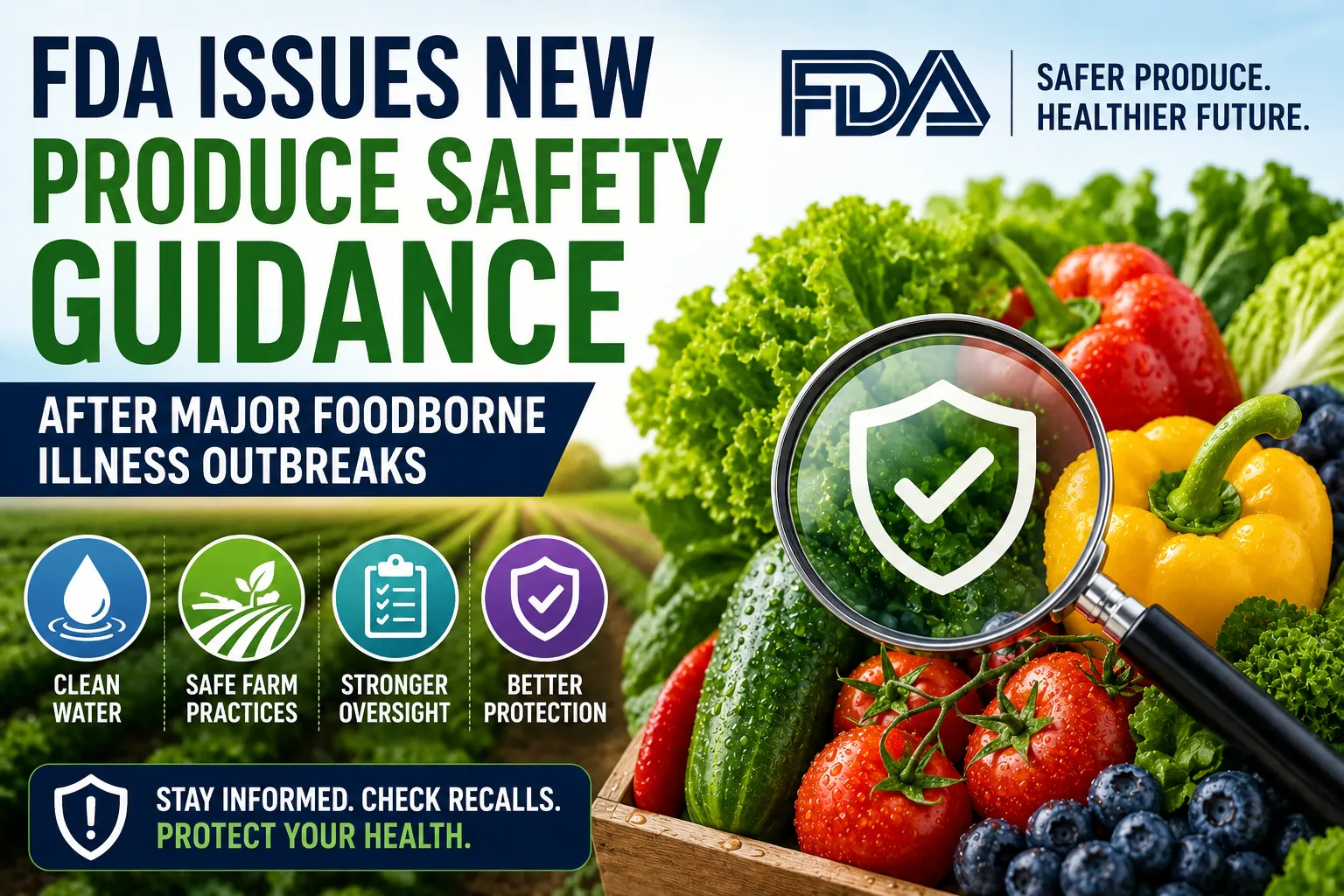

FDA Issues New Produce Safety Guidance After Major Foodborne Illness Outbreaks
Fresh fruits and vegetables are central to a healthy diet, but their journey from farm to table also creates food-safety challenges. Produce can become contaminated during growing, harvesting, packing, transportation or handling, and several foodborne illness investigations in 2026 have renewed attention on how those risks are managed.
Recent U.S. Food and Drug Administration (FDA) actions show a broader push to strengthen produce safety. The agency has introduced new regulatory program standards for state produce regulators, advanced work on agricultural water and sprout safety, assessed risks associated with untreated manure and other biological soil amendments, and continued responding to outbreaks involving products such as frozen blueberries and iceberg lettuce.
The developments matter not only to growers and food businesses but also to consumers who want to understand how produce safety is monitored and what they can do to reduce their own risk.
Why Produce Safety Is Receiving More Attention
Unlike many foods that undergo cooking or extensive processing, fresh produce is often eaten raw or with minimal preparation.
That means contamination introduced earlier in the supply chain may remain a concern when the food reaches consumers.
The FDA notes that pathogens such as Shiga toxin-producing E. coli (STEC) and Salmonella can contaminate produce, with risks influenced by environmental conditions and agricultural practices.
Potential contamination points include:
- Agricultural water
- Soil amendments and manure
- Farm workers
- Harvesting equipment
- Packing facilities
- Transportation
- Storage
- Retail handling
- Cross-contamination in kitchens
Food safety is therefore a supply-chain issue rather than something that begins when a consumer brings produce home.
What the FDA Is Changing
It is important to distinguish between a single new regulation and the FDA’s broader series of produce-safety initiatives.
In February 2026, the FDA announced Produce Regulatory Program Standards, developed with state and industry regulatory partners. The standards are intended to create a more consistent foundation for produce-safety oversight across federal, state, local and tribal agencies.
The agency has also identified fresh and processed produce safety as a 2026 priority area.
Its planned work includes additional grower training on agricultural-water requirements, updated training for sprout producers, research into Salmonella in cantaloupes, new cantaloupe safety guidelines, a leafy-greens data-sharing pilot, a cucumber safety initiative in Florida and cooperation involving produce imported from Mexico.
So, rather than viewing the changes as one isolated piece of guidance, it is more accurate to see them as part of a wider effort to improve produce safety oversight.
Recent Outbreaks Highlight the Challenge
The FDA’s 2026 public-health advisories include several foodborne illness events involving foods ranging from eggs and iceberg lettuce to frozen blueberries.
One notable investigation involved E. coli O145:H28 and frozen organic blueberries.
According to the FDA, a multistate outbreak investigation linked illnesses to GreenWise organic frozen blueberries. Twelve people in two states had been reported infected with the outbreak strain, with four hospitalizations and no reported deaths as of the agency’s July 30 update.
Publix subsequently recalled all lots of certain GreenWise organic frozen blueberries and whole mixed berries because of potential E. coli contamination.
The episode illustrates why traceback and supply-chain monitoring are so important: investigators may need to connect illnesses reported in different locations with a common food product, supplier or production source.
Iceberg Lettuce and Cyclospora
Another ongoing investigation involves Cyclospora, a parasite that can cause intestinal illness.
The FDA listed an active investigation linked to iceberg lettuce in July 2026 and reported that the investigation was ongoing.
Cyclospora is particularly relevant to produce safety because contaminated fresh produce can serve as a vehicle for transmission.
For consumers, the broader lesson is that food-safety risks are not limited to familiar bacterial pathogens such as Salmonella and E. coli.
Why Agricultural Water Matters
Water used on farms can become an important pathway for contamination.
Agricultural water may be used for activities including:
- Irrigation
- Crop cooling
- Produce washing
- Spraying
- Other growing and harvesting activities
If water becomes contaminated with pathogens, it can potentially transfer those organisms to crops.
The FDA’s 2026 produce-safety priorities include additional training for growers concerning agricultural-water requirements.
This reflects a broader shift toward preventing contamination before produce reaches processing facilities or stores.
The Role of Manure and Soil Amendments
Farmers use biological soil amendments, including animal manure, to improve soil fertility.
However, untreated manure can contain microorganisms capable of causing human illness.
In March 2026, the FDA released a risk assessment examining the risk of foodborne illness associated with produce grown in fields amended with untreated biological soil amendments of animal origin, including raw manure.
The assessment examined how pathogens such as:
- STEC O157:H7
- Non-O157 STEC
- Salmonella
can survive and potentially contaminate crops.
The FDA said the findings would help inform policy decisions concerning appropriate standards for the use of raw manure and other untreated biological soil amendments.
Why Grower Practices Matter
Produce safety begins well before a product reaches a supermarket.
Growers and agricultural businesses need to consider potential contamination during:
- Planting
- Irrigation
- Fertilization
- Harvesting
- Equipment maintenance
- Worker handling
- Packing
The FDA’s existing guidance for fresh fruits and vegetables addresses areas including agricultural and postharvest water, manure and biosolids, worker health and hygiene, sanitation, transportation and traceback.
Good agricultural practices can therefore reduce the likelihood that contamination reaches later stages of the supply chain.
What Produce Safety Means for Consumers
Government oversight and agricultural controls are only part of the food-safety system.
Consumers also have an important role once produce enters the home.
The FDA recommends four basic food-safety principles:
Clean, separate, cook and chill.
For produce, cleaning hands, surfaces and utensils can help reduce the risk of transferring contamination.
Should You Wash Fruits and Vegetables?
Washing produce under running water can help remove dirt and some microorganisms from the surface.
However, washing does not guarantee that all harmful organisms will be eliminated.
Consumers should also avoid using household soaps or detergents on food unless a product is specifically intended and approved for that purpose.
For packaged produce, follow the handling instructions on the label.
Prevent Cross-Contamination
One of the easiest ways to undermine food safety is to allow contaminated food to come into contact with other foods or kitchen surfaces.
Use care when handling produce alongside:
- Raw meat
- Poultry
- Seafood
- Eggs
- Unwashed produce
Keep cutting boards and utensils clean, and wash your hands before and after handling foods when appropriate.
The FDA specifically recommends cleaning and sanitizing surfaces that may have contacted recalled food during an outbreak.
What Consumers Should Do During a Produce Recall
When a specific produce item is recalled, consumers should follow the recall instructions rather than simply washing the product and eating it.
For recalled produce, the FDA advises consumers not to eat the affected product and recommends following instructions for disposal or return.
Consumers should also check:
- The brand
- Product name
- Package size
- Lot number
- UPC
- Best-by date
- Distribution information
Not every product within the same general category is necessarily included in a recall.
Food recalls can also extend beyond fresh fruits and vegetables when a contaminated ingredient is used in prepared foods. For example, the Taylor Farms recall and what consumers need to know about the latest Salmonella risk illustrates how an ingredient-related food-safety problem can affect products further along the supply chain.
Why Frozen Produce Is Not Automatically Risk-Free
Freezing can preserve food for long periods, but it does not necessarily eliminate every pathogen.
The FDA notes, for example, that Listeria monocytogenes does not grow at freezer temperatures but can survive freezing.
This is why consumers should still follow recall notices involving frozen fruits and vegetables.
The frozen-blueberry investigation demonstrates that food-safety concerns can involve products that consumers might otherwise assume are protected simply because they have been frozen.
How Foodborne Illness Investigations Work
When multiple people become ill after consuming the same food, public-health agencies investigate whether the illnesses are connected.
An investigation can involve:
- Interviews with people who became sick.
- Laboratory testing.
- Epidemiological analysis.
- Food-supply traceback.
- Inspections.
- Product sampling.
- Recalls where appropriate.
The FDA’s CORE Network coordinates investigations involving FDA-regulated foods and works with federal, state and local partners.
Investigations can take time because investigators must establish evidence connecting illnesses to a specific product or source.
Why Traceability Is Important
Traceability allows investigators to follow food through the supply chain.
When an outbreak occurs, investigators may need to determine:
- Where the food was grown
- Who processed it
- Which facilities handled it
- Where it was distributed
- Which stores received it
- Which consumers may have purchased it
Better traceability can help regulators identify potentially contaminated products more quickly and narrow the scope of recalls.
The FDA has also been working on broader efforts to improve outbreak response and food traceability.
What Retailers Need to Know
Retailers play an important role when a contaminated product is recalled.
The FDA advises retailers to stop selling or serving recalled produce and keep it separated from other food and equipment. Retailers should also assess whether cross-contamination could have occurred and determine the source of the affected product.
Employees who handle recalled produce should wash their hands thoroughly afterward.
These procedures are designed to prevent a contaminated product from creating additional exposure after it has already entered the retail environment.
What Food Businesses Should Watch
Produce growers, packers, distributors and retailers should pay close attention to evolving FDA guidance and outbreak alerts.
Key areas include:
Agricultural Water
Businesses should understand applicable requirements and evaluate potential water-contamination risks.
Worker Hygiene
Employee health and hygiene can be important barriers against contamination.
Sanitation
Equipment and food-contact surfaces need appropriate cleaning and sanitation.
Transportation
Produce should be protected from contamination during transportation and handled under appropriate conditions.
Traceability
Businesses should maintain records that can help identify where products came from and where they went.
Is the FDA Banning Raw Manure?
The FDA’s 2026 risk assessment concerning untreated biological soil amendments should not be interpreted as an announcement of a blanket ban on raw manure.
The agency said the assessment would be used to inform policy decisions about appropriate standards for the use of raw manure and other untreated biological soil amendments.
That distinction matters.
A risk assessment evaluates evidence and potential hazards; it is not necessarily the same thing as a new final regulation.
What the New Produce Standards Could Mean
The FDA’s new Produce Regulatory Program Standards are intended to provide a more consistent framework for government produce regulators.
That could help strengthen coordination between different levels of government and create greater consistency in how produce-safety programs are implemented and evaluated.
For consumers, the benefit may be less visible than a product recall but potentially important over the long term.
More consistent oversight can contribute to earlier detection of problems and better prevention practices.
Produce Remains an Important Part of a Healthy Diet
Food-safety concerns should not discourage people from eating fruits and vegetables.
Produce remains an important source of nutrients and is a central component of healthy eating patterns.
The FDA itself describes produce as an essential component of a nutrient-dense, whole-foods diet while emphasizing the importance of improving its safety.
The goal of produce-safety policies is therefore not to make people avoid fruits and vegetables.
It is to reduce preventable contamination while keeping nutritious foods available to consumers.
A Safer Path From Farm to Table
The latest FDA actions show that produce safety is increasingly being approached as a farm-to-table system rather than a problem that can be solved at the supermarket or kitchen sink alone.
Recent outbreaks involving foods such as frozen blueberries and iceberg lettuce have highlighted the importance of surveillance, traceback, agricultural practices, sanitation and rapid communication. At the same time, the FDA’s 2026 agenda includes broader work on agricultural water, sprouts, cantaloupes, leafy greens, cucumbers and imported produce.
For consumers, the practical message is straightforward: pay attention to current recall notices, handle produce carefully, prevent cross-contamination and follow official instructions when a food-safety alert affects something in your home.
For the food industry, the larger challenge is prevention—identifying contamination risks early enough that unsafe produce never reaches the consumer.
Food-safety rules can also affect products beyond fresh produce. Consumers following developments such as the new orange juice rule taking effect August 19 can see how regulatory changes can shape the safety requirements surrounding foods they regularly purchase.
Continue Reading
Similar Posts
Broccoli Sprouts Linked to Multistate Salmonella Outbreak: What Consumers Need to Know
For consumers, the most important step is to determine whether recalled broccoli sprouts are in the refrigerator, freezer, or kitchen and to avoid eating, serving, or selling them.
Read article
Fibermaxxing Is Taking Over Social Media: How Much Fiber Is Actually Too Much
More is not automatically better. Increasing fiber too rapidly or consuming very large amounts can cause bloating, gas, abdominal discomfort, constipation, or changes in bowel habits.
Read article
Salmonella Outbreak Linked to Broccoli Sprouts: What Consumers Need to Know
For consumers, the most important issue right now is knowing what products are affected, what symptoms to watch for, and how to reduce the risk of foodborne illness.
Read article

Join 10,000+ Readers Building Healthier Habits
Get actionable wellness tips every week plus our newest articles delivered straight to your inbox.