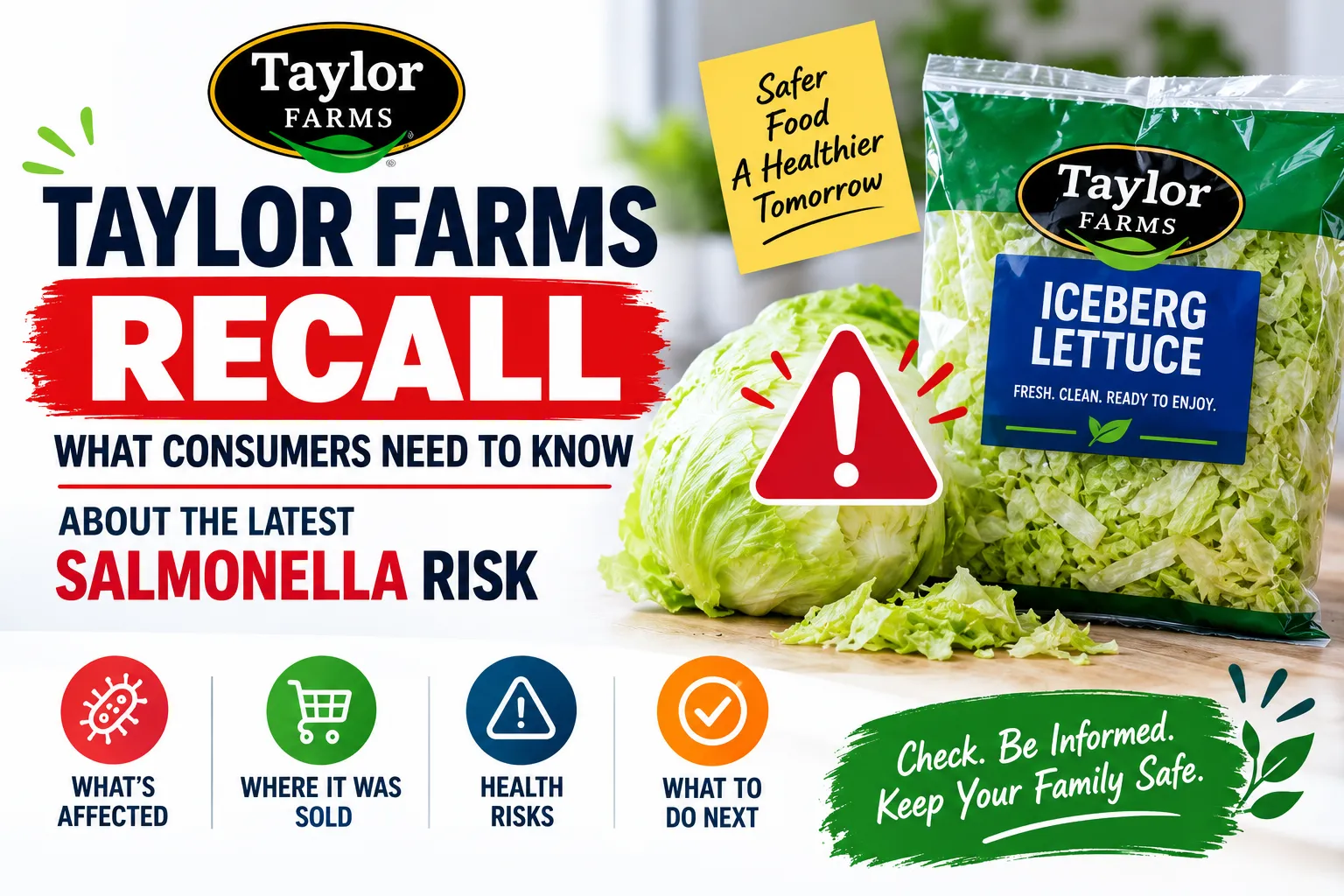

Taylor Farms Recall: What Consumers Need to Know About the Latest Salmonella Risk
A recent Taylor Farms recall has put food safety back in the spotlight, but there is an important detail consumers should know: the latest Taylor Farms recall involves a possible Cyclospora contamination risk, not Salmonella.
Taylor Farms de Mexico announced on July 17, 2026, that it was voluntarily removing iceberg lettuce sourced from central Mexico from the U.S. market. The action followed a multistate outbreak investigation involving Cyclospora, a microscopic parasite that can cause a prolonged intestinal illness known as cyclosporiasis.
The recall affects certain retail and food-service products, including Marketside-brand iceberg salads and shredded lettuce sold at select Walmart stores, as well as iceberg lettuce distributed to food-service customers.
For consumers who may have purchased the affected products, understanding what was recalled, where it was distributed, what symptoms to watch for, and what to do next is important.
A Key Correction: This Recall Involves Cyclospora, Not Salmonella
The title of this article refers to a “Salmonella risk,” but the current Taylor Farms recall is specifically connected to possible Cyclospora contamination.
The U.S. Food and Drug Administration lists the July 2026 Taylor Fresh Foods recall as a food-safety recall involving possible Cyclospora contamination. FDA’s investigation has linked illnesses to shredded iceberg lettuce supplied by Taylor Farms de Mexico.
Salmonella is a different foodborne pathogen and is responsible for separate recalls and outbreaks.
This distinction matters because Cyclospora is a parasite rather than a bacterium, and the illness it causes has different characteristics and treatment considerations.
For broader context on how investigations can lead to recalls and additional food-safety alerts, see the complete guide to FDA food safety investigations and new recalls.
What Is Cyclospora?
Cyclospora cayetanensis is a microscopic parasite that infects the intestinal tract.
People can become infected after consuming food or water contaminated with the parasite. According to the CDC, cyclosporiasis is generally not life-threatening, but it can cause significant and sometimes prolonged gastrointestinal illness.
Fresh produce has been associated with Cyclospora outbreaks in the United States, including imported produce.
One reason these outbreaks can be difficult to identify is that symptoms may not appear immediately after someone eats contaminated food.
Why Was Taylor Farms Lettuce Recalled?
The recall followed a multistate investigation into illnesses associated with shredded iceberg lettuce.
FDA’s traceback investigation found that Taylor Farms de Mexico was a common supplier of shredded iceberg lettuce used at Taco Bell locations where people who became sick had reported eating.
Based on epidemiological and traceback information, FDA and its partners continued to focus on shredded iceberg lettuce supplied by Taylor Farms from growers in central Mexico.
Taylor Farms subsequently voluntarily removed iceberg lettuce sourced from central Mexico from the U.S. market and suspended distribution of that lettuce.
The company says it is working with the FDA, CDC, and state authorities as the investigation continues.
What Products Are Included in the Recall?
The recall covers a range of iceberg lettuce products distributed to retail and food-service customers.
Among the consumer products specifically identified by FDA are:
- Marketside Iceberg Salad — 12 oz and 24 oz
- Marketside Shredded Lettuce — 8 oz and 16 oz
The listed Best if Used By dates for these products range from July 18, 2026, through August 3, 2026.
The recall also covers numerous food-service products, including chopped lettuce, shredded lettuce, lettuce salad mixes, and lettuce blends sold under several brand or customer labels.
Because the food-service list is extensive, restaurants and institutions that receive produce through commercial suppliers should check the official recall information rather than relying only on consumer product names.
Where Were the Recalled Products Distributed?
The affected lettuce was distributed through food-service channels in numerous states.
Taylor Fresh Foods reported distribution of the recalled shredded iceberg products from June 29 through July 16, 2026, across states including:
- Alabama
- Arkansas
- Connecticut
- Florida
- Georgia
- Illinois
- Indiana
- Kansas
- Kentucky
- Louisiana
- Maryland
- Michigan
- Missouri
- Mississippi
- North Carolina
- New Jersey
- Ohio
- Oklahoma
- Pennsylvania
- South Carolina
- Tennessee
- Texas
- Virginia
- Wisconsin
Additional states are included in the official recall information.
The recalled Marketside products were sold at select Walmart stores in:
- Alabama
- Arkansas
- Florida
- Georgia
- Indiana
- Kansas
- Kentucky
- Louisiana
- Missouri
- Mississippi
- Oklahoma
- Tennessee
- Texas
- Virginia
- West Virginia
Consumers should check the official recall information rather than assuming that every Walmart store or every product carrying the Marketside name was affected.
What About Taco Bell?
The investigation also involved Taco Bell locations.
FDA said illnesses were associated with exposure to shredded iceberg lettuce served at Taco Bell locations in several states. As the investigation expanded, the number of states involved increased to nine.
Taco Bell has said it stopped using lettuce from Taylor Farms de Mexico as of July 17, 2026.
This does not mean that every Taco Bell restaurant was affected.
The relevant concern is whether a particular location received and served the recalled lettuce.
How Serious Is the Outbreak?
As of the FDA’s July 24 update, 1,947 people infected with Cyclospora who reported Taco Bell exposure had been reported across nine states.
The reported illnesses began between June 22 and July 20, 2026. At least 98 hospitalizations had been reported, and no deaths had been reported.
FDA cautioned that the number of confirmed cases could continue to change.
One reason is the relatively long period between exposure and confirmation of an illness. Officials noted that it can take as long as six weeks for health authorities to determine whether someone who became sick is part of an outbreak.
What Are the Symptoms of Cyclospora Infection?
The most common symptom is watery diarrhea.
Other possible symptoms include:
- Loss of appetite
- Weight loss
- Stomach cramps
- Abdominal discomfort
- Bloating
- Increased gas
- Nausea
- Fatigue
- Vomiting
- Body aches
- Headache
- Low-grade fever
Some people infected with Cyclospora may have no symptoms at all.
One of the more frustrating characteristics of cyclosporiasis is that symptoms can disappear and then return.
Without treatment, illness can last from several days to a month or longer.
When Do Symptoms Appear?
Cyclospora symptoms usually begin about one week after infection, although the CDC says the interval can range from about two days to two weeks or more.
That delay can make it difficult for someone to immediately identify which food caused an illness.
For example, a person who develops diarrhea several days after eating a salad may not immediately associate the illness with that meal.
This is one reason public-health investigations rely on information from many people rather than a single person’s recollection.
Who May Be More Vulnerable?
Cyclospora can affect anyone who consumes contaminated food or water.
However, people with weakened immune systems may experience more severe or prolonged illness and complications. FDA specifically warns that immunocompromised people can experience longer-lasting illness requiring closer medical attention.
Anyone experiencing persistent or concerning gastrointestinal symptoms should speak with a healthcare professional.
How Is Cyclospora Diagnosed?
Diagnosing Cyclospora is not always straightforward.
The CDC notes that routine stool testing does not necessarily include Cyclospora. Healthcare professionals may need to specifically request testing for the parasite.
In some cases, more than one stool sample collected on different days may be necessary because the parasite can be difficult to detect.
This is particularly important for people experiencing prolonged diarrhea or other symptoms consistent with cyclosporiasis.
How Is Cyclosporiasis Treated?
According to the CDC, cyclosporiasis is commonly treated with the antibiotic trimethoprim-sulfamethoxazole.
People experiencing diarrhea should also maintain adequate fluid intake to reduce the risk of dehydration.
Treatment decisions should be made with a healthcare professional rather than through self-medication.
If symptoms persist, recur, or become severe, medical evaluation is especially important.
What Should Consumers Do If They Bought Recalled Lettuce?
If you have recalled Taylor Farms iceberg lettuce in your refrigerator, do not eat it.
Taylor Farms advises consumers who purchased recalled iceberg lettuce to discard it immediately. The company also says consumers can seek a refund from the location where the product was purchased.
Consumers should check the product description and Best if Used By date against the official recall information.
Do not assume that a product is safe simply because:
- It looks normal.
- It smells normal.
- It is still within its date.
- Nobody in the household has become sick.
- It was purchased recently.
Food contaminated with a pathogen or parasite may not show obvious signs of spoilage.
Should You Wash the Recalled Lettuce?
No.
If a product is specifically included in a recall, washing it is not an appropriate substitute for discarding it.
The safest approach is to follow the recall instructions and dispose of the affected product.
The CDC recommends general produce-handling practices such as washing fruits and vegetables under running water, but it also notes that food labeled prewashed does not need to be washed again.
For recalled food, however, consumers should follow the recall notice rather than attempting to make the product safe through additional washing.
What If You Already Ate the Lettuce?
Eating a recalled product does not necessarily mean that you will become ill.
However, consumers who ate recalled lettuce should pay attention to their health and be aware of the symptoms associated with Cyclospora infection.
Because symptoms can take about a week or longer to appear, people should not assume that they are unaffected simply because they feel fine immediately after eating the product.
If symptoms develop—particularly persistent or severe diarrhea—contact a healthcare professional and mention the possible exposure to recalled lettuce.
That information can help a healthcare provider determine whether Cyclospora testing may be appropriate.
What About Lettuce That Was Already Served?
Restaurants, schools, hospitals, caterers, and other food-service operations that receive commercial produce should check their inventories and supplier information against the official recall.
The recall covers numerous food-service products and date ranges, so businesses should use the detailed recall list rather than relying only on the general description of “iceberg lettuce.”
Any recalled product should not be served to customers.
An Important Update About Product Testing
The investigation has also highlighted the challenges involved in detecting Cyclospora.
FDA initially reported a positive result involving a lettuce sample, but on July 19 the agency said its laboratory experts had re-reviewed the result and determined that it was a false positive.
As of that update, FDA and state partners had not confirmed a positive product sample for Cyclospora.
Importantly, FDA said the false-positive result did not change the basis for its ongoing investigation or the epidemiological evidence supporting the recall.
This is an important distinction: a foodborne outbreak investigation can rely on multiple types of evidence, including epidemiological patterns and traceback information, rather than requiring every recalled food sample to test positive.
Why Food Recalls Can Happen Before Every Sample Tests Positive
Consumers sometimes assume that a recall should only occur after a contaminated package has been definitively identified in a laboratory.
Public-health investigations do not always work that way.
Officials can examine:
- Where sick people ate
- What foods they consumed
- Common suppliers
- Distribution records
- Timing of illnesses
- Laboratory results
- Genetic or epidemiological relationships
- Production and supply-chain information
When multiple lines of evidence point toward a common food source, regulators and companies may take precautionary action while laboratory testing continues.
The Taylor Farms case demonstrates why traceback investigations can be important in food safety.
How Cyclospora Differs From Salmonella
Because the title of this article mentions Salmonella, it is worth making the distinction clear.
Salmonella is a group of bacteria, while Cyclospora is a microscopic parasite.
Both can cause gastrointestinal illness, but they are different organisms and can behave differently.
Salmonella infections can cause diarrhea, fever, stomach cramps, nausea, and vomiting, while cyclosporiasis is particularly associated with prolonged or recurring watery diarrhea, loss of appetite, weight loss, bloating, and fatigue.
The appropriate testing and treatment can also differ.
Consumers should therefore avoid assuming that every food recall involving gastrointestinal illness is a Salmonella recall.
What Consumers Can Learn From the Recall
Food recalls can be disruptive, but they also highlight the importance of paying attention to food-safety alerts.
Fresh produce can move through complicated supply chains before reaching supermarkets, restaurants, and consumers.
A single supplier can potentially distribute ingredients to numerous businesses and locations.
That means a recall can expand quickly when investigators identify a common source.
For consumers, the most useful response is not panic.
It is checking the specific product information and following official instructions.
How to Stay Updated on Food Recalls
Consumers can reduce their risk by regularly checking official food-safety sources.
The FDA maintains a database of recalls, market withdrawals, and safety alerts. Consumers can also follow CDC outbreak investigations when illnesses are involved.
For this particular recall, Taylor Farms maintains an official recall page containing product and consumer information.
What Happens Next?
The Taylor Farms recall is part of an ongoing public-health investigation, and information can change as investigators gather additional evidence.
Consumers should therefore rely on updated information from the FDA, CDC, Taylor Farms, and relevant state health authorities rather than older social-media posts or unverified recall lists.
For now, the key message is straightforward: do not consume products included in the Taylor Farms iceberg lettuce recall.
And while the headline may refer to a Salmonella risk, the current Taylor Farms alert is specifically about Cyclospora, a parasite associated with an ongoing multistate outbreak investigation.
The Safest Response Is to Check, Not Guess
Food recalls can create confusion, particularly when multiple foodborne illness outbreaks are happening at the same time.
In the Taylor Farms case, the most important distinction is that the latest recall is connected to a possible Cyclospora contamination risk rather than Salmonella. The recalled iceberg lettuce includes specific retail and food-service products, dates, and distribution areas, so consumers should check the official recall information carefully.
If you have an affected product, discard it rather than trying to salvage it. If you consumed recalled lettuce and later develop persistent diarrhea or other concerning symptoms, tell a healthcare professional about the possible exposure.
The broader lesson is simple: when food-safety officials issue a recall, the safest approach is to verify the product, follow the disposal or refund instructions, and rely on current information from official public-health sources rather than assumptions.
Continue Reading
Similar Posts
Broccoli Sprouts Linked to Multistate Salmonella Outbreak: What Consumers Need to Know
For consumers, the most important step is to determine whether recalled broccoli sprouts are in the refrigerator, freezer, or kitchen and to avoid eating, serving, or selling them.
Read article
Fibermaxxing Is Taking Over Social Media: How Much Fiber Is Actually Too Much
More is not automatically better. Increasing fiber too rapidly or consuming very large amounts can cause bloating, gas, abdominal discomfort, constipation, or changes in bowel habits.
Read article
Salmonella Outbreak Linked to Broccoli Sprouts: What Consumers Need to Know
For consumers, the most important issue right now is knowing what products are affected, what symptoms to watch for, and how to reduce the risk of foodborne illness.
Read article

Join 10,000+ Readers Building Healthier Habits
Get actionable wellness tips every week plus our newest articles delivered straight to your inbox.