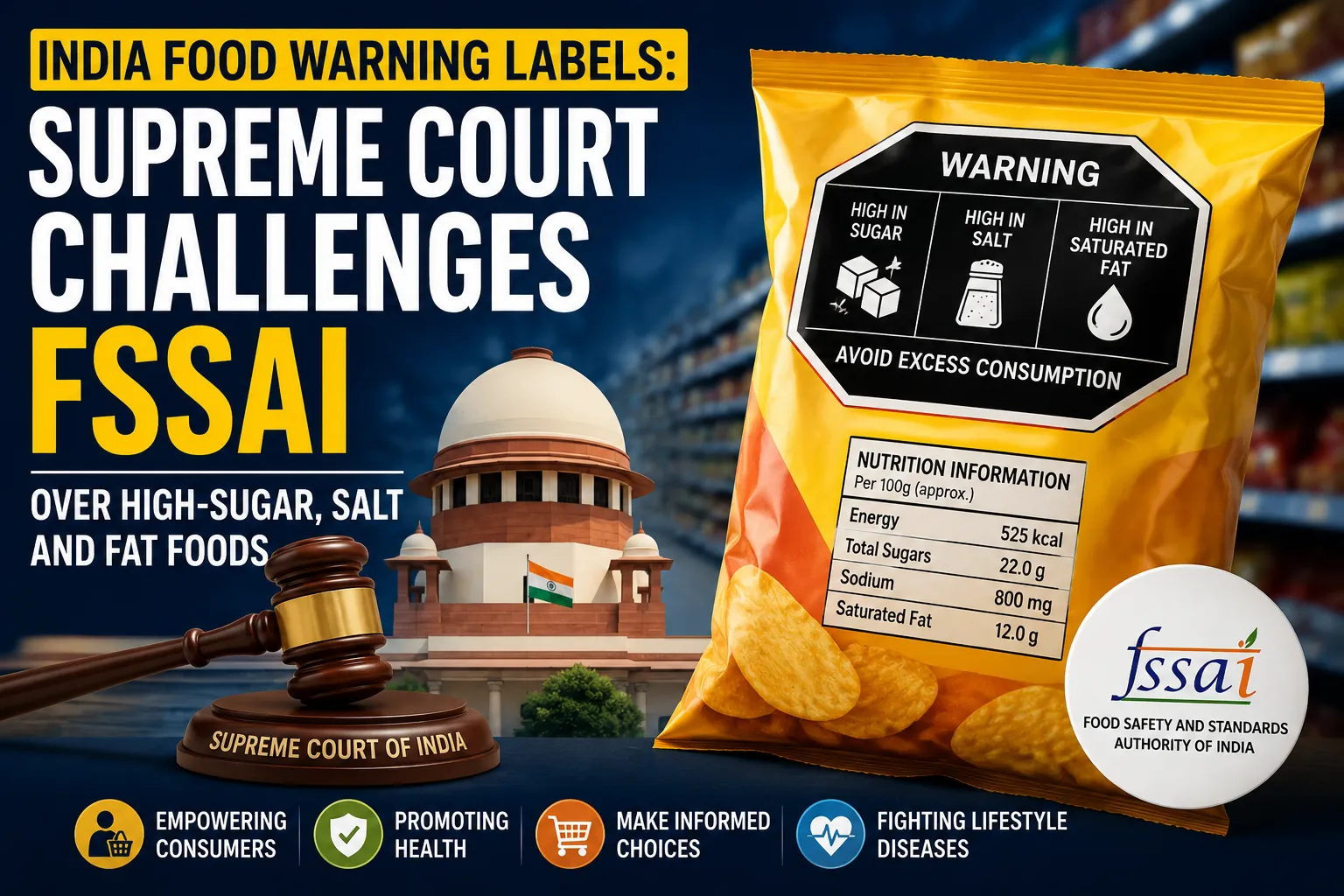

India Food Warning Labels: Supreme Court Challenges FSSAI Over High-Sugar, Salt and Fat Foods
India’s debate over how packaged food should warn consumers about excessive sugar, salt and saturated fat has entered a significant new phase.
The issue has been under scrutiny in the Supreme Court, where judges have questioned the progress made by the Food Safety and Standards Authority of India (FSSAI) on front-of-package nutrition labelling. More recently, a parliamentary standing committee has also urged the regulator to move ahead with clear, easy-to-understand labels that allow consumers to assess a product’s nutritional profile at a glance.
The debate matters because the proposed system could change how millions of Indian consumers evaluate packaged snacks, beverages, cereals, instant foods and other processed products.
Why India’s Food Labels Are Under Scrutiny
Most packaged foods already carry nutritional information under India’s food-labelling framework. Required information includes items such as ingredients, nutritional information, manufacturer details, net quantity and dates relating to manufacture, best-before or expiry information.
The controversy is not simply about whether nutrition information should appear on food packaging. It is about how prominently and clearly that information should be presented.
Traditional nutrition panels can require consumers to stop, read relatively small text and interpret numbers. Front-of-package labelling, by contrast, is designed to provide an immediate visual signal about nutrients of concern.
The proposed approach has focused particularly on:
- Sugar
- Sodium or salt
- Saturated fat
- Total energy
- Other nutritional characteristics that may help consumers assess overall food quality
The goal is to make nutritional information easier to understand before a purchase is made.
What the Supreme Court Has Asked FSSAI to Consider
The Supreme Court’s intervention is connected to a public-interest case filed by 3S and Our Health Society, which sought directions for mandatory front-of-package warning labels on packaged foods.
In February 2026, the court examined FSSAI’s compliance with earlier directions and expressed dissatisfaction with the progress made. The court noted that front-of-package labelling is internationally prevalent and asked the authority to consider a system in which pre-packaged foods could carry prominent warnings relating to nutrients such as sugar, sodium and saturated fat.
Importantly, this does not mean that every packaged food in India has suddenly been ordered to carry a new warning label.
Rather, the court has pushed the regulatory process forward and asked FSSAI to respond on the proposed approach.
That distinction is important for consumers and businesses because a court direction to consider or develop regulations is different from a fully notified regulation that has already entered into force.
FSSAI’s Earlier Approach Included a Star Rating
India’s front-of-package labelling debate has been going on for several years.
One earlier proposal involved an Indian Nutrition Rating (INR) system. Under that model, eligible packaged foods could receive a rating ranging from 0.5 to 5 stars, with the score calculated using factors including energy, sugar, sodium and saturated fat, while also taking positive nutritional characteristics into account.
The proposal generated substantial debate.
FSSAI told the Supreme Court that its earlier draft had received around 14,000 comments from stakeholders, including food businesses, consumer organisations, public-health groups and other bodies. An expert committee was subsequently established to examine the feedback.
The controversy illustrates one of the central questions facing policymakers: should consumers receive an overall health rating, or should packaging provide direct warnings about individual nutrients that may be excessive?
Warning Labels Versus Health Ratings
The difference between the two approaches is significant.
A health rating attempts to summarize the nutritional profile of a product into one overall score.
A warning-label system, meanwhile, focuses attention on specific nutrients or characteristics that may warrant caution.
For example, a simplified front-of-pack design could potentially tell a shopper that a product is:
High in sugar
or
High in sodium
without requiring the consumer to calculate percentages or compare serving sizes.
Supporters of warning labels argue that this can make nutritional information more accessible, particularly when consumers are shopping quickly.
Critics and industry stakeholders have raised questions about scientific thresholds, implementation, product categories and the potential economic effects on food manufacturers.
Parliament Also Pushes for Clearer Front-of-Pack Information
The issue has gained additional momentum outside the courtroom.
In July 2026, a parliamentary standing committee recommended that packaged foods should carry simple, interpretive front-of-pack nutrition information. The committee called for labels that consumers could understand quickly and recommended approaches including colour-coded indicators for sugar levels or warning labels for foods high in sugar.
The committee also urged FSSAI to notify front-of-pack nutrition-labelling regulations after years of delay.
This creates an important convergence: the Supreme Court, public-health advocates and a parliamentary committee have all increased pressure for clearer front-of-pack nutrition information, although the precise regulatory model remains a matter for the authorities.
The discussion also fits into the broader regulatory debate over new nutrition policies targeting ultra-processed foods, where policymakers are likewise considering how clearer food information could affect consumer choices.
What Could Change on Food Packaging?
If mandatory front-of-package warnings are eventually introduced, shoppers could see important nutritional information displayed more prominently on the front of packaged products.
Instead of relying primarily on the detailed nutrition table on the back or side of a package, consumers could potentially identify high levels of certain nutrients before purchasing the product.
A future label could therefore make it easier to compare two similar products.
For example:
| Product characteristic | Traditional approach | Front-of-pack approach |
|---|---|---|
| Sugar | Detailed nutrition panel | Potential prominent warning |
| Sodium/salt | Detailed nutrition panel | Potential prominent warning |
| Saturated fat | Detailed nutrition panel | Potential prominent warning |
| Energy | Nutrition declaration | Potential simplified information |
| Overall nutrition | Requires interpretation | Could be presented visually |
The exact design, thresholds and mandatory requirements would depend on the regulations ultimately notified by the government.
Why Sugar, Salt and Saturated Fat Matter
The focus on sugar, salt and saturated fat reflects their importance in discussions around diet-related health risks.
FSSAI has already run public-awareness initiatives encouraging people to reduce consumption of foods high in fat, salt and sugar. The government’s health ministry has also highlighted the regulator’s role in setting science-based food standards and monitoring food safety.
From a consumer perspective, the concern is not that sugar, salt or fat are automatically harmful in every circumstance.
They are nutrients with legitimate roles in the diet.
The issue is excessive intake, particularly when highly processed foods and beverages contribute substantial amounts without providing an appropriately balanced nutritional profile.
This is why a well-designed label needs to provide context rather than simply encouraging consumers to fear individual nutrients.
The Ultra-Processed Food Debate
The front-of-package labelling discussion is also part of a larger debate about ultra-processed foods.
Packaged snacks, sugary beverages, confectionery, instant foods and other highly processed products have become increasingly important parts of modern diets.
Public-health researchers and policymakers are examining whether consumers need clearer information to recognize products that are particularly high in nutrients associated with diet-related health risks.
The Indian government has already launched awareness initiatives around foods high in fat, salt and sugar, reflecting growing concern about dietary patterns and public health.
However, the terms “processed food,” “packaged food” and “ultra-processed food” are not interchangeable. A packaged product is not automatically unhealthy, and processing itself does not determine a food’s nutritional value.
That distinction will be important if new labelling rules are introduced.
For another perspective on this issue, the proposed FDA definition of ultra-processed food could reshape how Americans think about healthy eating.
Why Front-of-Pack Labels Could Matter to Consumers
One of the strongest arguments for front-of-pack labelling is simplicity.
Consumers often make purchasing decisions in seconds. A nutrition table containing multiple numbers can be useful, but it may not be immediately accessible to everyone.
A prominent interpretive label could potentially help consumers answer a simple question:
“Is this product particularly high in a nutrient I should limit?”
That could be especially useful when comparing similar products.
For example, a shopper choosing between two breakfast cereals could use the front label as an initial screening tool before looking at the detailed ingredient and nutrition information.
The label would not replace the nutrition panel. Ideally, it would make the panel easier to use.
What the New Rules Could Mean for Food Manufacturers
Mandatory front-of-pack labelling could have major implications for India’s food industry.
Manufacturers could have to:
- Recalculate nutritional information.
- Review product formulations.
- Redesign packaging.
- Adapt printing and labelling systems.
- Ensure nutrient declarations meet new thresholds.
- Update product databases.
- Train compliance teams.
- Reassess marketing and nutrition claims.
- Potentially reformulate products that receive prominent warnings.
The effect could vary considerably between large multinational companies, established Indian food manufacturers and smaller businesses.
This is one reason the regulatory process involves consultation and scientific review before final rules are adopted.
Why the Regulatory Process Has Taken So Long
The history of India’s front-of-package labelling debate helps explain why implementation has been complicated.
FSSAI has previously proposed nutrition-labelling approaches, received extensive stakeholder feedback and commissioned expert reviews. The authority’s February 2026 compliance affidavit acknowledged that there was not consensus around the earlier Indian Nutrition Rating model. It also described plans for additional research, consumer surveys, product mapping and stakeholder consultation.
FSSAI also told the court that proposed amendments concerning nutrition information in bold letters and larger type had been considered through its scientific and regulatory processes, with the matter still requiring further action.
This means the current debate is not simply a question of whether labels are desirable.
It also involves what the labels should look like, which foods they should cover, what thresholds should apply and how the rules should be implemented.
What Consumers Should Do While the Rules Are Being Decided
Consumers do not need to wait for new warning labels to make informed food choices.
Existing packaging can already provide useful information.
When buying packaged food, look beyond the marketing claims on the front and check:
- Serving size — understand how much the listed nutrition values actually represent.
- Total sugar and added sugar information — where provided.
- Sodium or salt content — especially for savoury packaged foods.
- Saturated fat — particularly in foods containing significant amounts of fats.
- Protein and fibre — useful when assessing overall nutritional value.
- Ingredient list — ingredients are generally listed in descending order by weight.
- Energy content — consider how the product fits into your overall diet.
- Serving frequency — an occasional food and an everyday staple should not necessarily be evaluated in exactly the same way.
A product’s packaging claim — such as “natural,” “multigrain,” “light” or “healthy” — should not be treated as a substitute for reading its nutritional information.
For broader guidance on how different nutrients fit into a balanced dietary pattern, readers can also explore the complete guide to healthy eating and balanced nutrition.
The Bigger Question: Can Better Labels Change Eating Habits?
Front-of-pack warnings are not a complete solution to unhealthy diets.
Nutrition is influenced by income, food availability, culture, cooking habits, advertising, education and access to fresh foods.
But labels can address one important part of the problem: information at the point of purchase.
If consumers can quickly identify products high in sugar, sodium or saturated fat, they may be better positioned to compare alternatives.
The effectiveness of any future system will ultimately depend on whether the labels are scientifically sound, visually clear, consistently applied and understood by consumers.
What Happens Next?
The regulatory process remains unfinished.
As of August 2026, the available record shows that FSSAI has been under pressure to advance front-of-package nutrition labelling, while Parliament has separately urged the regulator to introduce clear interpretive labels. The Supreme Court has also continued to scrutinize the pace and substance of the regulator’s work.
That means consumers should not yet assume that a final nationwide warning-label system is already in force.
The next important developments will be the regulatory decisions on the format, thresholds, covered products, implementation requirements and final notification of any amendments.
Why India’s Food-Label Debate Could Reshape Grocery Shopping
India’s push toward clearer food warning labels is bigger than a packaging redesign.
It represents a debate over how much responsibility should fall on consumers, manufacturers and regulators when people make everyday food choices.
A successful front-of-pack system could make complicated nutritional information easier to understand without eliminating the need for consumers to read full labels. At the same time, poorly designed labels could oversimplify nutrition or create confusion.
For now, the direction of travel is clear: India’s food-labelling framework is under increasing pressure to make important nutrition information more visible, understandable and useful at the moment consumers choose what to buy.
The final rules — rather than the current proposals or court observations — will determine exactly what appears on food packages across India.
Sources
- Supreme Court of India proceedings in 3S and Our Health Society v. Union of India, including the February 10, 2026 order concerning front-of-package labelling.
- Food Safety and Standards Authority of India information on food-labelling regulations and nutrition-labelling developments.
- Government of India, Ministry of Health and Family Welfare, information on measures addressing foods high in fat, salt and sugar.
- Parliamentary standing committee recommendations reported in July 2026 concerning front-of-pack nutrition labelling.
Continue Reading
Similar Posts

Broccoli Sprouts Linked to Multistate Salmonella Outbreak: What Consumers Need to Know
For consumers, the most important step is to determine whether recalled broccoli sprouts are in the refrigerator, freezer, or kitchen and to avoid eating, serving, or selling them.
Read article
Fibermaxxing Is Taking Over Social Media: How Much Fiber Is Actually Too Much
More is not automatically better. Increasing fiber too rapidly or consuming very large amounts can cause bloating, gas, abdominal discomfort, constipation, or changes in bowel habits.
Read article
Salmonella Outbreak Linked to Broccoli Sprouts: What Consumers Need to Know
For consumers, the most important issue right now is knowing what products are affected, what symptoms to watch for, and how to reduce the risk of foodborne illness.
Read article

Join 10,000+ Readers Building Healthier Habits
Get actionable wellness tips every week plus our newest articles delivered straight to your inbox.