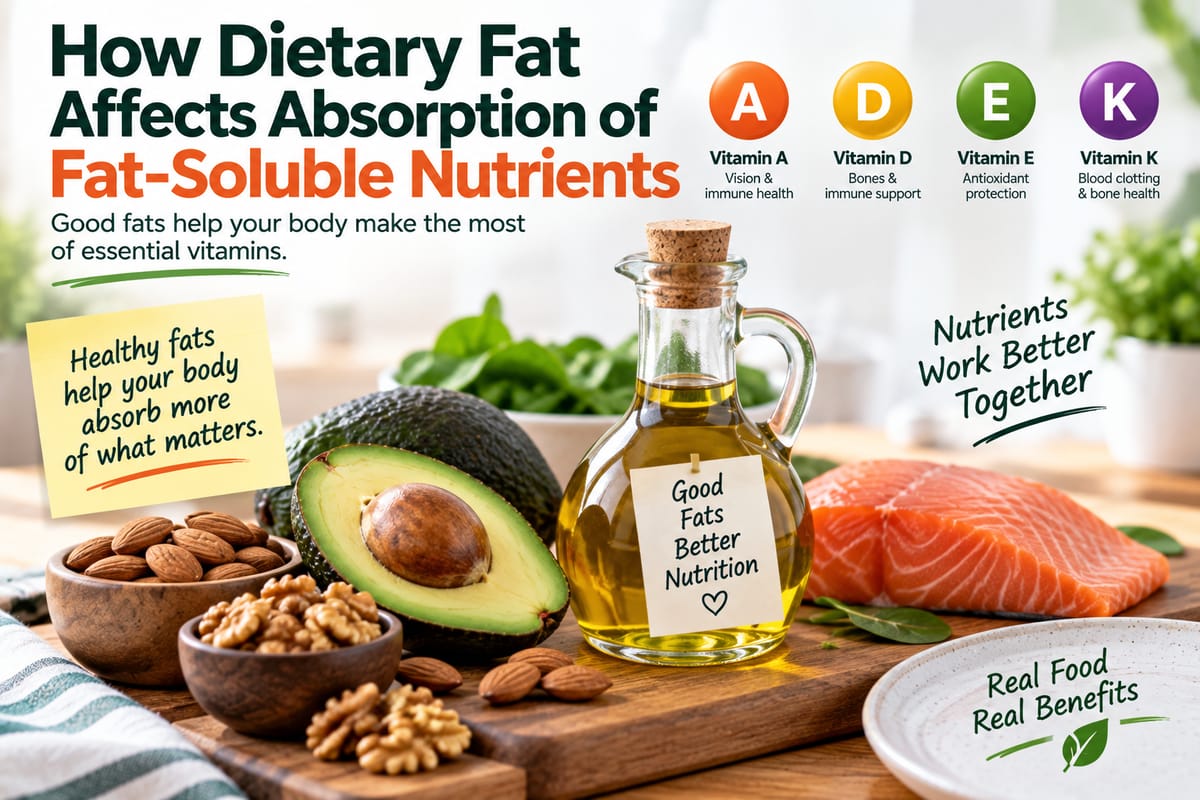

How Dietary Fat Affects Absorption of Fat-Soluble Nutrients
Dietary fat does more than provide energy. It also plays an important role in helping the body absorb certain vitamins and other fat-soluble nutrients from food and supplements.
Some nutrients dissolve more readily in fat than in water. Their absorption can therefore be influenced by what is eaten alongside them, particularly whether a meal contains an appropriate amount of dietary fat.
This relationship helps explain why the nutritional value of a food or supplement cannot always be judged simply by the amount of a nutrient listed on its label. The body must also be able to digest, absorb, transport, and use that nutrient.
What Are Fat-Soluble Nutrients?
Fat-soluble nutrients are substances that are absorbed and transported through processes associated with dietary fat.
The best-known fat-soluble vitamins are:
- Vitamin A
- Vitamin D
- Vitamin E
- Vitamin K
These vitamins perform different functions throughout the body. Vitamin A is involved in vision and normal cell function, vitamin D helps regulate calcium and supports bone health, vitamin E contributes to antioxidant protection, and vitamin K is important for normal blood clotting and bone-related processes.
The broader functions of vitamins are covered in the Complete Guide to Vitamins and Their Roles.
Understanding whether a nutrient is fat-soluble or water-soluble provides useful context for understanding how the body handles it.
Why Dietary Fat Matters
When dietary fat enters the digestive system, it triggers processes that help the body break fats into smaller components and make them available for absorption.
Fat-soluble vitamins can become incorporated into structures called micelles during digestion. These microscopic structures help transport fat and fat-soluble compounds toward the surface of intestinal cells, where absorption can occur.
Without sufficient dietary fat, the absorption of some fat-soluble nutrients may be reduced.
This does not mean that large quantities of fat are necessary. Rather, the presence of an appropriate amount of dietary fat as part of a meal can support the normal digestive processes involved in absorbing these nutrients.
How Fat Digestion Supports Nutrient Absorption
The process begins when dietary fat reaches the digestive tract.
Several steps contribute to fat digestion and absorption:
- Fat is consumed as part of a meal.
- The digestive system releases substances that help process dietary fat.
- Bile helps emulsify fats, breaking them into smaller droplets.
- Digestive enzymes break triglycerides and other fats into smaller components.
- Fat-soluble vitamins can become incorporated into micelles.
- These structures transport the nutrients toward intestinal cells.
- Nutrients can then be absorbed and processed by the body.
This is one reason that the composition of a meal can influence how efficiently certain nutrients become available.
Fat-Soluble and Water-Soluble Vitamins Are Different
Not all vitamins depend on dietary fat in the same way.
Water-soluble vitamins, including vitamin C and the B vitamins, generally dissolve in water and follow different absorption and storage patterns.
Fat-soluble vitamins behave differently because they are associated with dietary fats during digestion and can be stored in body tissues.
The distinction is explained in more detail in What Is the Difference Between Water-Soluble and Fat-Soluble Vitamins?.
Understanding this difference can help explain why taking every supplement in exactly the same way is not necessarily appropriate.
Does More Dietary Fat Mean Better Absorption?
Not necessarily.
The relationship between dietary fat and nutrient absorption is more complicated than simply assuming that more fat produces greater absorption.
A meal containing an appropriate amount of fat may help support absorption of fat-soluble vitamins. Increasing fat indefinitely, however, is not a sensible strategy for maximizing nutrient absorption.
The overall composition of the meal matters, as do the specific nutrient, food source, digestive conditions, and formulation of a supplement.
For everyday nutrition, the goal should generally be a balanced diet rather than adding large amounts of fat simply to increase vitamin absorption.
The Type of Fat May Matter
Research has examined whether different types of dietary fat affect the absorption of fat-soluble vitamins differently.
Meal composition can influence digestion and the formation of micelles, meaning the type and amount of fat may affect the way certain compounds become available for absorption.
However, this does not mean that people need to choose a particular fat solely because they are trying to absorb a vitamin.
Sources of dietary fat can include:
- Nuts and seeds
- Avocados
- Vegetable oils
- Fatty fish
- Eggs
- Dairy products
- Nut and seed butters
Choosing nutrient-rich sources of fat can allow dietary fat to contribute both energy and other useful nutrients to a balanced eating pattern.
Whole Foods Can Provide Both Fat and Vitamins
Many foods naturally combine fat with fat-soluble nutrients.
For example, some foods contain naturally occurring vitamin E alongside fats, while eggs and certain animal foods provide fat along with fat-soluble vitamins.
Plant foods can also contribute carotenoids, some of which the body can convert into vitamin A. Their absorption can be influenced by the presence of dietary fat.
This is one reason the overall structure of a meal can be more important than focusing on individual nutrients in isolation.
Carotenoids and Dietary Fat
Carotenoids are plant pigments found in foods such as carrots, sweet potatoes, leafy greens, tomatoes, and other colorful fruits and vegetables.
Some carotenoids, including beta-carotene, can contribute to vitamin A nutrition.
Because carotenoids are fat-soluble compounds, consuming them with some dietary fat can support their absorption.
For example, adding a small amount of oil, nuts, seeds, avocado, or another source of fat to a meal containing colorful vegetables can change the digestive environment in which these compounds are processed.
The exact amount of fat needed can vary, and nutrient absorption is influenced by more than one factor.
Why Meal Composition Matters
A nutrient rarely exists in isolation when people eat food.
A meal can contain carbohydrates, protein, fat, fiber, vitamins, minerals, water, and numerous other compounds. These components interact during digestion.
For fat-soluble nutrients, the presence of dietary fat can be particularly relevant.
This illustrates an important principle in nutrition: the body responds to foods and meals, not just isolated numbers on a nutrition label.
A meal containing vegetables and a source of healthy fat may provide a different nutrient-absorption environment from eating the same vegetables completely by themselves.
Fat Can Also Affect Supplement Absorption
The same principle can apply to dietary supplements.
Some supplements contain fat-soluble vitamins in forms that are intended to be absorbed through normal digestive processes. Taking such a supplement with a meal that contains some fat may support absorption.
However, supplement formulations differ considerably.
The amount and chemical form of a nutrient, the formulation of the product, the presence of other ingredients, and individual digestive factors can all influence bioavailability.
The relationship is discussed further in How Supplement Absorption and Bioavailability Affect Nutrient Availability.
Timing a Fat-Soluble Vitamin With a Meal
For many fat-soluble vitamin supplements, taking the product alongside a meal can be a practical way to provide dietary fat at the same time.
The specific instructions on a supplement label should still be followed.
Some products may have particular directions concerning meals, timing, or interactions with other substances. People taking medications or managing medical conditions may also have additional considerations.
The goal is not to consume a high-fat meal every time a fat-soluble vitamin is taken. A normal balanced meal containing a source of dietary fat may be sufficient for supporting the digestive processes involved.
What Happens When Dietary Fat Is Very Low?
Extremely low dietary fat intake can potentially affect the absorption of fat-soluble nutrients, particularly when the diet does not provide adequate overall nutrition.
The body needs dietary fat for several physiological functions beyond vitamin absorption, including providing energy and supplying essential fatty acids.
However, the appropriate amount of dietary fat varies according to an individual’s overall dietary needs.
A balanced eating pattern generally provides a mixture of macronutrients rather than eliminating an entire category of foods without a specific reason.
Digestive Health Also Matters
Dietary fat is only one part of nutrient absorption.
The digestive system must also be functioning properly for nutrients to become available to the body.
Conditions affecting fat digestion or absorption can interfere with the absorption of fat-soluble vitamins. Problems involving bile production or release, pancreatic digestive enzymes, or portions of the gastrointestinal tract can sometimes affect nutrient absorption.
In these situations, simply increasing dietary fat may not solve the underlying problem.
Persistent digestive symptoms or concerns about nutrient deficiencies should be discussed with an appropriate healthcare professional.
Fat-Soluble Vitamins Can Be Stored in the Body
Another important difference between fat-soluble and water-soluble vitamins is how the body handles excess amounts.
Fat-soluble vitamins can be stored in tissues and the liver. This means they do not necessarily leave the body as quickly as many water-soluble compounds.
As a result, taking high doses of fat-soluble vitamin supplements without a nutritional reason can create risks.
More is not automatically better when it comes to vitamins.
People should follow product instructions and avoid assuming that increasing a supplement dose will necessarily provide additional health benefits.
Food First Can Simplify Nutrient Absorption
A varied diet can naturally combine nutrients with the foods that help the body process them.
For example, a meal might include vegetables, a source of protein, whole grains, and a source of dietary fat. This approach provides a range of nutrients while creating a normal digestive environment.
The broader principles of meal quality, nutrient variety, and balanced eating are discussed in the Complete Guide to Healthy Eating and Balanced Nutrition.
For many people, focusing on overall dietary quality is more useful than trying to optimize every individual nutrient through complicated timing strategies.
Common Mistakes to Avoid
Several misunderstandings can make nutrient absorption seem more complicated than it needs to be.
Avoiding All Dietary Fat
Eliminating dietary fat entirely can make it more difficult to obtain certain essential nutrients and may affect the absorption of fat-soluble compounds.
Adding Excess Fat to Every Meal
More fat is not automatically better. The goal is an appropriate and balanced amount rather than excessive consumption.
Assuming Every Supplement Works the Same Way
Different formulations can have different absorption characteristics. Supplement instructions should be followed rather than applying one rule to every product.
Taking High Doses Without a Reason
Fat-soluble vitamins can accumulate in the body, so high-dose supplementation should not be treated as harmless simply because a nutrient is essential.
Focusing on One Nutrient Instead of the Whole Diet
Nutrient absorption is only one part of nutrition. Overall dietary quality, food variety, adequate energy, protein, fiber, and other nutrients also matter.
Practical Ways to Support Fat-Soluble Nutrient Absorption
For people eating a varied diet, supporting absorption does not usually require complicated strategies.
Practical habits include:
- Include moderate amounts of dietary fat in balanced meals.
- Eat a variety of colorful vegetables and fruits.
- Choose nutrient-rich sources of dietary fat.
- Follow supplement instructions carefully.
- Avoid unnecessarily high doses of fat-soluble vitamin supplements.
- Consider the overall quality of the diet rather than individual nutrients alone.
- Pay attention to persistent digestive problems that could affect nutrient absorption.
- Ask a healthcare professional about supplementation when there is a suspected deficiency or a medical condition affecting digestion.
These habits focus on creating a supportive nutritional environment rather than trying to manipulate one isolated part of digestion.
A Bigger Picture of Nutrient Availability
The amount of a nutrient in food or a supplement does not tell the entire story.
The nutrient must be released from its food or supplement matrix, survive digestion, become available for absorption, cross the intestinal barrier, enter circulation, and ultimately be used or stored by the body.
Dietary fat can play an important role in this process for fat-soluble nutrients.
That does not mean that every meal needs to be carefully engineered. For most people, a varied diet that includes appropriate amounts of dietary fat can naturally support the digestive processes involved in absorbing vitamins A, D, E, K, and other fat-soluble compounds.
Understanding the relationship between dietary fat and nutrient absorption can therefore make nutrition decisions more practical. Instead of viewing vitamins as isolated substances, it is useful to consider how foods, meals, digestion, and overall dietary patterns work together to determine how much of a nutrient becomes available to the body.
Continue Reading
Similar Posts

What Is Creatine and How Does It Work?
Understanding how that system works helps explain why creatine has become so closely associated with activities such as weightlifting, sprinting, and other forms of high-intensity exercise.
Read article
Why Excessive Vitamin Intake Can Be Harmful
Understanding the difference between adequate intake and excessive intake is an important part of using vitamin supplements responsibly.
Read article
How Dietary Supplements Can Cause Side Effects
Understanding why side effects happen can help people make more informed decisions about supplement use and recognize situations where professional guidance may be appropriate.
Read article

Join 10,000+ Readers Building Healthier Habits
Get actionable wellness tips every week plus our newest articles delivered straight to your inbox.