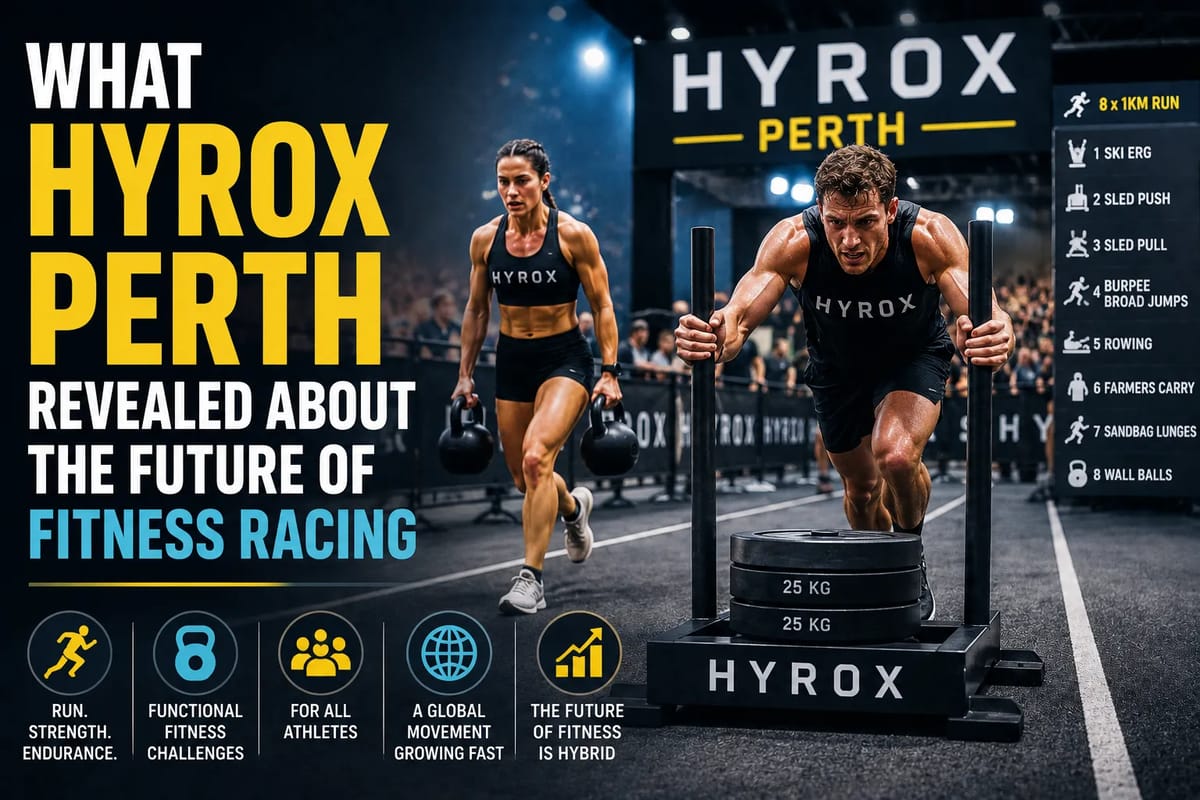

What HYROX Perth Revealed About the Future of Fitness Racing
Fitness racing is moving beyond the traditional boundaries of running events, bodybuilding competitions and obstacle races.
The latest example came in Perth, Australia, where AirAsia HYROX Perth brought thousands of competitors to the Perth Convention and Exhibition Centre from August 21–23, 2026. The event combined running, functional fitness, doubles competition, relay formats and adaptive divisions into a standardized competition designed to appeal to both serious athletes and everyday fitness enthusiasts. (Hyrox)
The scale of the event offers a useful glimpse into where fitness racing may be heading next.
HYROX is no longer simply a niche challenge for highly conditioned competitors. Its expanding formats, standardized course and increasingly international audience suggest that hybrid racing could become one of the defining categories in recreational and competitive fitness.
HYROX Is Built Around a Simple Formula
The basic HYROX format is remarkably easy to understand.
Competitors complete eight 1-kilometer runs, with each run followed by a functional fitness station. The stations include exercises such as sled pushes, sled pulls, rowing, burpee broad jumps, farmer’s carries, sandbag lunges and wall balls.
That combination creates a competition that tests several qualities simultaneously.
An athlete needs cardiovascular endurance to run repeatedly, but running ability alone is not enough. Strength, muscular endurance, pacing, technique and the ability to recover between efforts all influence the final result.
The standardized format is one of HYROX’s biggest advantages.
Unlike some endurance competitions where courses can vary dramatically between locations, competitors have a relatively consistent framework against which they can measure themselves.
Perth Showed How Broad the Sport Has Become
One of the clearest signals from Perth was the variety of ways athletes could compete.
The 2026 event included Open and Pro categories, men’s and women’s divisions, doubles, mixed doubles, team relays and adaptive categories. (Hyrox)
That structure matters because it lowers the psychological barrier to entry.
Someone who does not feel ready to compete alone can enter doubles.
Someone who wants a social experience can join a relay team.
Experienced competitors can move into Pro divisions.
Adaptive athletes have dedicated categories.
Rather than forcing everyone into the same version of competition, the event creates multiple entry points into the same fitness ecosystem.
That could become increasingly important as fitness racing attempts to grow beyond its early enthusiast base.
The Numbers Point to Rapid Growth
Third-party results data for HYROX Perth 2026 lists 9,875 athletes across the event’s divisions. The same source records approximately 6,973 athletes for the Perth event in 2025 and 2,423 in 2024. (TrainRox)
The figures should be treated as event-database counts rather than official attendance statistics, but the direction is striking.
If the underlying participation figures are comparable, Perth has experienced enormous growth in just two years.
That reflects a much broader HYROX trend.
Reuters reported this month that HYROX has grown from an event with about 650 participants when it was created in 2017 to a global fitness-racing phenomenon involving more than 1.5 million athletes globally. The competition now operates across more than 100 cities and 35 countries. (Reuters)
The implication is significant: hybrid fitness racing is increasingly becoming a mainstream participation sport rather than a specialized competition.
Standardization Could Be Fitness Racing’s Secret Weapon
Traditional races can be difficult to compare.
A marathon in one city may have dramatically different terrain and weather from another. Obstacle races can change their layouts and challenges between events.
HYROX’s standardized structure solves part of that problem.
An athlete can compete in Perth, then compare that performance with a result from another city using the same basic race architecture.
That creates something close to a global fitness benchmark.
The result is an experience that combines the motivation of a local event with the competitive structure of an international sport.
For recreational athletes, that can be powerful.
Instead of simply asking whether they are “fit,” they have a measurable performance target.
Fitness Becomes More Than a Gym Routine
HYROX also reflects a broader change in how people approach fitness.
Traditional gym training can sometimes lack an obvious objective.
A person might lift weights three times a week or perform regular cardio without having a specific performance goal.
A fitness race changes that dynamic.
Training now has a destination.
An athlete can decide to improve their 1-kilometer running pace, increase their sled-push capacity, become more efficient at wall balls or develop better endurance between stations.
That gives everyday training a purpose.
The race becomes the deadline, while the gym becomes the preparation ground.
The Rise of the Hybrid Athlete
Perhaps the biggest cultural shift represented by HYROX is the emergence of the hybrid athlete.
For years, fitness culture often separated athletes into categories.
There were runners, cyclists, weightlifters, bodybuilders and CrossFit competitors.
Hybrid fitness challenges blur those boundaries.
A successful HYROX competitor needs enough strength to move heavy loads and enough endurance to repeatedly run under fatigue.
That combination is increasingly attractive to recreational athletes who want a balanced form of fitness rather than specialization in a single physical quality.
The hybrid model may therefore influence mainstream gym programming even among people who never compete.
Running Is Still at the Center
Despite the emphasis on functional exercises, HYROX demonstrates that running remains extremely important.
The eight 1-kilometer segments create a substantial endurance component, while the workout stations force athletes to run again after their muscles have already been heavily taxed.
That produces a distinctive form of fatigue.
An athlete cannot simply maximize strength at every station.
They must manage effort carefully because every unnecessary burst of intensity can make the next run harder.
This makes pacing a central skill.
The future of fitness racing may therefore belong to athletes who can combine strength and endurance without allowing one quality to undermine the other.
Pacing Could Become More Important Than Raw Strength
One of the lessons from hybrid competition is that the strongest athlete does not necessarily win.
Nor does the fastest runner automatically dominate.
Performance depends on managing the entire race.
An athlete might gain time on a sled push but lose more time by running the following kilometer too aggressively.
Another competitor may be slightly slower on individual stations but maintain a consistent pace throughout the event.
This creates a strategic element that distinguishes fitness racing from straightforward strength competitions.
Training therefore becomes about energy management, not simply maximum effort.
Doubles and Relay Formats Could Drive Further Growth
Perth’s extensive doubles and relay schedule provides another clue about the sport’s future.
HYROX included men’s, women’s and mixed doubles, alongside men’s, women’s and mixed relay competitions. (Hyrox)
These formats make the event more social.
A person may be reluctant to sign up for an intense individual race but more comfortable entering with a friend, partner or group of colleagues.
That could make team-based fitness racing particularly attractive to workplaces, gyms and social fitness communities.
It also changes the event experience.
Instead of being purely about individual performance, the competition becomes something people can train for together.
The Spectator Experience Matters Too
Another important feature of HYROX is that the competition is relatively easy to understand from the sidelines.
The running laps and functional stations happen in a controlled indoor environment.
Spectators can see competitors repeatedly move through recognizable challenges.
That makes it easier to follow the action than some endurance events where competitors disappear for long periods.
As fitness racing becomes more commercialized, this spectator-friendly format could become increasingly valuable.
A sport needs participants, but large-scale competitive fitness also needs an audience.
Adaptive Competition Is Part of the Bigger Picture
Perth also included adaptive divisions for athletes with disabilities. (Hyrox)
The inclusion of adaptive competition reflects an important direction for the industry.
Fitness events increasingly need to consider how different athletes can participate rather than treating accessibility as an afterthought.
The details of adaptive categories, equipment and movement standards will continue to evolve, but the broader principle is important.
If fitness racing wants to become a genuinely mainstream sport, participation pathways need to accommodate a wider range of physical abilities.
Technology Is Making Fitness Racing More Measurable
Modern fitness racing also benefits from technology.
HYROX competitors receive individual race times and split timings for workout stations, while results systems allow athletes to compare performances and rankings. (Hyrox)
This creates a data-rich experience.
Athletes can identify where they lost time, compare station performances and adjust their training accordingly.
Wearable devices add another layer.
Heart-rate monitors, GPS watches and fitness trackers can help athletes understand how their bodies respond to different training loads.
As fitness technology improves, training for hybrid competitions is likely to become increasingly analytical.
The Sport Is Becoming More Professional
At the elite level, HYROX is already developing characteristics associated with professional sport.
Top athletes compete for rankings and qualification opportunities, while the organization has introduced elite competition structures and world championship events.
The 2026 World Championships in Stockholm attracted competitors from 101 countries, according to Reuters. (Reuters)
That international structure creates a pathway from local participation to global competition.
An athlete can begin with an Open race, improve through age-group competition and potentially progress toward elite events.
That kind of pathway is important for the long-term development of any sport.
HYROX Is Also Chasing Olympic Recognition
The ambitions extend beyond commercial fitness events.
According to Reuters, HYROX organizers are pursuing Olympic inclusion through a proposed Hyathlon format, with ambitions targeting the 2032 or 2036 Games. (Reuters)
Olympic recognition would be a dramatic step for fitness racing.
It would require the sport to demonstrate international participation, competitive depth, standardized rules and a sufficiently developed governance structure.
Whether that ambition ultimately succeeds remains uncertain.
But the fact that it is being seriously pursued demonstrates how far the category has moved from its origins.
The Global Nature of HYROX Could Be Its Biggest Advantage
One of the most interesting aspects of the current HYROX expansion is its geographic reach.
Events are taking place across major markets in Europe, North America, Asia-Pacific and elsewhere.
The current calendar includes cities such as Beijing, Shanghai, Guangzhou, Singapore, Seoul, Johannesburg, São Paulo and Rio de Janeiro, alongside Australian events. (HYROX)
That creates an international community built around a common competitive format.
An athlete does not necessarily need to live near the original center of the sport to participate.
As more cities host races, local fitness communities can connect to a much larger global movement.
Gyms Are Likely to Adapt
The growth of fitness racing could also change what gyms offer.
Traditional gyms may increasingly create hybrid training areas containing:
- Sleds
- Rowing machines
- SkiErgs
- Sandbags
- Wall balls
- Farmers-carry equipment
- Running treadmills
Coaches may also develop programs that combine strength and cardiovascular conditioning rather than treating them as separate disciplines.
This creates a feedback loop.
More races create more participants.
More participants create demand for specialized training.
More gyms offer specialized training.
That makes the sport easier for new athletes to enter.
Fitness Racing Could Become a New Social Fitness Category
There is also a community element that should not be underestimated.
Running clubs have grown partly because people enjoy exercising with others.
CrossFit developed strong communities around shared training.
Fitness racing can combine those social characteristics with a clear competitive goal.
Training partners can meet regularly, compare times and prepare for the next event.
The race itself then becomes a shared experience rather than simply an individual test.
That could be particularly appealing to younger consumers who increasingly view fitness as both a health activity and a social lifestyle.
There Are Still Challenges Ahead
Rapid growth does not guarantee long-term success.
Fitness racing faces several challenges as it becomes larger.
One is maintaining event quality.
Large competitions require venues, equipment, staff, medical support, timing systems and carefully managed athlete flows.
Another challenge is accessibility.
Race entry fees, travel and training costs can make participation expensive compared with ordinary gym memberships or local running events.
There is also the question of injury management.
Hybrid competitions place significant demands on athletes because they combine endurance work with heavy functional movements.
As participation expands, education around training progression, recovery and appropriate preparation will become increasingly important.
More Athletes Could Mean More Pressure on the Sport
Growth can also create competitive pressure.
When a sport becomes popular, expectations rise.
Athletes expect reliable timing, fair judging, consistent equipment, efficient registration and high-quality venues.
Sponsors expect strong audiences and commercial returns.
Cities hosting events expect economic benefits.
Organizers must balance all of these interests without losing the characteristics that made the sport attractive in the first place.
That may become one of HYROX’s biggest tests over the coming years.
What Perth Suggests About the Next Era of Fitness
Perth offered a useful snapshot of where fitness racing is going.
The event combined individual competition with doubles, relays and adaptive divisions. It offered Open and Pro pathways and used a standardized format that allowed athletes to measure themselves against competitors beyond their local community. (Hyrox)
The broader growth numbers are even more significant.
From a small event in 2017 to a global competition involving more than 1.5 million athletes, HYROX has demonstrated that there is substantial demand for a fitness format that sits between traditional endurance racing and functional fitness. (Reuters)
That does not mean HYROX will replace running, traditional gym training or other fitness competitions.
Instead, it may help create a larger category in which strength, endurance, competition and community exist together.
The Hybrid Athlete May Become the New Fitness Ideal
The most important lesson from Perth may ultimately have little to do with race times.
It is about what people increasingly want from fitness.
They want to be strong enough to handle demanding physical tasks.
They want enough cardiovascular fitness to run meaningful distances.
They want measurable progress.
And increasingly, they want an experience that gives their training a purpose.
HYROX packages those goals into a format that is relatively easy to understand, repeatable across cities and accessible through multiple competition categories.
That combination could make fitness racing one of the most influential developments in the next generation of recreational sport.
If the growth seen in Perth and other international markets continues, the future of fitness may not be defined by choosing between strength and endurance.
It may belong to athletes—and everyday gym-goers—who train for both.
Continue Reading
Similar Posts

HHS Launches $10 Million Presidential Fitness Challenge for Schools and Youth Programs
Announced October 1 at Westlake High School in Austin, Texas, the initiative is designed to encourage organizations to implement the revived Presidential Fitness Test while creating positive experiences that can help children develop long-term exercise habits.
Read article
Peloton Tread Flex Launches October 1 as AI-Powered Running Enters a New Phase
Together, the hardware and software changes signal a broader shift in how connected fitness equipment can support runners. Instead of simply displaying workouts, newer machines are increasingly designed to interpret performance data and adapt the training experience around the individual.
Read article
Retatrutide Weight-Loss Results Put Exercise and Muscle Preservation Back in Focus
Those results make retatrutide an important development in obesity medicine. They also reinforce a broader lesson about weight management: **a successful outcome cannot be measured by the number on the scale alone.**
Read article

Join 10,000+ Readers Building Healthier Habits
Get actionable wellness tips every week plus our newest articles delivered straight to your inbox.