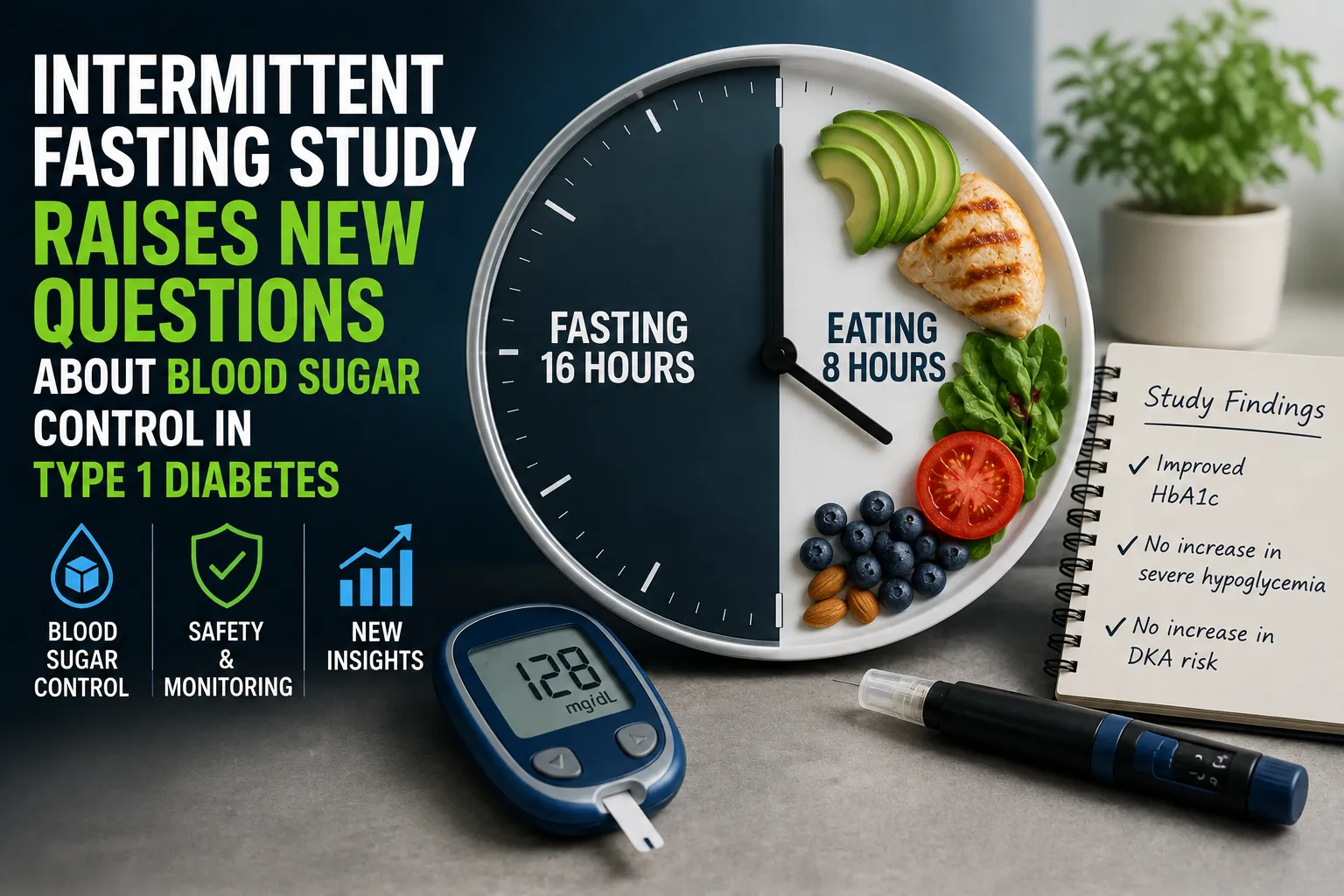

Intermittent Fasting Study Raises New Questions About Blood Sugar Control in Type 1 Diabetes
Intermittent fasting has long been promoted as a strategy for weight management and metabolic health, but people with Type 1 diabetes have traditionally faced a much more complicated question: can restricting when you eat be done without putting blood sugar control at risk?
A new randomized controlled trial from researchers at the University of Illinois Chicago is adding important evidence to that debate.
Published in Diabetes Care in August 2026, the study found that an eight-hour time-restricted eating schedule was associated with a reduction in HbA1c among adults with Type 1 diabetes and overweight or obesity, compared with a conventional daily calorie-restriction approach. The researchers also reported that the fasting strategy did not increase the risk of severe hypoglycemia, extreme hyperglycemia or diabetic ketoacidosis during the six-month study.
The findings are encouraging, but they do not mean that intermittent fasting is suddenly appropriate for everyone with Type 1 diabetes. The study was relatively small and focused on a specific group of adults, leaving important questions for larger and longer-term research.
**What the New Study Actually Tested**
The study involved **32 adults with Type 1 diabetes who also had overweight or obesity**. Participants were randomly assigned to one of three groups for six months.
One group followed an eight-hour time-restricted eating schedule, eating between **noon and 8 p.m.** without having to count calories. Another group followed a traditional calorie-restriction approach involving a **25% reduction in daily energy intake**. The third group made no dietary intervention.
The researchers were particularly interested in whether limiting the hours in which participants ate could help with weight management without compromising blood sugar control.
That distinction is important because intermittent fasting is not a single diet. Time-restricted eating focuses primarily on **when** food is consumed rather than necessarily specifying exactly **what** foods must be eaten.
**Blood Sugar Improved Without a Rise in Major Diabetes Risks**
The most notable result involved HbA1c, a blood test that provides an estimate of average blood glucose levels over roughly the previous two to three months.
After six months, HbA1c was significantly lower in the time-restricted eating group than in the calorie-restriction group. The difference was about **0.46 percentage points**, while the study’s conference presentation reported an average reduction of approximately 0.5 percentage points.
At the same time, the researchers did not observe an increased risk of diabetic ketoacidosis, severe hypoglycemia or severe hyperglycemia among participants following the time-restricted eating schedule.
That safety finding is particularly significant for Type 1 diabetes, where insulin remains essential and changes in food intake can affect glucose levels and insulin requirements.
**The Weight-Loss Finding Was Less Impressive**
Interestingly, the study did **not** show that time-restricted eating produced significantly greater weight loss than the comparison approaches.
By six months, body weight had not changed significantly in the time-restricted eating group or the calorie-restriction group compared with the control group. The researchers therefore concluded that the approach appeared more promising for improving HbA1c than for producing additional weight loss in this small trial.
That distinction matters because intermittent fasting is often marketed primarily as a weight-loss strategy.
The new findings suggest that its potential value in Type 1 diabetes may not be limited to the number on the scale.
For broader context on how physical activity, body weight and sustainable lifestyle habits can interact, see the complete guide to healthy weight management.
**Why Type 1 Diabetes Makes Fasting Different**
Type 1 diabetes is fundamentally different from Type 2 diabetes.
People with Type 1 diabetes produce little or no insulin, meaning they depend on insulin therapy to regulate blood glucose. Changing the timing or amount of food consumed can therefore require careful consideration of insulin dosing and glucose monitoring.
During fasting, blood glucose can fall if insulin levels are too high relative to available glucose. At the same time, inadequate insulin can allow blood glucose and ketone levels to rise, potentially contributing to diabetic ketoacidosis.
That makes fasting considerably more complicated than simply skipping breakfast or eating dinner earlier.
**Continuous Glucose Monitoring Can Be Especially Important**
Modern glucose-monitoring technology has changed how people with diabetes can approach changes in eating patterns.
Continuous glucose monitors can provide frequent information about glucose levels and trends, allowing people and their healthcare teams to see how blood sugar responds to changes in food, activity and insulin.
Earlier research involving fasting in people with Type 1 diabetes has also emphasized the importance of structured education and advanced glucose monitoring. A 2019 study of Ramadan fasting found that selected people with uncomplicated Type 1 diabetes could fast safely when they received structured education, adjusted insulin under supervision and used advanced glucose monitoring.
Another study involving 20 adults found that a controlled 36-hour fast did not produce a significant increase in hypoglycemia compared with a 12-hour overnight fast, although it was conducted under carefully controlled research conditions.
These studies do not establish that fasting is universally safe. Instead, they show why careful selection, monitoring and medical support are important when studying fasting in Type 1 diabetes.
**Time-Restricted Eating Is Not the Same as a Prolonged Fast**
The distinction between different forms of fasting is important.
Time-restricted eating generally limits daily food intake to a specific window. In the new UIC study, participants ate between noon and 8 p.m., meaning the remaining hours of the day were outside the eating window.
Other approaches can involve fasting for much longer periods or significantly restricting calories on particular days.
Those strategies can produce different metabolic effects and may carry different risks.
The latest study therefore should not be interpreted as evidence that people with Type 1 diabetes can safely undertake arbitrary prolonged fasts.
**Earlier Research Already Raised Some Questions**
The new findings do not emerge in isolation.
A 2024 review published in Trends in Endocrinology & Metabolism examined the potential clinical use of fasting in Type 1 diabetes, particularly among people with overweight or obesity. The review noted that time-restricted eating could potentially provide a simpler dietary approach while also emphasizing the need to evaluate its effectiveness and safety.
Research involving Ramadan fasting has also produced mixed but increasingly informative evidence.
A 2024 study of 294 people with Type 1 diabetes found that participants using automated insulin delivery had better fasting-related outcomes and glucose-control measures than some other treatment groups.
These studies suggest that technology, insulin management and patient selection can all influence how successfully someone with Type 1 diabetes manages a fasting period.
**The New Results Do Not Mean Insulin Is Less Important**
One of the biggest potential misunderstandings surrounding fasting and Type 1 diabetes is the idea that reducing food intake somehow eliminates the need for insulin.
It does not.
People with Type 1 diabetes require insulin because their bodies do not produce enough of it. Eating less may change insulin requirements, but it does not remove the underlying need for insulin therapy.
This is fundamentally different from some popular discussions of fasting that focus on reducing food intake as a way of changing insulin levels.
For people with Type 1 diabetes, insulin management remains central.
**Why the Study’s Size Matters**
The results are promising, but **32 participants is a small sample**.
Small studies can provide valuable early evidence, but they cannot necessarily establish how an intervention will perform across the much broader Type 1 diabetes population.
The participants were also adults with Type 1 diabetes and overweight or obesity, meaning the findings may not apply to people with normal weight, children, adolescents, older adults or people with different health conditions.
The researchers themselves have described the trial as an important first step and said larger, multisite studies are needed to determine whether the results can be reproduced more broadly.
**The Question of Long-Term Effects Remains Open**
Six months provides useful information, but it does not answer every question about a dietary pattern that someone might follow for years.
Researchers will need to examine whether improvements in HbA1c persist over longer periods and whether people can comfortably maintain the eating schedule.
They will also need to investigate whether the approach affects other outcomes, including:
- Body composition
- Cardiovascular risk factors
- Diabetes complications
- Quality of life
- Eating behavior
- Insulin requirements
- Hypoglycemia frequency
- Long-term glucose variability
Longer studies could also help determine which patients are most likely to benefit.
**What the Findings Mean for Nutrition Research**
The study adds to a broader shift in nutrition research away from focusing exclusively on individual foods and toward examining **eating patterns and timing**.
Time-restricted eating is attractive partly because it can be simpler than counting calories every day.
A person may find it easier to follow a defined eating window than to continuously calculate how much energy they consume.
The UIC study suggests that this simplicity could potentially have value for some adults with Type 1 diabetes, although more evidence is needed before it can be considered a broadly established treatment strategy.
The American Diabetes Association’s 2026 Standards of Care note that time-restricted eating is one form of intermittent fasting and say it can be adapted to different eating patterns. They also emphasize that people with diabetes who use insulin or certain other glucose-lowering medications should have medical monitoring during fasting periods.
**What People With Type 1 Diabetes Should Take From the Study**
The most reasonable takeaway is not that fasting is now universally safe.
Instead, the research suggests that **a carefully structured eight-hour eating window may be feasible for some adults with Type 1 diabetes and overweight or obesity, while potentially improving HbA1c**.
That is an important distinction.
People with Type 1 diabetes should not independently change insulin doses or begin prolonged fasting based solely on the results of one study.
Any significant change in eating patterns can affect insulin needs and blood glucose, making individualized guidance from a diabetes care team particularly important.
**A Potentially Useful Tool, Not a Universal Prescription**
Intermittent fasting has generated enormous interest because it promises a relatively simple change: eat during a defined period and fast outside it.
For Type 1 diabetes, however, simplicity has to be balanced against the complexity of insulin management.
The new UIC trial provides an encouraging signal. Participants following an eight-hour eating window experienced a meaningful improvement in HbA1c compared with daily calorie restriction, without the study finding an increased risk of severe hypoglycemia, severe hyperglycemia or diabetic ketoacidosis.
But the study was small, lasted six months and focused on adults with Type 1 diabetes who also had overweight or obesity. Larger and longer trials will be needed to determine whether the benefits hold across different groups and whether they translate into meaningful long-term health outcomes.
For now, the research changes the conversation more than it settles it. Rather than treating intermittent fasting as automatically unsafe for everyone with Type 1 diabetes—or assuming it is a simple solution—the emerging evidence points toward a more nuanced question: **which patients can use time-restricted eating safely, under what conditions, and with what kind of glucose and insulin management?**
Those answers could determine whether fasting eventually becomes another practical nutrition tool in Type 1 diabetes care or remains primarily an approach that requires carefully selected patients and close medical supervision.
Continue Reading
Similar Posts

Broccoli Sprouts Linked to Multistate Salmonella Outbreak: What Consumers Need to Know
For consumers, the most important step is to determine whether recalled broccoli sprouts are in the refrigerator, freezer, or kitchen and to avoid eating, serving, or selling them.
Read article
Fibermaxxing Is Taking Over Social Media: How Much Fiber Is Actually Too Much
More is not automatically better. Increasing fiber too rapidly or consuming very large amounts can cause bloating, gas, abdominal discomfort, constipation, or changes in bowel habits.
Read article
Salmonella Outbreak Linked to Broccoli Sprouts: What Consumers Need to Know
For consumers, the most important issue right now is knowing what products are affected, what symptoms to watch for, and how to reduce the risk of foodborne illness.
Read article

Join 10,000+ Readers Building Healthier Habits
Get actionable wellness tips every week plus our newest articles delivered straight to your inbox.