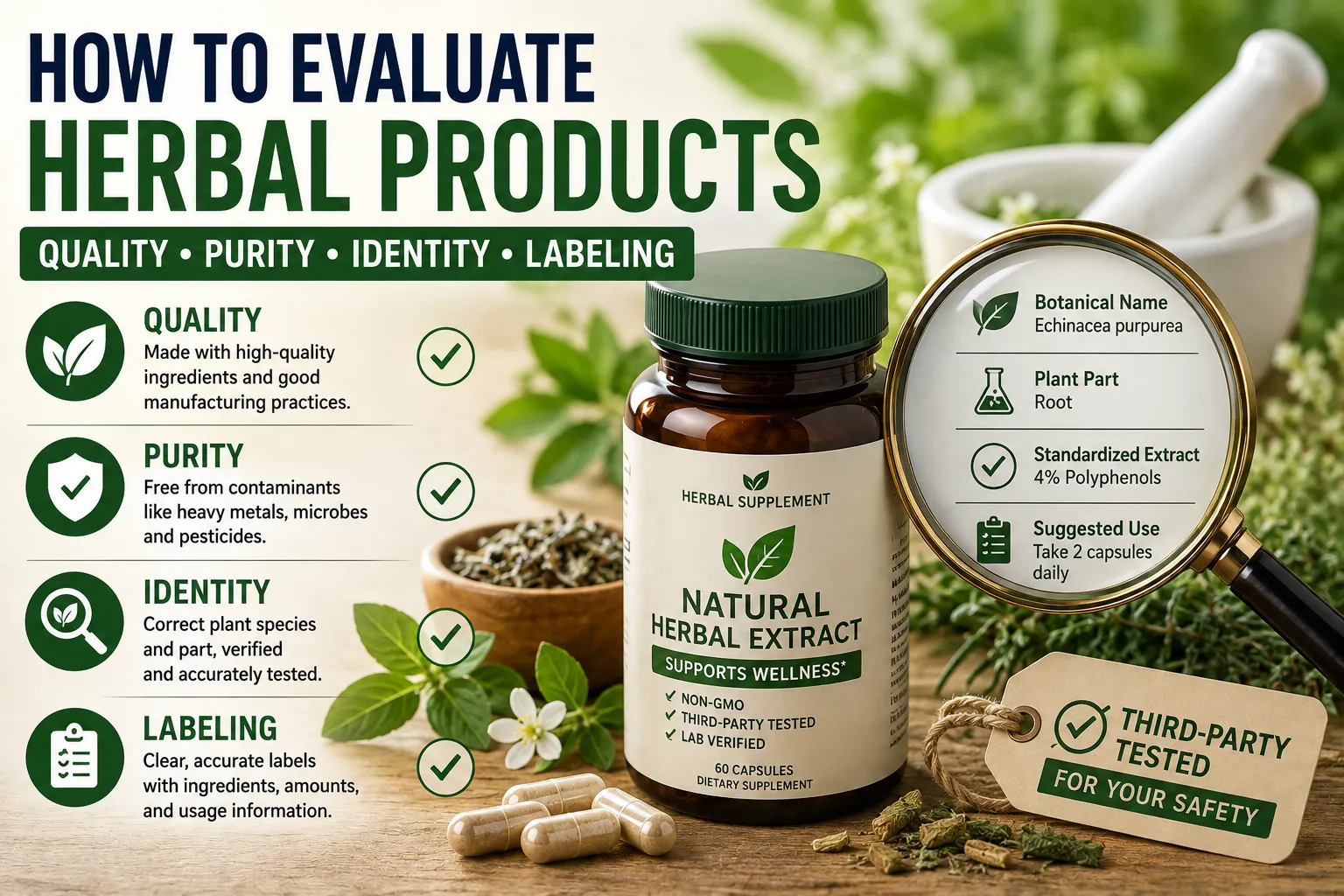

How to Evaluate the Quality, Purity, Identity, and Labeling of Herbal Products
Herbal products are often marketed as natural alternatives for supporting health and wellbeing. They can come in many forms, including teas, capsules, powders, tinctures, extracts, oils, and traditional preparations.
But choosing a good herbal product involves more than looking for the word natural on a package.
The quality of an herbal product can depend on whether the correct plant was used, which part of the plant was included, how it was processed, whether it contains contaminants, how consistently it is manufactured, and whether the label accurately describes its contents. The World Health Organization (WHO) treats identity and purity as fundamental elements of quality control for medicinal plant materials. (World Health Organization)
For consumers, the challenge is that many of these qualities cannot be confirmed simply by looking at the product. A thoughtful evaluation therefore involves examining the label, manufacturer, testing information, claims, packaging, and available evidence.
What Makes an Herbal Product High Quality?
A high-quality herbal product should provide reasonable assurance that:
- The plant or botanical ingredient is correctly identified.
- The intended plant part is used.
- The ingredients are present in the stated amounts where applicable.
- The product has been manufactured under appropriate quality controls.
- Contaminants and adulterants are controlled.
- The packaging protects the product from deterioration.
- The label accurately identifies what the product contains.
- The manufacturer’s claims do not exaggerate what the evidence supports.
WHO quality-control guidance describes procedures for establishing the identity and purity of herbal materials, including macroscopic and microscopic examination and other analytical testing. (Iris)
This distinction matters because a product can look professional while still having problems that are invisible to the consumer.
Start With the Plant’s Identity
Identity means determining whether the material actually comes from the plant claimed on the package.
This can be more complicated than it sounds.
Many plants have common names that vary between regions. Some plants have similar-looking species. Different parts of the same plant can also have different chemical compositions.
For greater clarity, a label may provide the botanical name in addition to the common name. For example, a botanical name can help distinguish a particular species from other plants that share a similar common name.
Quality-control laboratories can use analytical techniques to help confirm botanical identity. WHO describes approaches including macroscopic and microscopic examination as well as chemical methods for evaluating herbal materials. (Iris)
Look for Specific Ingredient Information
A stronger label generally tells you:
- The common name of the herb
- The botanical name where appropriate
- The plant part used
- Whether it is a powder, extract, oil, or another preparation
- The amount per serving
- The serving size
- Other ingredients
Vague descriptions such as “proprietary herbal blend” can make it more difficult to determine exactly how much of each ingredient is present.
Why the Plant Part Matters
The leaves, roots, bark, flowers, seeds, and fruits of a plant can contain different compounds.
For that reason, simply knowing the name of an herb may not provide enough information to understand what is actually in a product.
A label that specifies the plant part gives consumers and healthcare professionals more useful information.
For example, “root extract” provides more information than simply listing the plant’s common name.
The form of the ingredient also matters. A powdered plant and a concentrated extract are not necessarily equivalent.
Understand What “Extract” Means
An herbal extract is produced by processing plant material to obtain certain compounds.
The extraction process can influence the resulting product. Different solvents, extraction methods, plant parts, and concentration ratios can produce preparations with substantially different chemical profiles.
This is why comparing two products based only on the number of milligrams listed on their front labels can be misleading.
One product may contain 500 milligrams of powdered plant material, while another contains 500 milligrams of an extract made from a substantially larger amount of starting material.
The label should ideally make the preparation clear enough for a meaningful comparison.
What Does “Standardized” Actually Mean?
The word standardized can sound like a guarantee of quality, but it should not automatically be interpreted that way.
NCCIH specifically cautions that terms such as “standardized,” “verified,” or “certified” do not necessarily guarantee product quality or consistency. (NCCIH)
In some contexts, standardization refers to controlling a particular chemical constituent or marker compound. But consumers should still ask what exactly has been standardized and what testing supports the claim.
A useful question is:
Standardized to what, and verified by whom?
The answer can provide much more information than the word itself.
Purity Is About More Than Cleanliness
Purity refers broadly to whether the herbal material is free from unacceptable amounts of unwanted substances.
Potential contaminants can include:
- Microorganisms
- Mold
- Pesticide residues
- Heavy metals
- Foreign plant material
- Environmental contaminants
- Undeclared pharmaceutical ingredients
- Other adulterants
WHO has dedicated guidance addressing quality assessment of herbal medicines with particular attention to contaminants and residues. (World Health Organization)
This is especially important because contamination is not always visible.
A product can have an attractive color, pleasant packaging, and a professional-looking label while still requiring laboratory testing to establish its quality.
Look for Evidence of Independent Testing
One of the most useful things consumers can look for is credible evidence that a product has undergone independent quality testing.
NCCIH notes that third-party verification programs can provide additional assurance that a supplement contains what is stated on the label and is not contaminated or adulterated. (NCCIH)
Examples of information that may be useful include:
- The name of the independent testing organization
- A recognizable certification or verification program
- A certificate of analysis where appropriate
- Batch or lot testing information
- Testing for contaminants
- Testing for identity and potency
However, a certification logo should not automatically be treated as proof that the product is effective for a particular health condition.
Product quality and clinical effectiveness are two different questions.
A product can be accurately manufactured and still lack strong evidence that it provides the health benefit advertised.
Examine the Supplement Facts Panel
If the product is sold as a dietary supplement in a jurisdiction using a supplement-facts style label, inspect the detailed ingredient panel rather than relying only on the front of the package.
The U.S. FDA’s labeling guidance requires dietary supplements to provide a statement of identity, while the detailed supplement label provides information about ingredients and amounts. (U.S. Food and Drug Administration)
Check for:
- Serving size
- Amount per serving
- Botanical ingredients
- Extract information
- Other ingredients
- Suggested use
- Manufacturer or distributor information
- Lot or batch information
- Expiration or best-before information where applicable
- Storage instructions
Regulatory requirements vary by country, so consumers should also check the rules and registration requirements applicable where they live.
Be Careful With Dramatic Health Claims
One of the easiest ways to identify a potentially questionable product is to examine its marketing claims.
Be skeptical of products promising to:
- Cure multiple unrelated diseases
- Replace prescribed medicines
- Produce rapid and dramatic weight loss
- “Detox” the entire body
- Guarantee hormonal balance
- Prevent every infection
- Reverse serious chronic diseases
- Work without any lifestyle changes
- Produce results for everyone
NCCIH emphasizes that “natural” does not automatically mean safe and notes that some supplements can interact with medications or cause adverse effects. (NCCIH)
A confident marketing message is not a substitute for clinical evidence.
Separate Quality From Effectiveness
This is one of the most important distinctions when evaluating herbal products.
There are at least three separate questions:
1. Is the product what it claims to be?
This is the identity question.
2. Is the product acceptably free from unwanted substances?
This is the purity and contamination question.
3. Does the product actually provide the claimed health benefit?
This is the effectiveness question.
A product can perform well on one of these dimensions and poorly on another.
For example, laboratory testing may confirm that a bottle contains the stated botanical ingredient, but that does not prove that the botanical treats a particular medical condition.
NCCIH notes that the amount of scientific evidence varies considerably between dietary supplements and that products available commercially may differ in important ways from products studied in research. (NCCIH)
Check the Manufacturer
The company behind an herbal product matters.
Look for manufacturers that provide transparent information about:
- Manufacturing locations
- Quality-control procedures
- Testing practices
- Ingredient sourcing
- Batch identification
- Contact information
- Product documentation
- Recalls or safety notices
A company that provides little information beyond aggressive marketing claims gives consumers fewer ways to evaluate the product.
Transparency does not guarantee quality, but a lack of transparency can make quality much harder to assess.
Packaging Can Reveal Warning Signs
Packaging should protect the contents and provide enough information for consumers to identify the product.
Be cautious when you encounter:
- Missing ingredient information
- Spelling errors throughout the label
- No manufacturer information
- Missing lot or batch identification
- Broken or poorly sealed packaging
- Unusually vague dosage information
- Claims that contradict established medical knowledge
- Labels that appear copied or altered
- Products sold in damaged or questionable packaging
None of these signs alone proves that a product is unsafe, but several together should encourage additional caution.
Consider Where You Buy Herbal Products
The source can affect the reliability of a product.
Buying directly from a reputable manufacturer or an established pharmacy or retailer can make it easier to trace a product and obtain information about its ingredients and manufacturing.
Products sold through informal channels, anonymous online sellers, or unverified social-media accounts may be harder to trace.
This is particularly important when products are marketed as powerful treatments for serious medical conditions.
NCCIH warns that some supplements have been found to contain hidden prescription drugs or other undeclared compounds, particularly products marketed for weight loss, sexual enhancement, and bodybuilding. (NCCIH)
Understand What Laboratory Testing Can and Cannot Tell You
Laboratory testing can provide valuable information about a product’s identity, chemical composition, contaminants, and other quality characteristics.
But testing should be interpreted in context.
For example, detecting a particular chemical marker does not automatically establish that an herbal product is clinically effective.
Likewise, a test showing that a product contains the claimed herb does not necessarily demonstrate that it is appropriate for every person.
WHO’s quality-control framework distinguishes quality assessment from broader questions of safety and efficacy. (World Health Organization)
Be Wary of “All Natural” Marketing
The phrase all natural can create an impression of safety that isn’t necessarily justified.
Plants contain biologically active chemicals. Those chemicals can have useful effects, but they can also produce side effects or interact with medicines.
NCCIH specifically states that natural does not necessarily mean safe and highlights both drug interactions and contamination as important concerns with dietary supplements. (NCCIH)
Consumers should therefore evaluate an herbal product based on evidence and quality information rather than the word “natural” alone.
Herbal Products Can Interact With Medicines
If you take prescription medicines, over-the-counter drugs, or other supplements, check for possible interactions before starting an herbal product.
Some interactions can alter how medicines work.
NCCIH gives St. John’s wort as an example of an herb that can interact with numerous medicines, including some antidepressants, hormonal contraceptives, and medicines used to treat HIV. (NCCIH)
People who are pregnant, breastfeeding, preparing for surgery, managing chronic illnesses, or giving supplements to children should be particularly cautious and seek appropriate professional advice.
A Practical Herbal Product Checklist
Before purchasing an herbal supplement, ask these questions:
| Question | What to Look For |
|---|---|
| What plant is included? | Clear common and preferably botanical name |
| Which part is used? | Root, leaf, flower, seed, bark, etc. |
| What form is it? | Powder, extract, tincture, oil, tea, etc. |
| How much is provided? | Clearly stated serving and ingredient amounts |
| Is the manufacturer identifiable? | Company name and contact information |
| Is there quality testing? | Credible third-party or laboratory verification |
| Are contaminants addressed? | Testing or quality information where appropriate |
| Does the label make realistic claims? | Avoid exaggerated cure-all promises |
| Can the product be traced? | Lot or batch information |
| Is the packaging intact? | No signs of damage or tampering |
| Does it interact with medicines? | Check with a healthcare professional |
| Is there evidence it works? | Look beyond testimonials and marketing |
What a Strong Herbal Product Label Looks Like
A useful label should allow a consumer to answer basic questions without having to guess.
For example, it should make it reasonably clear:
What is it?
An herbal supplement containing a named botanical.
How much is included?
The serving size and quantity of relevant ingredients are stated.
What form is used?
The label identifies whether the ingredient is powdered plant material or an extract.
Who made it?
The responsible manufacturer or distributor is identifiable.
How should it be stored and used?
Relevant directions and storage information are provided.
Can the product be traced?
A lot or batch identifier is useful for quality control and recalls.
Exact labeling requirements differ between countries, but the underlying principle is the same: consumers need enough information to identify and evaluate what they are buying.
Why Quality Control Matters Before the Product Reaches Consumers
Quality cannot be established by labeling alone.
Manufacturers and laboratories can use a range of analytical techniques to assess herbal materials. WHO’s quality-control resources describe approaches that can include visual, microscopic, chemical, and other laboratory examinations. (Iris)
Good manufacturing and quality-control systems are therefore an important part of the supply chain.
WHO also maintains guidance covering quality assurance, manufacturing practices, contaminants, residues, and other aspects of herbal medicines. (World Health Organization)
For consumers, the practical implication is simple: the more important the product is to your health, the more important it becomes to know how its quality is established.
Don’t Confuse Reviews With Quality Evidence
Online reviews can help reveal practical issues such as packaging, taste, delivery, or customer service.
They are much less reliable for establishing:
- Botanical identity
- Purity
- Potency
- Contamination status
- Clinical effectiveness
- Drug interactions
A large number of positive reviews does not prove that a product has been independently tested.
Likewise, testimonials from individuals cannot replace controlled scientific evidence when evaluating whether an herbal product works for a particular health condition.
When Professional Advice Matters
An herbal product deserves the same level of caution as other products capable of affecting the body.
Talk with a qualified healthcare professional or pharmacist before using an herbal supplement if you:
- Take prescription medication
- Have a chronic medical condition
- Are pregnant or breastfeeding
- Are preparing for surgery
- Are considering an herbal product for a child
- Have experienced a previous reaction to supplements
- Are replacing a prescribed treatment with an herbal product
NCCIH recommends telling healthcare providers about complementary health products being used so potential interactions and safety issues can be considered. (NCCIH)
Making Better Choices in a Crowded Herbal Market
Evaluating an herbal product does not require consumers to become laboratory scientists.
It requires asking better questions.
Start by identifying exactly what plant and plant part the product contains. Examine the form and amount of the ingredient. Look for transparent labeling and an identifiable manufacturer. Investigate credible quality-testing information rather than relying on attractive certification language alone. Be cautious of exaggerated claims and remember that independent verification of product contents is different from evidence that the product can treat a disease.
Most importantly, quality, purity, identity, labeling, safety, and effectiveness should be evaluated as separate pieces of the same decision.
Herbal products can be useful in some circumstances, but “natural” is not a quality-control standard. A carefully labeled, appropriately tested, traceable product gives consumers a much stronger starting point than one supported primarily by marketing claims. And when an herbal product could interact with medication or affect an existing health condition, professional advice can be just as important as the information printed on the bottle. (NCCIH)
Continue Reading
Similar Posts
How Traditional African Herbal Medicine Works
Understanding how these remedies work requires looking at both traditional knowledge and modern scientific research. Some medicinal plants contain compounds with biological effects that researchers can study, while evidence for other traditional uses remains limited or uncertain.
Read article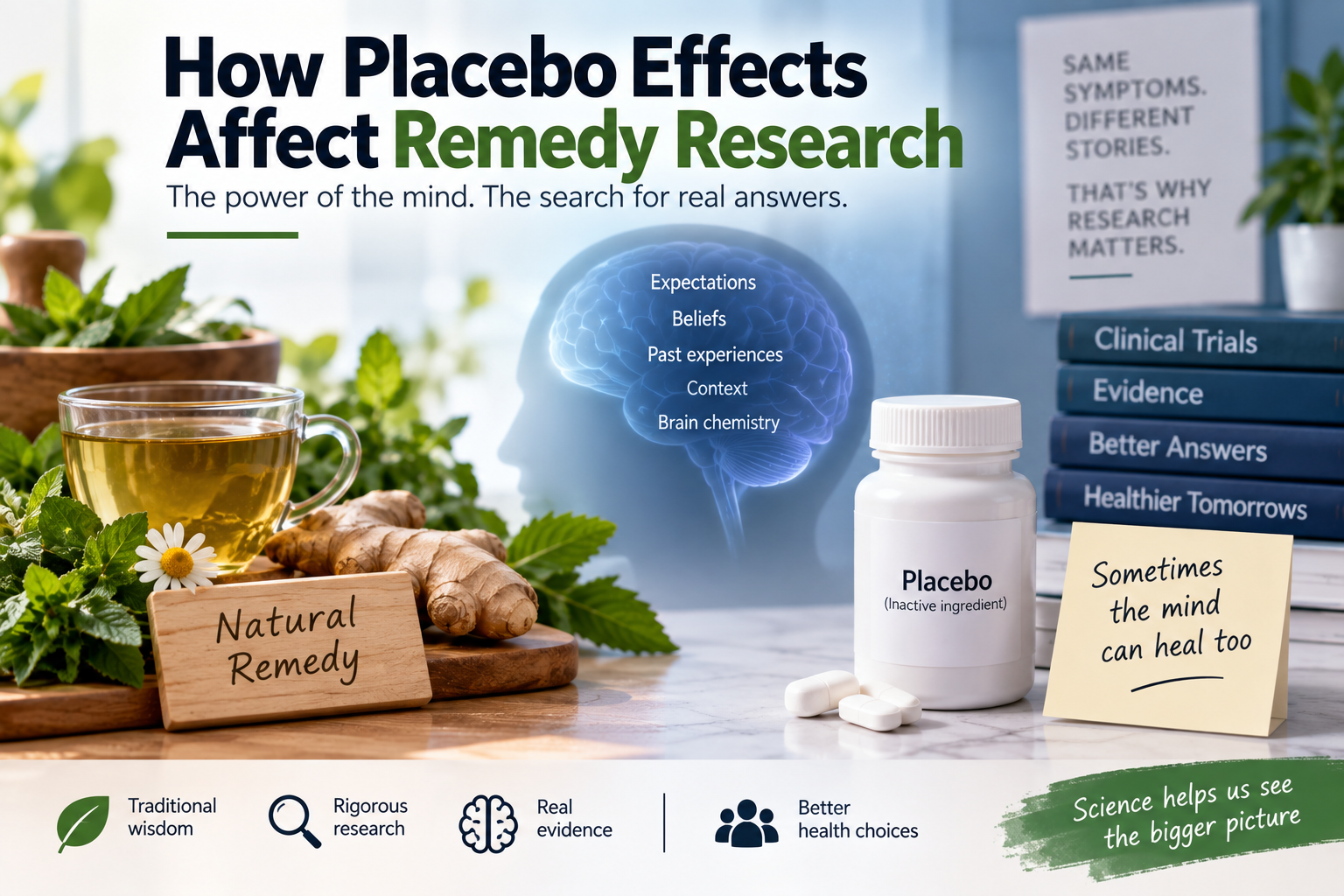
How Placebo Effects Affect Remedy Research
For natural remedies, this distinction can be particularly important. Many remedies have long histories of traditional use, and people may have strong expectations about their effectiveness. Carefully designed research is therefore needed to determine whether improvements are caused by the remedy, the context surrounding its use, natural changes in symptoms or some combination of factors
Read article
Are Natural Remedies Safe During Pregnancy
The safest approach is not to assume that a remedy is harmless simply because it is natural. Instead, its ingredients, dose, purpose, evidence, and potential risks should all be considered.
Read article

Join 10,000+ Readers Building Healthier Habits
Get actionable wellness tips every week plus our newest articles delivered straight to your inbox.