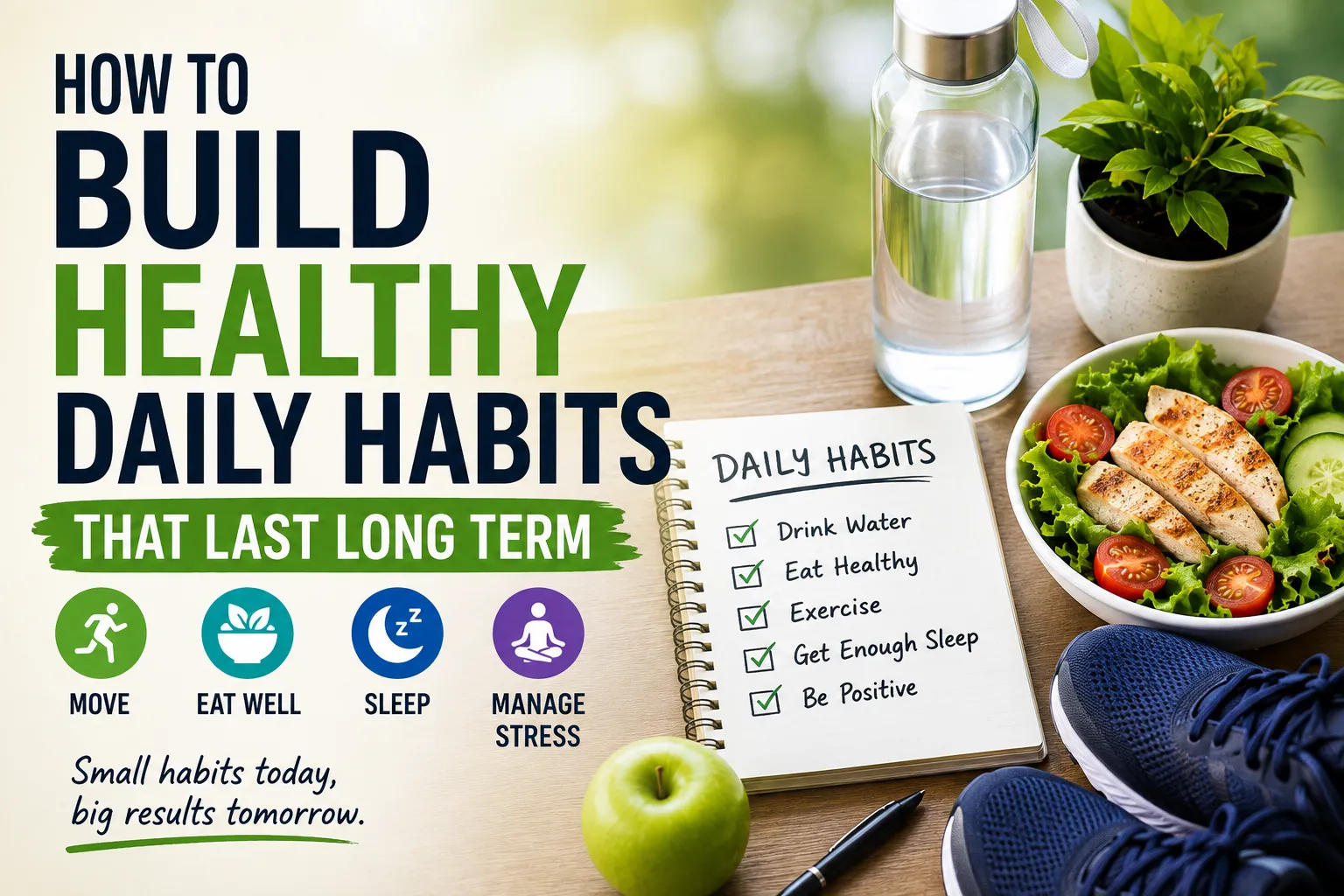

How to Build Healthy Daily Habits That Last Long Term
Building healthier habits sounds simple until real life gets in the way.
Work becomes busy. Sleep schedules change. Motivation disappears. Travel disrupts routines. Stress makes convenience more appealing than preparation. After a few difficult days, even a habit that seemed easy can disappear.
The problem is often not a lack of knowledge. Most people already understand that regular movement, nutritious food, adequate sleep and stress management are important. The harder part is turning those ideas into behaviors that can survive ordinary life.
Long-lasting healthy habits are rarely built through willpower alone. They are usually created through small, repeatable actions, realistic expectations and an environment that makes good choices easier.
What Makes a Healthy Habit Last?
A habit is a behavior that becomes increasingly automatic through repetition in a consistent context.
The goal is not to create a perfect daily routine. It is to reduce the amount of conscious effort required to make healthy decisions.
A sustainable habit usually has several characteristics:
- It is realistic for your current lifestyle.
- It is specific enough to know exactly what to do.
- It can be repeated regularly.
- It does not depend entirely on motivation.
- It provides some form of immediate or meaningful benefit.
- It can survive occasional disruptions.
This is why a modest habit practiced consistently can be more valuable than an ambitious routine that lasts two weeks.
Start With One or Two Changes
One of the biggest mistakes people make when trying to improve their health is changing everything simultaneously.
They may decide to exercise every day, eliminate certain foods, sleep eight hours, meditate, drink large amounts of water and completely reorganize their schedule.
The enthusiasm can be real, but the workload is enormous.
Instead, choose one or two behaviors that are likely to have a meaningful effect.
For example:
- Take a 10-minute walk after dinner.
- Eat a serving of vegetables with lunch.
- Go to bed at the same time most nights.
- Drink water with meals.
- Prepare tomorrow’s breakfast the night before.
Once the behavior becomes familiar, additional habits can be introduced.
Starting small is not settling for less. It is creating a foundation that can support more change later.
Make the Habit Specific
“I want to exercise more” is a goal, not a clearly defined habit.
A more useful version might be:
“I will walk for 20 minutes after work on Monday, Wednesday and Friday.”
The second statement answers several important questions:
- What will I do?
- When will I do it?
- How often will I do it?
Specificity removes ambiguity.
Instead of deciding every day whether to exercise, you already have a predefined action.
The same principle applies to eating, sleep and other areas of healthy living.
Attach New Habits to Existing Routines
One effective way to establish a new habit is to connect it to something you already do consistently.
This is sometimes described as habit stacking.
For example:
- After brushing your teeth, spend two minutes stretching.
- After lunch, take a short walk.
- After making coffee, drink a glass of water.
- After finishing work, prepare your clothes for tomorrow’s workout.
Existing routines act as reminders.
Rather than relying on memory or motivation, the established behavior becomes a cue for the new one.
Focus on Consistency Before Intensity
When starting a new healthy behavior, people often want immediate results.
That can lead to doing too much too soon.
Someone who has not exercised regularly may attempt intense workouts every day. Someone trying to improve their diet may make an extremely restrictive change.
These approaches can be difficult to maintain.
A better strategy is to establish consistency first.
If you can comfortably maintain a manageable routine, you can gradually increase its duration or intensity.
For exercise, that might mean walking regularly before adding more demanding workouts.
For nutrition, it might mean adding healthier foods before attempting major dietary restrictions.
The habit needs to become part of your life before it becomes challenging enough to test your limits.
Design Your Environment to Support Healthy Choices
Willpower becomes less important when your surroundings make healthy decisions easier.
If nutritious foods are convenient and visible, you may be more likely to eat them.
If workout clothes are prepared in advance, starting an exercise session becomes easier.
If your bedroom is dark, quiet and comfortable, creating a consistent sleep routine may become simpler.
Small environmental changes can reduce friction.
Consider asking:
What can I change around me so the healthy choice becomes the easy choice?
That question can be more productive than asking how to become more disciplined.
Make Unhealthy Choices Less Convenient
The same principle works in reverse.
If a behavior repeatedly interferes with your goals, adding a small amount of friction can help.
For example, you might:
- Keep highly tempting snacks out of immediate reach.
- Remove distracting apps from your phone’s home screen.
- Avoid keeping work materials beside your bed.
- Prepare healthy meals before you become hungry.
- Keep exercise equipment somewhere visible.
The objective is not to create an environment where unhealthy choices are impossible.
It is simply to make desirable behaviors easier to start.
Build Healthy Eating Habits Gradually
Healthy eating does not have to mean following an extremely restrictive diet.
For many people, sustainable improvements come from repeatedly choosing a wider variety of nutritious foods.
A balanced eating pattern can include:
- Vegetables and fruits
- Whole grains
- Beans and other legumes
- Nuts and seeds
- Protein-rich foods
- Healthy sources of fats
- Adequate fluids
Rather than focusing exclusively on foods to eliminate, consider what nutritious foods you can add.
For example, adding vegetables to meals, choosing whole grains more often or keeping fruit available can gradually improve the overall quality of a diet.
Long-term eating habits should also leave room for flexibility.
A sustainable approach does not require every meal to be perfect.
Avoid the “All or Nothing” Mindset
One unhealthy meal does not destroy a healthy diet.
Missing one workout does not erase months of progress.
Going to bed late one night does not mean your sleep routine has failed.
Yet people often interpret small setbacks as evidence that they have failed completely.
This can create a cycle:
Miss one day → feel discouraged → abandon the routine → try again weeks later.
A more useful mindset is:
Miss one day → resume at the next opportunity.
Consistency does not mean never breaking the routine.
It means returning to it.
Create a Sustainable Exercise Routine
Regular physical activity is an important part of healthy living, but your exercise routine should fit your circumstances.
Some people enjoy running. Others prefer cycling, swimming, strength training, walking, dancing or recreational sports.
The activity you enjoy is often easier to maintain than one you constantly force yourself to do.
A sustainable routine can combine different types of movement.
For example:
- Walking for everyday activity
- Strength training for muscular fitness
- Aerobic exercise for cardiovascular fitness
- Mobility exercises for flexibility and movement
You do not necessarily need to spend hours in a gym.
The most useful routine is one that you can perform consistently while gradually adapting it to your fitness level.
Make Movement Part of Everyday Life
Exercise does not have to be limited to formal workouts.
Everyday movement can contribute to an active lifestyle.
You might:
- Walk short distances instead of driving.
- Take the stairs when practical.
- Stand and move periodically during long work sessions.
- Walk while talking on the phone.
- Spend active time with family or friends.
- Perform household chores.
These activities may seem small individually, but regular movement throughout the day can help reduce long periods of inactivity.
Protect Your Sleep Routine
Sleep is often treated as something that can be sacrificed when schedules become busy.
Over time, however, consistently poor sleep can make healthy living more difficult.
Fatigue can affect concentration, mood, physical performance and decision-making.
A sustainable sleep habit starts with consistency.
Try to maintain relatively regular sleep and wake times, including on days when your schedule is more flexible.
A calming pre-bed routine can also help signal that the day is winding down.
Depending on your circumstances, this might include:
- Dimming lights
- Reading
- Gentle stretching
- Preparing for the next day
- Reducing stimulating activities before bed
The goal is to make sleep a routine rather than something that happens only when everything else is finished.
Pay Attention to Stress
Stress can interfere with nearly every other healthy habit.
When people are stressed, they may sleep poorly, skip exercise, rely on convenience foods or abandon routines.
Stress management therefore deserves a place in a long-term health strategy.
Healthy coping strategies can include:
- Walking
- Exercise
- Spending time with supportive people
- Relaxation exercises
- Hobbies
- Time outdoors
- Journaling
- Breathing exercises
- Taking deliberate breaks
There is no universally perfect stress-management technique.
The important thing is finding strategies that are practical enough to use regularly.
Replace Habits Instead of Simply Removing Them
Trying to eliminate a behavior without providing an alternative can be difficult.
Suppose you habitually reach for a snack whenever you become bored while working.
Simply telling yourself “don’t snack” leaves the original cue intact.
A replacement behavior might be drinking water, taking a brief walk or stepping away from the screen.
The goal is to create a different response to the same trigger.
Over time, the new behavior can become easier to initiate.
Understand Your Triggers
Many habits follow a predictable pattern:
Cue → Behavior → Reward
The cue might be boredom, stress, hunger, a particular time of day or a specific environment.
The behavior is what you do in response.
The reward is the benefit your brain associates with that behavior.
Understanding the pattern can help identify opportunities for change.
For example, if stress consistently triggers unhealthy snacking, addressing the stress itself may be more effective than simply trying to resist the food.
Healthy habits become easier to establish when you understand what drives the behavior you are trying to change.
Track Progress Without Becoming Obsessed With It
Tracking can provide useful feedback.
Depending on the habit, you might record:
- Number of workouts
- Walking time
- Sleep schedule
- Fruit and vegetable intake
- Water consumption
- Days you practiced a new behavior
The purpose is to identify patterns rather than create another source of pressure.
You do not need to track everything.
Choose one or two measurements that help answer an important question:
Is this habit actually becoming more consistent?
Use Goals and Systems Together
Goals describe what you want to achieve.
Systems describe what you repeatedly do to move toward that outcome.
For example:
Goal: Improve cardiovascular fitness.
System: Walk or exercise for 30 minutes on specific days each week.
The goal provides direction.
The system creates the behavior that can eventually produce the result.
This distinction matters because you cannot directly control every health outcome. You can, however, control many of the actions that influence those outcomes.
Give Yourself a Minimum Version
Some days will be difficult.
Instead of having only two choices—complete the full routine or do nothing—create a smaller version.
For example:
- Full workout → 10-minute walk
- Full meal preparation → Prepare one healthy component
- Long meditation → Two minutes of quiet breathing
- Full cleaning session → Tidy one area
The minimum version keeps the habit alive during difficult periods.
It also prevents the psychological gap between “perfect” and “nothing.”
Plan for Difficult Days
Healthy habits are easiest when life is predictable.
It rarely is.
Travel, deadlines, social events, illness, family responsibilities and unexpected problems can disrupt routines.
Instead of assuming these situations will not happen, plan for them.
Ask:
- What will I do when I cannot follow my normal schedule?
- What is my backup workout?
- What healthy foods can I choose when I am away from home?
- How can I protect my sleep when my routine changes?
A flexible plan is more durable than a rigid one.
Don’t Depend on Motivation
Motivation changes.
Some mornings you may feel enthusiastic about exercising. Other mornings you may want to stay in bed.
If a habit requires high motivation every time, consistency becomes difficult.
This is why routines, reminders, preparation and environmental design matter.
The objective is to reduce the number of decisions you need to make.
Preparing workout clothes the night before, scheduling exercise at a regular time or keeping healthy foods available can make action easier even when motivation is low.
Make Healthy Habits Enjoyable
Health does not have to feel like punishment.
If you hate running, you do not necessarily need to run.
If you dislike eating a particular food, you can find another nutritious option.
If going to the gym feels miserable, explore activities outside the gym.
Enjoyment matters because habits that feel rewarding are easier to repeat.
Try different activities until you discover forms of movement, food and relaxation that fit your preferences.
Use Social Support
People often find it easier to maintain behaviors when others provide encouragement or accountability.
A friend can become a walking partner.
A family member can participate in healthier meals.
A colleague can encourage regular breaks from sitting.
A training partner can make exercise more enjoyable.
Social support does not need to involve formal accountability programs.
Sometimes simply telling someone what you are trying to change can make the commitment feel more tangible.
Reward the Process
Healthy habits often have delayed benefits.
You may not notice improved fitness after one workout or major changes in health after one nutritious meal.
That delay can make it difficult to stay motivated.
Recognizing immediate benefits can help.
Perhaps exercise improves your mood. Maybe preparing meals saves money. A consistent bedtime may make mornings easier.
Pay attention to these short-term rewards while allowing the longer-term benefits to develop gradually.
Expect Progress to Be Uneven
Healthy behavior rarely develops in a straight line.
There may be weeks when everything goes well and others when routines become difficult.
This does not necessarily mean the habit is failing.
Think about progress over months rather than judging yourself based on a single day.
The goal is to gradually increase the proportion of your life in which healthy behaviors are present.
That is very different from trying to achieve perfection.
Review Your Habits Regularly
A routine that works today may not work six months from now.
Your work schedule may change. Your fitness may improve. Your priorities may shift.
Review your habits occasionally.
Ask:
- What is working?
- What feels unnecessarily difficult?
- Which habits provide the most value?
- What keeps disrupting my routine?
- What could I simplify?
The ability to adjust is part of long-term success.
A healthy lifestyle should evolve with your life.
Focus on Identity, Not Just Outcomes
Another useful way to approach habits is to think about the type of person you want to become.
Instead of:
“I need to exercise because I want to lose weight.”
Consider:
“I am someone who makes regular movement part of my life.”
Instead of:
“I need to eat perfectly.”
Consider:
“I am someone who usually chooses foods that support my health.”
This shift puts attention on repeated behavior rather than a single outcome.
Every time you perform the habit, you reinforce the identity associated with it.
Give Yourself Room for Imperfection
A sustainable healthy lifestyle should have room for birthdays, holidays, restaurant meals, travel, celebrations and lazy weekends.
Trying to maintain perfect behavior indefinitely is unrealistic for most people.
The important distinction is between an occasional deviation and a permanent pattern.
One indulgent meal does not define your diet.
One missed workout does not define your fitness.
One late night does not define your sleep.
What matters is what happens most of the time.
Think in Years, Not Weeks
Long-term health is built through repeated behaviors.
A dramatic 30-day transformation may be exciting, but sustainable improvements often come from habits that continue for years.
That means choosing routines that fit your actual life.
A person who walks for 20 minutes several times a week for years may gain more practical benefit than someone who completes an extremely demanding exercise program for a month and then stops.
The best habit is not necessarily the most impressive one.
It is the one you can keep doing.
Build a Routine That Can Survive Real Life
Healthy living becomes more sustainable when it is treated as a collection of manageable behaviors rather than a constant pursuit of perfection.
Start with small actions. Make them specific. Attach them to existing routines. Adjust your environment. Plan for difficult days. Track progress when useful. And most importantly, return to your habits after inevitable setbacks.
You do not need to overhaul your entire life overnight.
A healthier lifestyle can emerge from ordinary decisions repeated consistently: choosing nutritious foods more often, moving your body regularly, protecting your sleep, managing stress and creating routines that support those choices.
The most powerful healthy habit is often not the hardest one. It is the one simple enough to keep doing when motivation fades and everyday life gets complicated.
Continue Reading
Similar Posts

What Nutrient Density Means and How to Choose Nutrient-Dense Foods
Understanding nutrient density can make everyday food choices easier without requiring complicated diets or strict rules. Instead of focusing only on calories, nutrient density encourages people to consider what nutrients a food contributes to the overall diet.
Read article
How to Recover After Breaking Healthy Habits
Breaking a healthy routine is usually a temporary interruption rather than a permanent failure. The important part is learning how to return to healthier behaviors without turning a short setback into a long-term pattern.
Read article
How Your Environment Affects Everyday Health
Understanding these connections can help people make practical changes that support healthier daily living.
Read article

Join 10,000+ Readers Building Healthier Habits
Get actionable wellness tips every week plus our newest articles delivered straight to your inbox.